
Actinopodidae
Ambush hunters that lie in their burrow lid at night preying on insects within catching range.
Actinopodidae is a family of mygalomorph spiders native to mainland Australia and South America, typically inhabiting open forests. This family includes the mouse spiders (Missulena species), which are notable for their medically significant and potentially dangerous bites.
Key Facts
- ›Found in Australia and South America, primarily in open forests.
- ›Includes mouse spiders (Missulena species), known for medically significant bites.
- ›Characterized by stout, black bodies with bulbous heads and jaw regions.
- ›Live in soil burrows with hinged tops, reaching depths of up to 30 CM.
- ›Act as ambush hunters, preying on insects near their burrows at night.
- ›Females are generally stockier and larger than males.
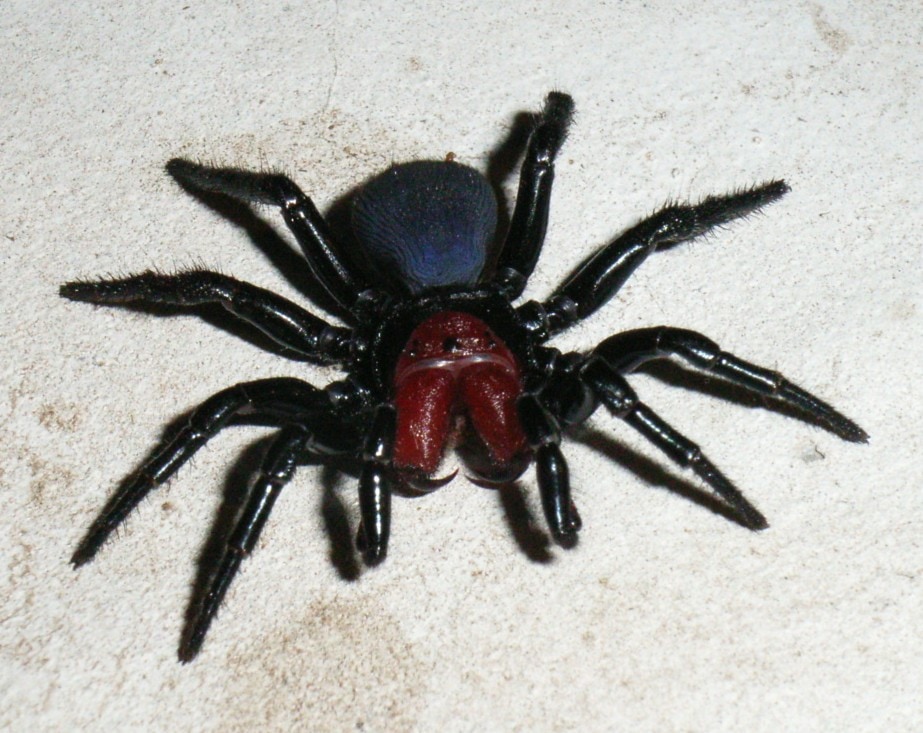
Mouse Spiders
Australia, South America
- Wider Vision Than Most Other Australian Mygalomorphs
- Wide Front To Their Carapace
- Distinctively Bulbous Heads and Jaw Regions
- Hinged Burrow Lids
- Males Wander From Burrows To Find Mates.
- Females Remain In Their Burrows For Most of Their Lives.
About Actinopodidae
Actinopodidae is a family of mygalomorph spiders indigenous to mainland Australia and South America, typically found inhabiting open forest environments. While the family encompasses various species, it is particularly recognized for including the mouse spiders, genus Missulena. These mouse spiders are notable because their bites, though infrequent, are classified as medically significant and potentially dangerous to humans.
Description and Habitat
Spiders belonging to the Actinopodidae family possess a wider field of vision compared to many other Australian mygalomorphs, complemented by a broad frontal section of their carapace. They are generally stout and black, with individual species ranging from 10 mm to 35 mm in body length. A defining characteristic is their distinctly bulbous head and jaw regions. The abdomen can be black or a dark blue, often adorned with a light grey to white patch on its dorsal surface. Their legs typically appear dark and somewhat slender, and their heads are a glossy black. Females of the family tend to be more robust and larger than the males.
These spiders construct burrows in the soil, which can extend to a depth of approximately 30 cm (12 inches). These burrows are crucial for their survival, providing refuge from predators, a means of temperature control, and protection from parasites. The entrance to these burrows is often covered by a hinged lid.
Diet and Hunting Strategy
Actinopodidae spiders are ambush predators. They position themselves at the entrance of their burrows, often lying in wait by their burrow lids, particularly during the night. Their diet consists primarily of insects that venture within their striking range. The male spiders exhibit a migratory behavior, leaving their burrows to seek out females for mating. In contrast, the females generally remain within the confines of their burrows for the majority of their lives, dedicating themselves to survival and reproduction within their established territory.
Source: Wikipedia ↗
Frequently Asked Questions
Where are Actinopodidae spiders found?
Actinopodidae spiders are found in mainland Australia and South America. They are most commonly encountered in open forest habitats, with a particular abundance in Queensland, Australia.
What do Actinopodidae spiders eat?
These spiders are ambush hunters, feeding primarily on insects. They wait by their burrow lids, often at night, to capture prey that comes within striking distance.
What is distinctive about the appearance of Actinopodidae spiders?
Actinopodidae spiders are typically stout and black, with distinctive bulbous heads and jaw regions. Their carapace has a wide front, and they possess wider vision than many other Australian mygalomorphs. Abdominal coloration varies from black to dark blue, often with a light patch on top.
Do Actinopodidae spiders build webs?
The provided information does not explicitly state that Actinopodidae spiders build webs for catching prey. Their hunting strategy is described as ambush predation from their burrows.
Are Actinopodidae spiders dangerous to humans?
Yes, some species within the Actinopodidae family, specifically mouse spiders (Missulena species), are considered medically significant. Their bites can be potentially dangerous and may require medical attention.
What is the habitat of Actinopodidae spiders?
Actinopodidae spiders typically inhabit open forests. They live in soil burrows that can extend up to 30 cm deep, equipped with a hinged top for protection and temperature regulation.
Related Spider species

Atracidae
Atracidae, commonly known as Australian funnel-web spiders, are a family of mygalomorph spiders native to Australia. These spiders are medium to large in size and are distinguished by their powerful fangs and the males' mating spurs. Some species possess venom that is dangerous to humans, with the Sydney funnel-web spider and northern tree-dwelling funnel-web spider being particularly noted for their potentially deadly bites.

Sicariidae
Sicariidae is a family of six-eyed venomous spiders, encompassing approximately 180 species across three genera. They are distinguished by their unique sphingomyelinase D venom, which can cause necrotic lesions, and members like the brown recluse and six-eyed sand spider are well-known. These spiders are found in warmer regions worldwide and deserts of southern Africa and the Americas, often exhibiting self-burying behaviors.

Theridiidae
Theridiidae, commonly known as tangle-web spiders or cobweb spiders, is a large and diverse family of araneomorph spiders found globally. They are notable for being the most common arthropod group in human dwellings worldwide and for spinning sticky capture silk, a characteristic that distinguishes them within the spider order.