
Theridiidae
Many Theridiidae build tangle space webs or gumfoot-webs which incorporate elastic, sticky silk trap lines. Some species are kleptoparasitic, living in the webs of larger spiders and stealing their prey.
Theridiidae, commonly known as tangle-web spiders or cobweb spiders, is a large and diverse family of araneomorph spiders found globally. They are notable for being the most common arthropod group in human dwellings worldwide and for spinning sticky capture silk, a characteristic that distinguishes them within the spider order.
Key Facts
- ›Theridiidae is one of the most common arthropod groups found in human dwellings globally.
- ›These spiders spin sticky capture silk, a trait that differentiates them from ecribellate spiders.
- ›The family includes medically significant widow spiders, which are important research subjects for their venom.
- ›Some genera, like Anelosimus, are studied for their evolved sociality and inbreeding.
- ›Certain species, such as the Hawaiian Theridion grallator, are known for their distinctive 'happy face' markings.

Tangle-Web Spiders, Cobweb Spiders, Comb-Footed Spiders
Global
- Possess A Comb of Serrated Bristles On the Tarsus of the Fourth Leg.
- Females Have A Genital Plate .
- Some Species Exhibit Sociality, With Some Permanently Social Species Being Highly Inbred.
- Sexual Cannibalism Is Observed In Some Species.
- Kleptoparasitism Is A Hunting Strategy For Some Members.
About Theridiidae
Theridiidae: The Cobweb Spiders
Theridiidae, widely recognized as tangle-web spiders, cobweb spiders, or comb-footed spiders, represents a vast and globally distributed family of araneomorph spiders. First described by Carl Jakob Sundevall in 1833, this family is exceptionally common, with its members being the most frequently encountered arthropod group in human dwellings worldwide. The family encompasses approximately 3,000 species across 128 genera, showcasing significant diversity in form and behavior.
Key Characteristics
A defining feature of Theridiidae is their method of silk production; they are ecribellate spiders, meaning they spin sticky capture silk rather than woolly silk. This sticky silk is essential for their web-building strategies. Physically, they possess a characteristic comb of serrated bristles, known as setae, on the tarsus of their fourth leg. Females are entelegyne, possessing a genital plate.
Ecological and Research Significance
Theridiidae plays a notable role in scientific research. The family includes the medically significant widow spiders, which are vital for studies investigating venom composition and its effects. Beyond venom research, widow spiders contribute to studies on silk properties and sexual biology, particularly sexual cannibalism. Other genera, such as Anelosimus, serve as model organisms for understanding sociality, as this trait has evolved multiple times within the genus, allowing for comparative studies. These social species are also valuable for research into inbreeding due to their highly inbred nature.
Web Diversity and Hunting
While often associated with tangle space webs, the web structures within Theridiidae are highly diverse. Many species construct webs that trap ants and other ground-dwelling insects using elastic, sticky silk lines leading to the soil surface. Some well-studied members, like those in the subfamily Argyrodinae, are kleptoparasitic, inhabiting the webs of larger spiders to steal prey. Their gumfoot-webs are anchored by frame lines and incorporate viscid silk, featuring either a central or peripheral retreat.
Notable Species and Variations
Among the notable species is the Hawaiian Theridion grallator, often called the "happyface" spider. Certain color morphs of this spider display a striking pattern resembling a smiley face or a grinning clown face on their yellow bodies, making them a subject of interest for understanding the genetic basis of color polymorphism within species.
With a vast number of species and genera, including extinct forms, Theridiidae continues to be a significant focus for ecological, evolutionary, and biochemical research.
Source: Wikipedia ↗
Frequently Asked Questions
What are Theridiidae spiders commonly called?
Theridiidae spiders are commonly known by several names, including tangle-web spiders, cobweb spiders, and comb-footed spiders. These names reflect their web-building habits and physical characteristics.
Where are Theridiidae spiders found?
This family is globally distributed, meaning they can be found in various habitats across the world. They are particularly prevalent in human dwellings, making them a very common arthropod group encountered by people.
What is distinctive about Theridiidae web silk?
Theridiid spiders are ecribellate, meaning they spin sticky capture silk rather than woolly silk. This sticky silk is crucial for trapping prey in their webs.
Are any Theridiidae spiders medically important?
Yes, the family includes medically important widow spiders. These spiders are subjects of research due to their venom and its clinical effects on humans.
What makes some Theridiidae spiders good research subjects?
Certain species are model organisms for research. For example, widow spiders are studied for their venom, while the genus Anelosimus is used to investigate sociality and inbreeding due to varying social structures within the genus.
What is the 'happy face' spider?
The 'happyface' spider is a common name for Theridion grallator, a Hawaiian species. Certain color variations of this spider display a pattern on its body that resembles a smiley face or a clown's face.
Related Spider species

Atracidae
Atracidae, commonly known as Australian funnel-web spiders, are a family of mygalomorph spiders native to Australia. These spiders are medium to large in size and are distinguished by their powerful fangs and the males' mating spurs. Some species possess venom that is dangerous to humans, with the Sydney funnel-web spider and northern tree-dwelling funnel-web spider being particularly noted for their potentially deadly bites.

Sicariidae
Sicariidae is a family of six-eyed venomous spiders, encompassing approximately 180 species across three genera. They are distinguished by their unique sphingomyelinase D venom, which can cause necrotic lesions, and members like the brown recluse and six-eyed sand spider are well-known. These spiders are found in warmer regions worldwide and deserts of southern Africa and the Americas, often exhibiting self-burying behaviors.
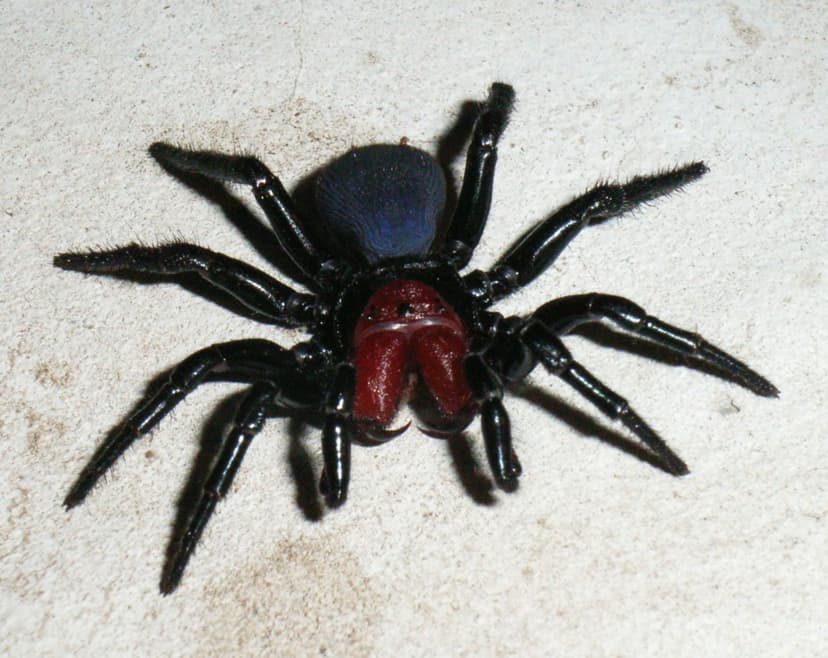
Actinopodidae
Actinopodidae is a family of mygalomorph spiders native to mainland Australia and South America, typically inhabiting open forests. This family includes the mouse spiders (Missulena species), which are notable for their medically significant and potentially dangerous bites.