
Agelenidae
Sheet web building with a funnel retreat; ambush predator that rushes to bite prey.
The Agelenidae, commonly known as funnel weavers, are a large family of spiders found globally. They are distinguished by their fast running speeds and the construction of flat sheet webs with a funnel-shaped retreat. While most species are solitary, some African species exhibit parasocial behavior, living in communal webs.
Key Facts
- ›Agelenidae are commonly called funnel weavers.
- ›They are known for their exceptional speed, with some species reaching over 0.5 M/s.
- ›These spiders build flat sheet webs with a funnel-shaped retreat.
- ›The web is made of non-sticky silk with entangling filaments to trap prey.
- ›Some species in Africa exhibit parasocial behavior, forming communal webs.
- ›Agelenids have eight eyes arranged in two horizontal rows.

Funnel Weaver, Grass Spider
Global
Eight Eyes In Two Horizontal Rows of Four., Cephalothorax Narrows Towards the Front., Flat Sheet Web With A Funnel-Shaped Retreat.
- Very Fast Runners.
- React Immediately To Vibrations On Their Webs.
- Males May Roam In Search of Prey and Seek Refuge In Houses.
- Some African Species Exhibit Parasocial Behavior: Communal Web-Building, Cooperative Prey Capture, and Communal Rearing of Young.
About Agelenidae
Agelenidae: The Funnel Weavers
The Agelenidae family encompasses a large and diverse group of spiders, commonly known as funnel weavers. These spiders are recognized for their remarkable speed and the distinctive webs they construct. Found worldwide, they play a role in controlling insect populations in their natural habitats.
Description and Biology
Agelenid spiders vary in size, with body lengths typically ranging from 4 mm to 20 mm, though some larger species can have a leg span of up to 10 cm. They possess eight eyes arranged in two horizontal rows of four. Their bodies are generally characterized by an oval abdomen, often adorned with lines and spots, and a cephalothorax that narrows towards the front. A key feature distinguishing many Agelenidae is the presence or absence of longitudinal lines on the cephalothorax, which can help differentiate between similar species.
Most members of this family are exceptionally fast runners, a trait that aids them in both hunting and escaping predators. Their hunting strategy involves building a flat sheet of non-sticky silk, typically in grassy or scrubland environments, with a funnel-shaped retreat at one side or in the center. Prey, such as grasshoppers, that land on the sheet become entangled in fine filaments. The spider, sensing vibrations, rapidly emerges from its retreat to deliver a venomous bite, paralyzing the victim before dragging it back into the funnel to feed.
Social Behavior and Distribution
While most Agelenidae are solitary hunters, a notable exception exists in Africa, where certain species within the genus Agelena exhibit parasocial behavior. These spiders engage in communal web-building, cooperative prey capture, and communal rearing of their young. However, this social structure does not extend to true eusociality as seen in insects like ants or bees.
Agelenidae are distributed globally, inhabiting a variety of environments. While they primarily reside in outdoor settings, some species, particularly males during mating season, may seek refuge in human dwellings, often found near windows or doors. Despite their speed and venom, they are generally not considered pests, as they are selective in their prey and do not consume large quantities. Their venom, particularly the agatoxin found in some species, has been a subject of scientific study.
Source: Wikipedia ↗
Frequently Asked Questions
What is another name for Agelenidae spiders?
The most widely accepted common name for members of the Agelenidae family is funnel weaver. They are also sometimes referred to as grass spiders, particularly those in the genus Agelenopsis.
How large do Agelenidae spiders get?
The body length of Agelenidae spiders typically ranges from 4 mm to 20 mm, excluding the legs. However, some exceptionally large species, like the giant house spider, can have a leg span of 5 to 10 cm.
What do Agelenidae spiders eat?
Agelenidae spiders primarily prey on insects such as grasshoppers that land on their webs. They are selective in their prey and do not consume large quantities.
How do Agelenidae spiders hunt?
Funnel weavers hunt by waiting on their flat sheet webs for prey to fall onto the non-sticky, yet entangling, silk. They then quickly rush out from their funnel-shaped retreat to bite and paralyze the victim.
Are Agelenidae spiders venomous?
Yes, Agelenidae spiders are venomous. They use their venom to paralyze prey, and the agatoxin found in some species has been studied for its properties.
Do Agelenidae spiders build webs?
Yes, all Agelenidae spiders are web builders. They construct a flat sheet of silk with a funnel-shaped retreat, which is characteristic of the family.
Where are Agelenidae spiders found?
Agelenidae spiders are found globally. They typically inhabit grassy areas or scrublands, though some species, like the giant house spider, may seek refuge in houses during certain times of the year.
Related Spider species
Amaurobiidae
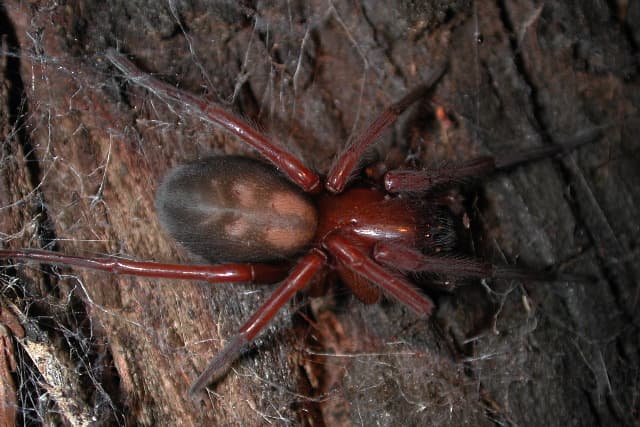
Amaurobiidae is a family of spiders characterized by their three-clawed feet and the presence of either a cribellum or its absence. These spiders are typically found in crevices, hollows, or under stones, where they construct retreats and are often captured in pitfall traps. While widespread, they can be challenging to distinguish from closely related spider families.
Anapidae
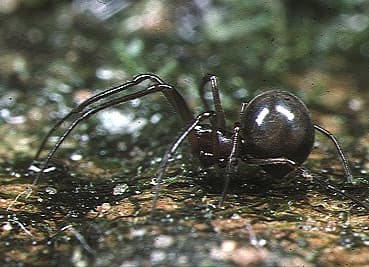
Anapidae is a diverse family of small spiders, with most species measuring less than two millimeters in length. These spiders are found worldwide, inhabiting leaf litter and moss in rainforest environments. A distinctive characteristic of many Anapidae species is their ability to build small orb webs, often less than three centimeters in diameter.

Ancylometidae
Ancylometidae is a genus of Central and South American semiaquatic spiders, notable for their ability to walk on water and dive for extended periods. They are among the largest araneomorph spiders, with a distinctive appearance and a diet that includes insects, small lizards, and fish.