
Amaurobiidae
Web builder, utilizing minimal sheet webs.
Amaurobiidae is a family of spiders characterized by their three-clawed feet and the presence of either a cribellum or its absence. These spiders are typically found in crevices, hollows, or under stones, where they construct retreats and are often captured in pitfall traps. While widespread, they can be challenging to distinguish from closely related spider families.
Key Facts
- ›Belong to the order Araneae and are characterized by three-clawed feet.
- ›Construct retreats in crevices, hollows, or under stones.
- ›Often collected using pitfall traps.
- ›Possess either a cribellum or its absence (ecribellate).
- ›Their taxonomic relationships have been subject to revision based on DNA analysis.
- ›Found in Australia, particularly in Tasmania and cooler rainforest areas.
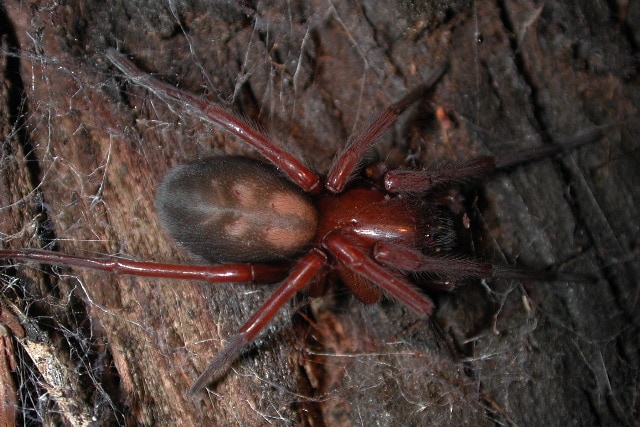
Australia, Tasmania
- Three-Clawed Feet
- Presence of A Calamistrum On Metatarsus Iv
- Eight Similar Eyes In Two Conservatively Curved Rows
- Australian Amaurobiids May Be Distinguished From Desidae By the Absence of A Pretarsal Fracture and the Presence of A Retrocoxal Hymen On Coxa I.
Build Retreats, Collected In Pitfall Traps
About Amaurobiidae
The Amaurobiidae family encompasses a group of spiders characterized by their three-clawed feet and the presence of either a cribellum or its absence. These spiders are known for constructing retreats within crevices, hollows, or beneath stones, and they are frequently encountered when using pitfall traps for collection. A notable aspect of their taxonomy is the ongoing revision of their intra- and interfamilial relationships, largely driven by extensive DNA analysis.
In Australia, Amaurobiidae spiders are typically small to medium-sized entelegyne spiders that create minimal sheet webs. They are reasonably common in Tasmania and the adjacent mainland Australia, favoring cooler rainforest environments, with some species also found in caves. While they are widespread, their presence along the eastern coastline is noted as uncommon. Morphologically, they generally possess eight eyes arranged in two subtly curved rows. Many species exhibit a calamistrum on their fourth metatarsus, which is associated with a cribellum. Australian amaurobiids can be differentiated from those in the Desidae family by the lack of a pretarsal fracture and the presence of a retrocoxal hymen on their first coxa.
The taxonomic landscape of Amaurobiidae has seen considerable change, with several genera being reassigned due to comprehensive DNA analyses. For instance, the genera Bakala and Manjala were moved to the Desidae family, while Toxopidae incorporated Midgee and the monotypic genus Jamara. Furthermore, some medium-sized brown Australian spiders, including Tasmabrochus, Tasmarubrius, and Teeatta, were transferred to the Macrobunidae family. The difficulty in replicating research and the scarcity of photographic evidence in species and genus diagnoses have led to poor performance of these groups in computer recognition models and citizen science platforms. As of September 2025, the Amaurobiidae family comprises 27 genera, organized into four subfamilies after Macrobuninae was elevated to family status.
Source: Wikipedia ↗
Frequently Asked Questions
What are the defining characteristics of Amaurobiidae spiders?
Amaurobiidae spiders are distinguished by their three-clawed feet. They also possess either a cribellum, a spinning organ used to produce silk for prey capture, or are ecribellate, meaning they lack this organ. They typically build retreats in sheltered locations.
Where are Amaurobiidae spiders commonly found?
In Australia, Amaurobiidae spiders are found in cooler rainforest environments, and some inhabit caves. They are fairly common in Tasmania and nearby mainland Australia. They are also noted as being widespread but uncommon along the eastern coastline.
How are Amaurobiidae spiders typically collected?
These spiders are frequently collected using pitfall traps, which are designed to capture ground-dwelling arthropods. Their habit of living in crevices and under stones also makes them accessible through these trapping methods.
Are Amaurobiidae spiders easily identifiable?
No, Amaurobiidae spiders are generally difficult to distinguish from related spiders in other families, such as Agelenidae and Desidae. Their intra- and interfamilial relationships have also been a subject of ongoing scientific discussion and revision.
What is the current classification of Amaurobiidae genera?
As of September 2025, the Amaurobiidae family includes 27 genera. These genera are organized into four subfamilies, following the elevation of Macrobuninae to its own full family.
Related Spider species

Agelenidae
The Agelenidae, commonly known as funnel weavers, are a large family of spiders found globally. They are distinguished by their fast running speeds and the construction of flat sheet webs with a funnel-shaped retreat. While most species are solitary, some African species exhibit parasocial behavior, living in communal webs.
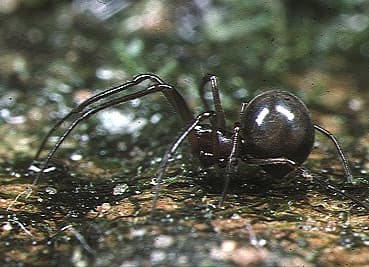
Anapidae
Anapidae is a diverse family of small spiders, with most species measuring less than two millimeters in length. These spiders are found worldwide, inhabiting leaf litter and moss in rainforest environments. A distinctive characteristic of many Anapidae species is their ability to build small orb webs, often less than three centimeters in diameter.

Ancylometidae
Ancylometidae is a genus of Central and South American semiaquatic spiders, notable for their ability to walk on water and dive for extended periods. They are among the largest araneomorph spiders, with a distinctive appearance and a diet that includes insects, small lizards, and fish.