
Heptathelinae
Burrow dwellers with trapdoors
Heptathelinae is a subfamily of basal spiders within the family Liphistiidae, representing the sole extant family in the suborder Mesothelae. These spiders are distinguished by unique abdominal segmentation and spinneret placement, and they construct burrows covered by trapdoors.
Key Facts
- ›Heptathelinae are among the most basal living spiders.
- ›They possess a segmented abdomen with plates on the upper surface.
- ›Their spinnerets are located in the middle of the abdomen's underside, unlike most spiders.
- ›Members of this subfamily construct burrows that are closed with trapdoors.
- ›The male palp of Heptathelinae spiders lacks a tibial apophysis.
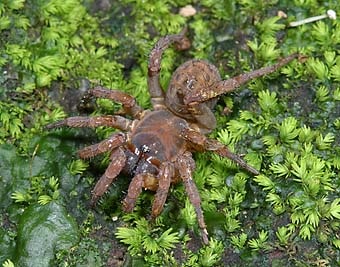
- Segmented Series of Plates On the Upper Surface of All Segments of the Abdomen
- Spinnerets Placed In the Middle of the Underside of the Abdomen
- Downward Pointing, Daggerlike Chelicerae
- Narrow Sternum
- Smaller Ventral Plate Between the Fourth Pair of Legs
- Male Palp Lacks A Tibial Apophysis
- Live In Burrows Closed By Trapdoors
- Do Not Construct Signal Lines Radiating From the Burrow
About Heptathelinae
Heptathelinae is a subfamily of spiders recognized for their basal position within the arachnid world, representing the sole extant family in the suborder Mesothelae. This group is part of the larger family Liphistiidae, though it has historically been treated as a separate family, Heptathelidae. As of November 2025, the classification merging Heptathelidae into Liphistiidae is widely accepted by the World Spider Catalog, placing Heptathelinae as one of its subfamilies.
Key Characteristics
Spiders in the Heptathelinae subfamily share distinctive features that set them apart. They are typically medium to large in size and possess downward-pointing, daggerlike chelicerae. A defining trait, shared with other members of the Mesothelae suborder, is the presence of a segmented series of plates, known as tergites, on the upper surface of their abdomen. Furthermore, their spinnerets are uniquely located in the middle of the abdomen's underside, rather than at the posterior end as seen in most other spiders. Anatomically, they have a narrow sternum and a smaller ventral plate, the sternite, situated between their fourth pair of legs. Respiration occurs through two pairs of book lungs.
Habitat and Behavior
Heptathelinae spiders are known for their specialized burrowing lifestyle. They construct burrows that are characteristically sealed with trapdoors. Unlike their relatives in the Liphistiinae subfamily, Heptathelinae do not extend signal lines from their burrows. The male palp in Heptathelinae spiders also lacks a specific structure called a tibial apophysis, a feature that distinguishes them from some other spider groups.
Source: Wikipedia ↗
Frequently Asked Questions
What suborder do Heptathelinae spiders belong to?
Heptathelinae spiders belong to the suborder Mesothelae, which contains the most basal living spiders. This suborder is characterized by unique abdominal and spinneret features.
How do Heptathelinae spiders differ from other spiders in their abdomen and spinnerets?
Unlike most extant spiders, Heptathelinae have a segmented series of plates on the upper surface of their abdomen. Their spinnerets are also positioned in the middle of the abdomen's underside, rather than at the end.
What kind of habitat do Heptathelinae spiders create?
Heptathelinae spiders live in burrows that they construct. These burrows are characteristically closed by trapdoors, providing a secure dwelling.
Do Heptathelinae spiders build signal lines from their burrows?
No, unlike members of the related Liphistiinae subfamily, Heptathelinae do not construct signal lines radiating from their burrows. Their trapdoor burrows are their primary dwelling structure.
What is the taxonomic classification of Heptathelinae?
Heptathelinae is currently accepted as a subfamily within the family Liphistiidae. Previously, it was sometimes treated as a separate family called Heptathelidae.