
Liphistiidae
While the text mentions burrow construction by Liphistius species with 'fishing lines', the general hunting strategy for the family is not fully described, suggesting they may be ambush predators utilizing their burrows.
The Liphistiidae, also known as Mesothelae, are an ancient suborder of spiders distinguished by their segmented abdomen and spinnerets located near the middle. These spiders, found exclusively in East and Southeast Asia, represent a basal lineage within the spider order, retaining primitive characteristics such as two pairs of book lungs and eight eyes grouped on a tubercle. They are medium to large-sized spiders, and while historically questioned, they are now known to possess venom glands.
Key Facts
- ›Liphistiidae are characterized by a segmented abdomen and MID-abdominal spinnerets.
- ›They are considered a basal lineage within the spider order, retaining ancestral traits.
- ›These spiders possess eight eyes grouped on a tubercle.
- ›Liphistiidae are found only in China, Japan, and Southeast Asia.
- ›Species of the genus Liphistius construct burrows with 'fishing lines', a feature absent in Heptathelinae.
- ›They possess venom glands and ducts.

Mesothelae
China, Japan, Laos, Malaysia, Myanmar, Thailand, Vietnam, Sumatra
- Segmented Abdomen
- Spinnerets Located Near the Middle of the Abdomen
- Eight Eyes Grouped On A Tubercle
- Two Pairs of Book Lungs
- Narrow Sternum On the Ventral Side of the Cephalothorax
Construct Burrows, Use 'Fishing Lines' In Front of Burrows
About Liphistiidae
The Spider Family Liphistiidae
The Liphistiidae, also known by the suborder name Mesothelae, represent a group of spiders that are notable for their ancient lineage and distinct morphology. These spiders are considered a basal group within the order Araneae, retaining primitive characteristics that set them apart from most other spider families. Their most striking features include a segmented abdomen, a trait largely absent in modern spiders, and spinnerets situated near the middle of the abdomen, a primitive positioning that gives the suborder its name (Mesothelae meaning "middle teat").
Taxonomy and Classification
The classification of Liphistiidae has seen some debate among arachnologists. Historically, the group was recognized as a single family. However, the description of new genera led to the proposal of separate families. Currently, the World Spider Catalog accepts a single family, Liphistiidae, which is divided into two subfamilies: Liphistiinae, containing the genus Liphistius, and Heptathelinae, which encompasses seven other genera. This structure reflects the phylogenetic understanding that Mesothelae forms the sister group to all other living spiders, preserving ancestral traits.
Description and Characteristics
Members of the Liphistiidae are generally medium to large-sized spiders. They possess eight eyes that are grouped together on a tubercle. A significant characteristic is the presence of two pairs of book lungs, another primitive feature. While it was once believed they lacked venom glands, subsequent studies have confirmed that at least some, and likely all, species within this family do possess both glands and ducts. This confirms they are venomous, though the specific effects on humans are not widely documented.
Distribution and Habitat
The geographic distribution of Liphistiidae spiders is restricted to East and Southeast Asia. They are found in countries such as China, Japan, Laos, Malaysia, Myanmar, Thailand, Vietnam, and on the island of Sumatra. These spiders typically inhabit terrestrial environments, where they construct burrows. Notably, species belonging to the genus Liphistius are known to create characteristic 'fishing lines' made of silk in front of their burrow entrances, a behavior not observed in the Heptathelinae subfamily.
Source: Wikipedia ↗
Frequently Asked Questions
What makes Liphistiidae spiders ancient?
Liphistiidae spiders are considered ancient because they retain primitive characteristics that are believed to be ancestral to all other living spiders. These include a segmented abdomen and spinnerets positioned in the middle of the abdomen, unlike the more posterior spinnerets found in most other spider groups.
Where are Liphistiidae spiders found?
The geographic distribution of Liphistiidae spiders is limited to East and Southeast Asia. They are naturally found in China, Japan, and various countries in Southeast Asia, including Laos, Malaysia, Myanmar, Thailand, and Vietnam, as well as Sumatra.
Do Liphistiidae spiders have venom?
Yes, despite some earlier claims, subsequent research has confirmed that Liphistiidae spiders do possess venom glands and ducts. While the effects of their venom on humans are not extensively documented, they are venomous.
What is distinctive about their abdomen and spinnerets?
A key characteristic of Liphistiidae is their segmented abdomen, a feature not commonly found in other spider groups. Furthermore, their spinnerets are located in the middle of the abdomen, a primitive trait that gives the suborder its name (Mesothelae means 'middle teat').
Are there different types of Liphistiidae spiders?
The family Liphistiidae is currently accepted by the World Spider Catalog as a single family with two subfamilies: Liphistiinae and Heptathelinae. Liphistiinae contains the genus Liphistius, while Heptathelinae includes seven other genera, such as Heptathela and Ganthela. Some authors have historically treated these subfamilies as separate families.
How do Liphistius spiders differ from Heptathelinae members?
Species of the genus Liphistius are known to construct burrows that are often adorned with 'fishing lines' made of silk in front of the entrance. Members of the subfamily Heptathelinae do not exhibit this specific burrow-decorating behavior.
Related Spider species
Actinopodidae
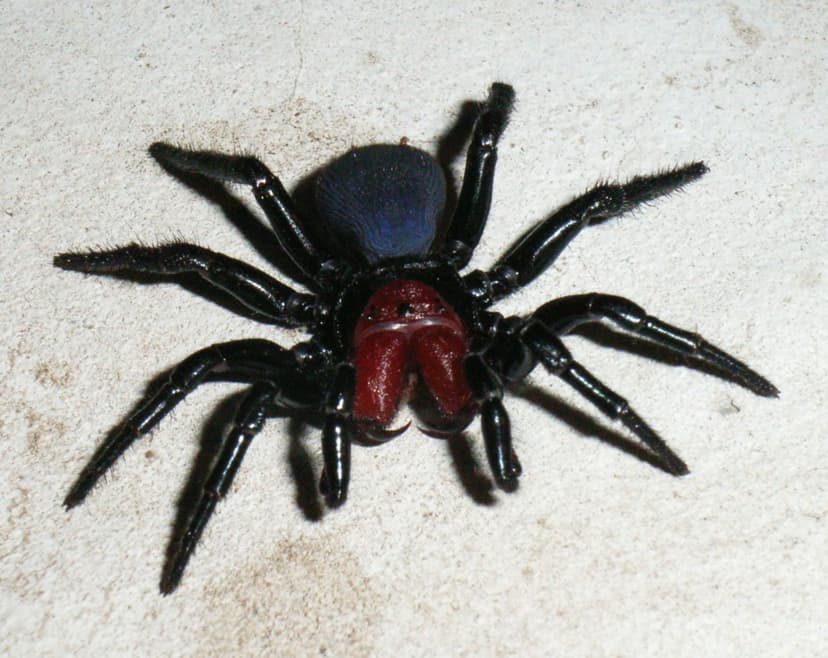
Actinopodidae is a family of mygalomorph spiders native to mainland Australia and South America, typically inhabiting open forests. This family includes the mouse spiders (Missulena species), which are notable for their medically significant and potentially dangerous bites.

Agelenidae
The Agelenidae, commonly known as funnel weavers, are a large family of spiders found globally. They are distinguished by their fast running speeds and the construction of flat sheet webs with a funnel-shaped retreat. While most species are solitary, some African species exhibit parasocial behavior, living in communal webs.
Amaurobiidae
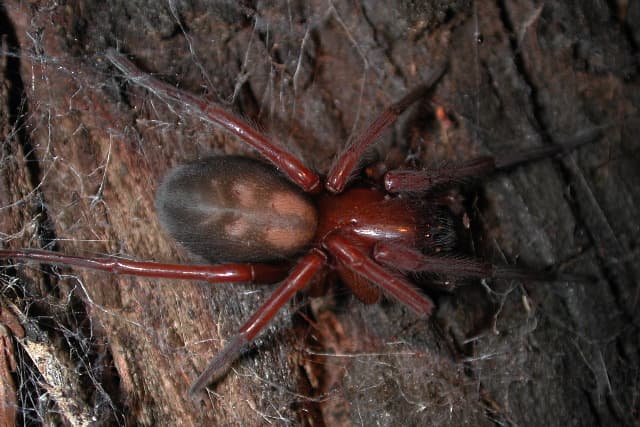
Amaurobiidae is a family of spiders characterized by their three-clawed feet and the presence of either a cribellum or its absence. These spiders are typically found in crevices, hollows, or under stones, where they construct retreats and are often captured in pitfall traps. While widespread, they can be challenging to distinguish from closely related spider families.