
Oecobiidae
Oecobiidae, also known as disc web spiders, are a family of small to moderately sized araneomorph spiders found globally. They are distinguished by their unique leg placement, which gives them a wheel-like scurrying motion, and their characteristic star-shaped webs constructed on or under various surfaces. These spiders are notable for their diet, primarily consisting of ants, leading to common names like 'anteater'.
Key Facts
- ›Oecobiidae are small to moderate-sized spiders, typically measuring 2 to 20 MM in body length.
- ›They possess a distinctive leg arrangement, with the first two pairs of legs often pointing forward and then curving backward, creating a wheel-like appearance.
- ›These spiders are known for building small, temporary star-shaped webs, often found on or under rocks, walls, or gravel.
- ›Their primary prey consists of ants, which has led to common names such as 'anteater' or 'miervreter'.
- ›The family name Oecobiidae suggests a 'house-living' nature, as some species build webs in homes.
- ›The species Oecobius navus has a worldwide distribution.

Disc Web Spiders, Anteater Spiders
Worldwide
- Legs Are Unusually Evenly Placed Around the Prosoma; the First Two Pairs of Legs of Many Oecobiids Point Forward Then Curve Backwards, Giving A Scurrying, Wheel-Like Impression.
- Anal Gland Bears A Tuft of Long Hairs.
- Exhibit A Characteristic Scurrying, Wheel-Like Movement.
- Hide Near Or Below Their Webs.
About Oecobiidae
What are Disc Web Spiders?
Oecobiidae, commonly known as disc web spiders, represent a family of araneomorph spiders comprising approximately 130 described species. These arachnids are characterized by their relatively small to moderate size, with body lengths typically ranging from 2 to 20 millimeters. Larger species within this family are often found in desert environments. A distinctive feature of Oecobiidae is the unusual and even placement of their legs around the prosoma; unlike many spiders that have legs directed clearly forward or backward, Oecobiidae spiders often have their first two pairs of legs pointing forward before curving backward. This arrangement contributes to a characteristic scurrying, wheel-like impression that aids in their field identification.
Web Building and Diet
Many Oecobiidae species are known for constructing small, temporary webs that are star-shaped. These webs are typically found on or under various surfaces, including rocks, walls, and gravel beds. The spiders tend to hide near or below these webs, patiently awaiting prey. Their diet primarily consists of ants, a fact that has led to common names such as 'anteater' or the Afrikaans 'miervreter' (meaning anteater). Some species of Oecobiidae have also been observed building tiny webs near ceilings in human homes, which may have influenced the family's name, as "Oeco biidae" can be interpreted as 'those who are house-living'.
Physical Characteristics and Distribution
Oecobiidae spiders exhibit characteristic coloration patterns. These can range from dark-patterned cream in smaller species to a more striking appearance with a few symmetrically placed, conspicuous round light spots, often yellow or white, set against a background that can vary from dull orange to black. They possess a rounded carapace with a compact group of six to eight eyes situated medially near the front of its dorsal surface. The species Oecobius navus is notable for its worldwide distribution, indicating a broad adaptability to various environments.
Source: Wikipedia ↗
Frequently Asked Questions
What are disc web spiders?
Disc web spiders, belonging to the family Oecobiidae, are a group of araneomorph spiders recognized by their unique leg structure and web-building habits. They are known for their small to moderate size and their distinctive scurrying movement.
What makes Oecobiidae spiders distinctive?
Their first two pairs of legs often point forward and then curve backward, giving them a characteristic wheel-like scurrying motion. They also build small, temporary star-shaped webs and primarily prey on ants.
Where do Oecobiidae spiders live?
Oecobiidae spiders are found around the world. Larger species tend to inhabit desert environments, while others may build small webs in homes, leading to their association with human dwellings.
What do Oecobiidae spiders eat?
The diet of Oecobiidae spiders largely consists of ants. This dietary preference has earned them common names like 'anteater' or 'miervreter'.
What is the typical size of an Oecobiidae spider?
Oecobiidae spiders are generally small to moderate in size, with a combined head and body length ranging from about 2 to 20 millimeters, depending on the specific species.
Do Oecobiidae spiders build webs?
Yes, many Oecobiidae spiders build small, temporary star-shaped webs. These webs are typically constructed on or under surfaces such as rocks, walls, or gravel.
Related Spider species
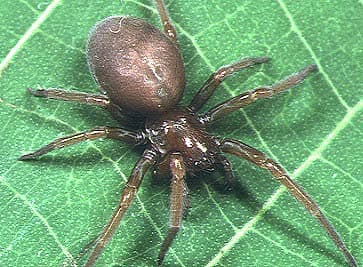
Titanoecidae
Titanoecidae is a family of araneomorph spiders first described in 1967. These spiders are found across the New World and Eurasia, and are characterized by their mostly dark coloration and the construction of "woolly" cribellate silk webs. Several species inhabit high altitudes in mountain ranges, where they can be quite abundant.
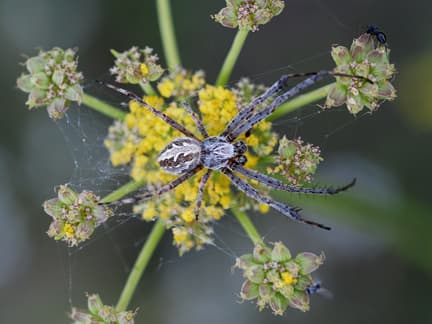
Diguetidae
Coneweb spiders, belonging to the family Diguetidae, are a small group of six-eyed haplogyne spiders. They are distinguished by their characteristic tangled space webs that feature a cone-like central retreat for hiding and egg-laying. This family is found in two distinct geographic regions: one in the Southwestern United States and Mexico, and another in South America.

Tetragnathidae
Tetragnathidae, commonly known as long-jawed orb weavers or long jawed spiders, are a family of araneomorph spiders characterized by their elongated bodies, legs, and chelicerae. These spiders are found near water, often in long vegetation, and construct small orb webs with open hubs.