
Tetragnathidae
Tetragnathidae, commonly known as long-jawed orb weavers or long jawed spiders, are a family of araneomorph spiders characterized by their elongated bodies, legs, and chelicerae. These spiders are found near water, often in long vegetation, and construct small orb webs with open hubs.
Key Facts
- ›They are characterized by elongated bodies, legs, and chelicerae.
- ›Tetragnathidae build small orb webs with an open hub.
- ›Many species are found in long vegetation near water.
- ›The family includes 45 genera and 990 species as of January 2026.
- ›Notable species include Leucauge mariana, Leucauge argyra, and Leucauge venusta.

Long-Jawed Orb Weavers, Long Jawed Spiders
Elongated Bodies, Elongated Legs, Elongated Chelicerae
About Tetragnathidae
What is Tetragnathidae?
Tetragnathidae, commonly known as long-jawed orb weavers or long jawed spiders, are a family of araneomorph spiders first formally described in 1866. This family is characterized by its members' distinctively elongated bodies, legs, and chelicerae.
Habitat and Web Construction
Species within the Tetragnathidae family are frequently found in areas with long vegetation, often situated near bodies of water. They are known for constructing small orb webs that feature an open hub. These webs are typically characterized by a sparse arrangement of radii and spirals, lacking a signal line or a retreat for the spider.
Taxonomy and Diversity
As of January 2026, the Tetragnathidae family encompasses a substantial diversity, including 45 genera and 990 species. While many extant genera and species are recognized, several extinct, fossil genera have also been described. At various times, other genera have been placed within or removed from this family as taxonomic understanding has evolved.
Notable Species
Some of the commonly recognized spiders belonging to this family include Leucauge mariana, Leucauge argyra, and Leucauge venusta. These species represent the typical morphology and ecological niches occupied by Tetragnathidae.
Source: Wikipedia ↗
Frequently Asked Questions
What are long-jawed orb weavers?
Long-jawed orb weavers, also known as long jawed spiders, are a family of araneomorph spiders. They are distinguished by their elongated body parts, including their legs and chelicerae.
What kind of webs do Tetragnathidae build?
Tetragnathidae spiders construct small orb webs. These webs have an open hub with few, wide-set radii and spirals, and they lack a signal line or retreat.
Where are long-jawed orb weavers typically found?
These spiders are often found in long vegetation, particularly in areas close to water. Their elongated bodies may help them blend in with grass and stems.
How many species are in the Tetragnathidae family?
As of January 2026, the Tetragnathidae family is comprised of 45 genera and 990 species. This number reflects ongoing taxonomic research and discoveries.
Are there any well-known species within this family?
Yes, some commonly recognized species within the Tetragnathidae family include Leucauge mariana, Leucauge argyra, and Leucauge venusta. These species are often observed in their natural habitats.
Related Spider species
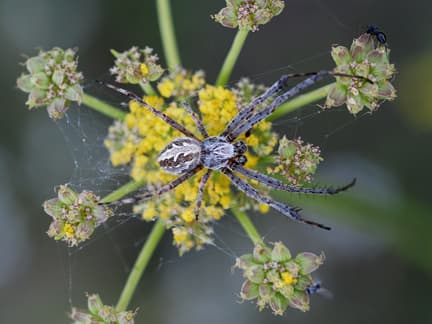
Diguetidae
Coneweb spiders, belonging to the family Diguetidae, are a small group of six-eyed haplogyne spiders. They are distinguished by their characteristic tangled space webs that feature a cone-like central retreat for hiding and egg-laying. This family is found in two distinct geographic regions: one in the Southwestern United States and Mexico, and another in South America.

Oecobiidae
Oecobiidae, also known as disc web spiders, are a family of small to moderately sized araneomorph spiders found globally. They are distinguished by their unique leg placement, which gives them a wheel-like scurrying motion, and their characteristic star-shaped webs constructed on or under various surfaces. These spiders are notable for their diet, primarily consisting of ants, leading to common names like 'anteater'.
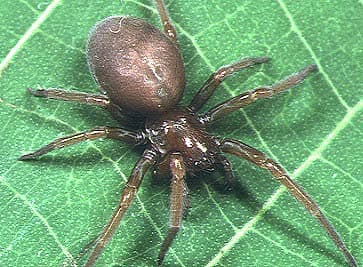
Titanoecidae
Titanoecidae is a family of araneomorph spiders first described in 1967. These spiders are found across the New World and Eurasia, and are characterized by their mostly dark coloration and the construction of "woolly" cribellate silk webs. Several species inhabit high altitudes in mountain ranges, where they can be quite abundant.