
Trogloraptoridae
Spins simple webs from cave roofs and likely uses its specialized leg claws to snatch passing flying insects.
Trogloraptor is a genus of large, cave-dwelling spiders found in southwestern Oregon, notable for their unique hook-like claws on their leg tarsi. As the sole genus in the family Trogloraptoridae, it represents one of the few new spider families described since 1990, possibly a relict taxon from North America. Their 'cave robber' name reflects their habitat and specialized predatory appendages.
Key Facts
- ›Belongs to the monotypic family Trogloraptoridae, one of only three new spider families described since 1990.
- ›Possesses distinctive hook-like, teethed claws on the last segments of its legs, used for capturing prey.
- ›Primarily found deep within caves in southwestern Oregon, with one specimen found in old-growth redwood forests of northwest California.
- ›Adult body length ranges from 7-10 MM, with a leg span of up to 3 inches (7.6 CM).
- ›Coloration includes a yellow-brown body with a dark brown V-shaped mark on the cephalothorax, orange-brown chelicerae, and a purple-brown abdomen.
- ›Spins simple webs from cave roofs and is believed to ambush passing flying insects using its specialized claws.
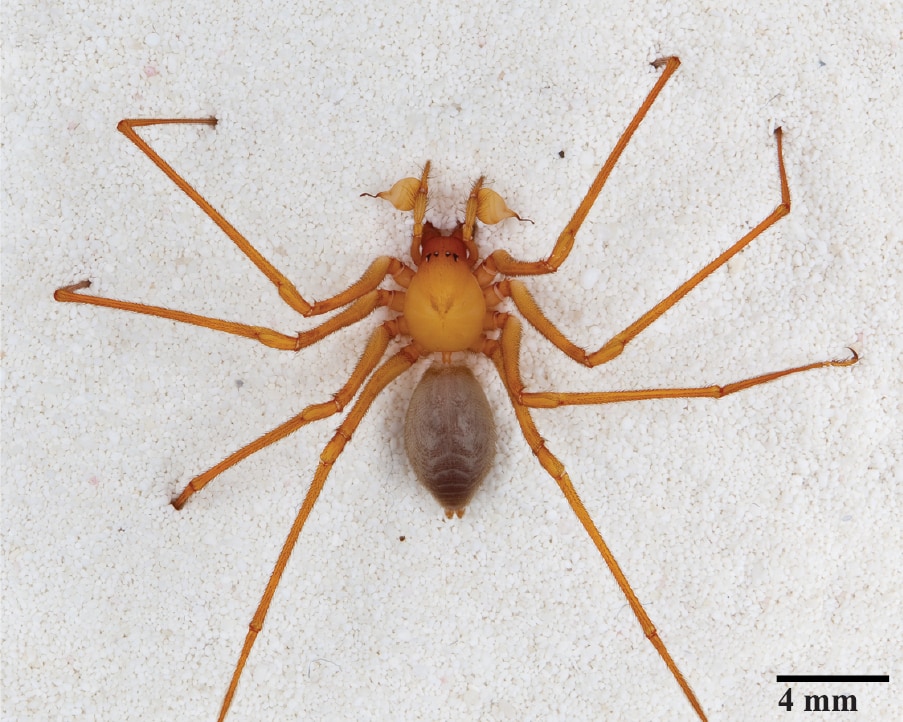
Cave Robber Spider
Southwestern Oregon, Northwestern Oregon, Northwest California
- Hook-Like, Teethed Claws On the Last Segments of Their Legs
- Six Eyes
Shy and Unaggressive, Flees Illumination
Arachnids, Moths
About Trogloraptoridae
Trogloraptoridae is a family of spiders that includes only one genus, Trogloraptor, and two known species: Trogloraptor marchingtoni and Trogloraptor tulishpun. These large spiders are found primarily in the caves of southwestern Oregon, with a notable discovery of a single juvenile specimen in the old-growth redwood forests of northwest California. The genus name, Trogloraptor, translates to "cave robber," an apt description given their habitat and their most distinctive physical characteristic: hook-like, teethed claws on the terminal segments of their legs.
Discovery and Taxonomy
The initial specimens of Trogloraptor were collected in 2010 by amateur cave biologists. They were formally described in 2012 by a team of arachnologists from the California Academy of Sciences. The discovery of this new genus and family was significant, as Trogloraptoridae is one of only three new spider families described globally since 1990. Genetic studies suggest the family may have diverged from other spiders around 130 million years ago, potentially making it a relict taxon from North America. The first described species, Trogloraptor marchingtoni, was named in honor of Neil Marchington, an amateur cave biologist involved in its discovery.
Description and Ecology
Adult Trogloraptor spiders have a body length of about 7 to 10 mm, with a leg span that can reach up to 3 inches (7.6 cm). Their coloration is generally yellow-brown, distinguished by a dark brown V-shaped mark on the cephalothorax, orange-brown chelicerae, and a purple-brown abdomen marked with faint chevron patterns. The specialized claws on their legs are thought to be crucial for capturing prey. Trogloraptor spiders spin simple webs, typically with only a few strands, from the roofs of caves. It is hypothesized that they dangle upside down from these webs, using their unique claws to snatch passing flying insects.
While Trogloraptor spiders possess venom glands, their venom is not considered harmful to humans. They are known to be very shy and unaggressive, immediately fleeing from light. The precise diet for Trogloraptor marchingtoni remains a subject of study, as captive specimens declined common insect offerings. However, Trogloraptor tulishpun has been observed to prey on arachnids and moths, indicating its role as a top predator within its limited cave environment.
Source: Wikipedia ↗
Frequently Asked Questions
Where are Trogloraptor spiders found?
Trogloraptor spiders are primarily found in the caves of southwestern Oregon. One species, Trogloraptor tulishpun, has also been discovered in lava tubes and shallow caves in the Columbia River Gorge in northwestern Oregon. A single juvenile specimen was found in the understory debris of old-growth redwood forests in northwest California.
What makes Trogloraptor spiders unique?
These spiders are remarkable for their hook-like, teethed claws on the last segments of their legs, which are believed to be crucial for capturing prey. They also belong to Trogloraptoridae, a recently described spider family, making them of significant scientific interest.
What is the scientific name for Trogloraptor spiders?
The genus is Trogloraptor. Two species have been described: Trogloraptor marchingtoni and Trogloraptor tulishpun. The family is Trogloraptoridae.
What do Trogloraptor spiders eat?
The exact prey of Trogloraptor marchingtoni remains unknown, although they have been observed to decline common insects like moths and crickets in captivity, suggesting a preference for specific prey. Trogloraptor tulishpun has been observed to eat arachnids and moths and is considered a top predator in its habitat.
Are Trogloraptor spiders dangerous to humans?
Trogloraptor spiders possess venom glands, but their venom is not known to be harmful to humans. They are also described as very shy and unaggressive, tending to flee from light.
How large are Trogloraptor spiders?
Adult Trogloraptor spiders have a body length of approximately 7 to 10 mm. With their legs spread, they can reach a total length of up to 3 inches (7.6 cm).
Related Spider species

Dipluridae
Dipluridae, commonly known as curtain-web spiders, are a family of mygalomorph spiders characterized by two pairs of booklungs and stabbing chelicerae. While historically encompassing genera now moved to other families, the current Dipluridae are primarily found in South America and the Caribbean, known for building messy funnel-webs or silk-lined burrows.

Deinopidae
Deinopidae, commonly known as net-casting spiders, are a family of circumtropical cribellate spiders recognized for their unique hunting strategy. These stick-like spiders catch prey by stretching a specialized web between their front legs and then propelling themselves forward, entangling their victims. Their exceptional night vision, facilitated by large posterior median eyes, allows them to hunt effectively in low-light conditions.

Hypochilidae
Hypochilidae, commonly known as lampshade spiders, represent one of the most primitive lineages within the araneomorph spiders. These long-legged arachnids are characterized by their distinctive "lampshade" style webs, typically constructed under overhangs and within caves. The family is distributed across North America and China, with most species found in mountainous regions.