
Deinopidae
Net-casting: they stretch a web between their front legs and propel themselves forward to entangle prey.
Deinopidae, commonly known as net-casting spiders, are a family of circumtropical cribellate spiders recognized for their unique hunting strategy. These stick-like spiders catch prey by stretching a specialized web between their front legs and then propelling themselves forward, entangling their victims. Their exceptional night vision, facilitated by large posterior median eyes, allows them to hunt effectively in low-light conditions.
Key Facts
- ›They are known as net-casting spiders due to their unique prey capture method.
- ›Deinopidae spiders have exceptionally good night vision, superior to that of cats and owls.
- ›Their posterior median eyes are significantly larger than other eyes, sometimes giving the appearance of only two eyes.
- ›These spiders are found in tropical regions worldwide.
- ›The family includes genera such as Deinopis (ogre-faced spiders) and Menneus (humped-back spiders).

Net-Casting Spiders, Ogre-Faced Spiders, Humped-Back Spiders
Australia, Africa, the Americas, Tropics Worldwide
- Stick-Like, Elongated Body Shape
- Posterior Median Eyes Are Exceptionally Large and Adapted For Night Vision
- Appearance of Having Only Two Eyes Due To the Prominent Posterior Median Eyes
Hang Upside Down During the Day, Active Hunters At Night, Possess Excellent Night Vision
About Deinopidae
Deinopidae: The Net-Casting Spiders
Deinopidae, commonly known as net-casting spiders, constitute a family of cribellate spiders found throughout tropical regions globally. These spiders are characterized by their distinctive elongated, stick-like appearance and a unique hunting method. Instead of traditional orb webs, they construct a small, highly elastic net which they stretch between their front legs. When prey comes within range, the spider launches itself forward, casting the net to entangle its victim.
Hunting and Vision
A remarkable adaptation of Deinopidae is their exceptional night vision. The posterior median eyes are significantly enlarged and possess a highly sensitive light-gathering membrane that regenerates nightly. This allows them to hunt with remarkable accuracy in low-light conditions, demonstrating visual acuity that surpasses even that of cats and owls. The prominent size of these eyes can sometimes give the impression that the spider has only two eyes.
Distribution and Genera
Deinopidae spiders are found across the tropics, with populations identified in Australia, Africa, and the Americas. During daylight hours, they often remain hidden, typically hanging upside down from silk lines secured beneath foliage, such as palmetto fronds. As darkness falls, they emerge to practice their specialized hunting technique on various invertebrate prey. The family currently comprises three genera, including the well-known Deinopis, commonly called ogre-faced spiders, and Menneus, known as humped-back spiders.
Source: Wikipedia ↗
Frequently Asked Questions
What is a net-casting spider?
A net-casting spider is a type of spider belonging to the family Deinopidae. They are distinctive for their method of catching prey by stretching a small, elastic net between their front legs and then lunging forward to ensnare insects.
How do Deinopidae spiders hunt?
Deinopidae spiders hunt by creating a small, stretchy net and holding it with their front legs. They then position themselves above or near potential prey and launch themselves forward, casting the net over the unsuspecting invertebrate. The web stretches significantly upon impact, entangling the prey.
Where are net-casting spiders found?
Net-casting spiders are found in tropical regions around the world. Their distribution spans from Australia to Africa and throughout the Americas, indicating a preference for warm climates.
What makes the eyes of Deinopidae spiders special?
The posterior median eyes of Deinopidae spiders are remarkably large and possess excellent night vision. They are capable of gathering light very efficiently, even without a reflective layer, allowing them to hunt effectively in dim light conditions.
Are there different types of net-casting spiders?
Yes, the family Deinopidae includes several genera. The most well-known genus is Deinopis, often referred to as ogre-faced spiders, and the family also includes the genus Menneus, known as humped-back spiders.
Related Spider species
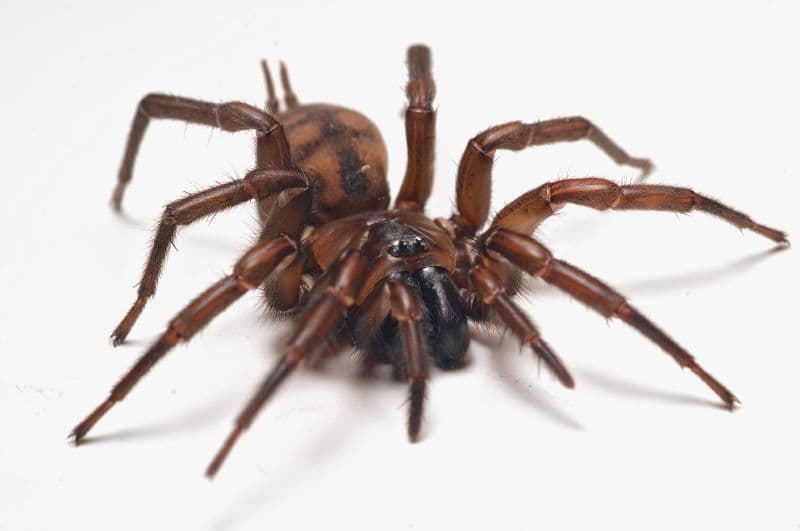
Hexathelidae
Hexathelidae is a family of mygalomorph spiders, commonly referred to as tunnelweb or funnel-web spiders. These spiders are characterized by their medium to large size, dark coloration, and powerful chelicerae and fangs. Historically, the family was much larger, but in 2018, several genera were moved to new families, significantly reducing its scope.

Araneidae
The Araneidae, commonly known as orb-weaver spiders, are a widespread family of spiders renowned for constructing distinctive spiral wheel-shaped webs. Found globally, these spiders are characterized by their eight eyes, hairy or spiny legs, and the absence of stridulating organs. With nearly 5,000 described species, they represent one of the largest spider families, playing a significant role in controlling insect populations.

Scytodidae
Scytodidae, commonly known as spitting spiders, are a family of araneomorph spiders distinguished by their unique hunting method of spitting a venomous, sticky fluid to immobilize prey. These spiders are typically found in ground and plant habitats across various biomes and are known for their nocturnal activity.