
Hypochilidae
Web building
Hypochilidae, commonly known as lampshade spiders, represent one of the most primitive lineages within the araneomorph spiders. These long-legged arachnids are characterized by their distinctive "lampshade" style webs, typically constructed under overhangs and within caves. The family is distributed across North America and China, with most species found in mountainous regions.
Key Facts
- ›Hypochilidae are considered among the most primitive araneomorph spiders.
- ›They construct characteristic "lampshade" shaped webs.
- ›Most species possess two pairs of book lungs, a trait shared with mygalomorphs.
- ›The family comprises two genera: Hypochilus and Ectatosticta.
- ›Hypochilus species are primarily found in the Appalachian, Rocky, and California Mountains in the United States.
- ›Ectatosticta species are native to China.

Lampshade Spiders
United States, China
Two Pairs of Book Lungs, Intersecting Fangs
About Hypochilidae
Hypochilidae: Primitive Lampshade Weavers
The family Hypochilidae, commonly known as lampshade spiders, represents a fascinating and ancient lineage within the vast order of araneomorph spiders. These arachnids are distinguished by their primitive characteristics and their unique method of web construction, which gives them their common name.
Key Characteristics and Distribution
Lampshade spiders are noted for being among the most primitive of araneomorph spiders. A notable feature is their respiratory system; most hypochilids possess two pairs of book lungs, a trait shared with the mygalomorph spiders, which sets them apart from many other araneomorphs. Their fangs typically intersect, though some species exhibit chelicerae positioned at an angle that is neither fully orthognathous nor labidognathous.
These spiders are characterized by their long legs and the distinctive "lampshade" style webs they construct. These webs are typically found in sheltered locations such as under rocky overhangs and within caves, providing a secure environment for prey capture.
The geographic distribution of Hypochilidae is primarily concentrated in mountainous regions. In the United States, species are associated with the Appalachian, Rocky, and California Mountains, with ten species belonging to the genus Hypochilus found in these areas. The genus Ectatosticta, comprising the remaining species, is found in China.
Taxonomy and Evolution
Within spider systematics, Hypochilidae holds a significant position. One analytical study proposed Hypochilidae as a sister clade to the Neocribellatae, a group that encompasses all other araneomorph spider species. More recent research has placed them alongside the Haplogynae. The family currently includes two genera and thirty-three recognized species.
Source: Wikipedia ↗
Frequently Asked Questions
What are lampshade spiders?
Lampshade spiders, belonging to the family Hypochilidae, are a group of primitive araneomorph spiders known for their distinctive webs. These webs are typically built in sheltered locations like under overhangs or inside caves, resembling the shape of a lampshade.
Where are Hypochilidae spiders found?
The geographic distribution of Hypochilidae spiders includes mountainous regions of North America, specifically the Appalachian, Rocky, and California Mountains in the United States, where ten species of the genus Hypochilus are found. The genus Ectatosticta is found in China.
What makes Hypochilidae spiders primitive?
Hypochilidae spiders are considered primitive because they retain certain characteristics found in more ancient spider groups, such as having two pairs of book lungs, which is a feature more commonly seen in mygalomorphs rather than other araneomorphs.
What kind of webs do lampshade spiders build?
Lampshade spiders construct webs that are described as "lampshade" style. These webs are typically found under overhangs and within caves, providing shelter and a means to capture prey.
How many species are in the Hypochilidae family?
As of current classifications, the Hypochilidae family includes two genera and thirty-three species. These genera are Hypochilus and Ectatosticta, each containing various species.
Related Spider species

Agelenidae
The Agelenidae, commonly known as funnel weavers, are a large family of spiders found globally. They are distinguished by their fast running speeds and the construction of flat sheet webs with a funnel-shaped retreat. While most species are solitary, some African species exhibit parasocial behavior, living in communal webs.
Amaurobiidae
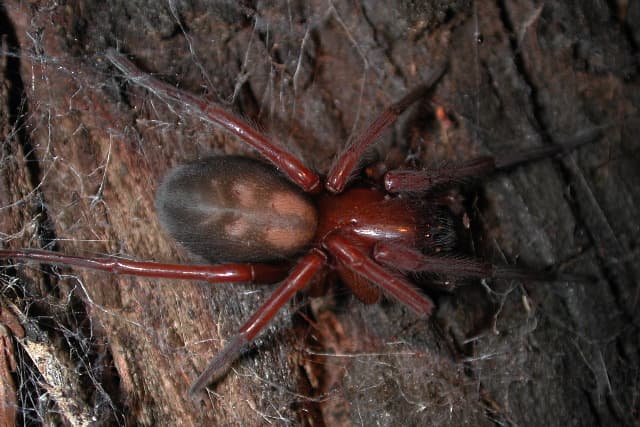
Amaurobiidae is a family of spiders characterized by their three-clawed feet and the presence of either a cribellum or its absence. These spiders are typically found in crevices, hollows, or under stones, where they construct retreats and are often captured in pitfall traps. While widespread, they can be challenging to distinguish from closely related spider families.
Anapidae
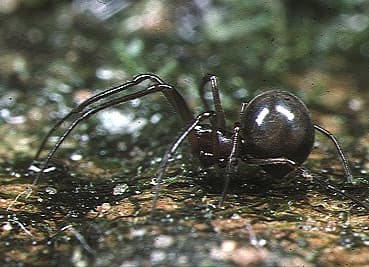
Anapidae is a diverse family of small spiders, with most species measuring less than two millimeters in length. These spiders are found worldwide, inhabiting leaf litter and moss in rainforest environments. A distinctive characteristic of many Anapidae species is their ability to build small orb webs, often less than three centimeters in diameter.