
Aldabra giant tortoise
Testudinidae·Primarily herbivores, eating grasses, leaves, woody plant stems, and fruit. Occasionally consume small invertebrates and carrion. In captivity, they eat fruits and vegetable pellets. One observation noted a female hunting and eating a juvenile bird.·Hard-shelled
The Aldabra giant tortoise is one of the largest living tortoise species, native to the Aldabra atoll in the Seychelles. It is distinguished by its high-domed, tan or brown carapace, long neck to reach higher vegetation, and stocky, scaled legs. Historically found on many Indian Ocean islands, it is now primarily found in the Seychelles, with a significant population on Aldabra atoll.
Key Facts
- ›It is one of the largest tortoise species in the world.
- ›Carapace averages 122 cm (48 in) in length, with males averaging 250 kg (550 lb).
- ›Found primarily on Aldabra atoll in the Seychelles, which hosts the world's largest population.
- ›Primarily herbivores, they feed on grasses, leaves, stems, and fruit, obtaining moisture from their food.
- ›They are active in the mornings, grazing and browsing, and seek shade or water to cool down during the day.
- ›Some individuals are believed to live over 200 years, with one specimen reputedly reaching 255 years.
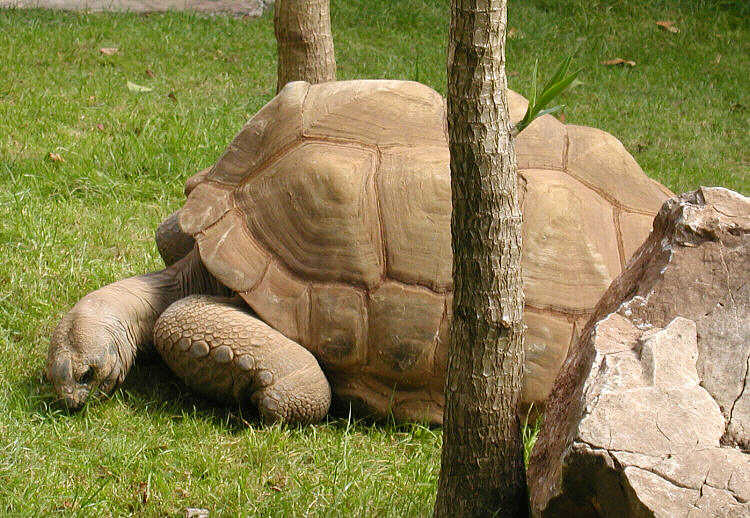
- High, Domed Carapace, Brown Or Tan In Color
- Stocky, Heavily Scaled Legs
- Very Long Neck, Used To Reach Food Up To A Meter From the Ground
- Carapace Averages 122 cm In Length
- Males Have A More Pronounced Downward Extension of the Front of the Shell If Food Is Ground-Based; Flattened Top Shells If Food Is Higher.
- Found Individually and In Herds, Often Gathering On Open Grasslands.
- Most Active In the Mornings, Engaging In Grazing and Browsing.
- Seek To Cool Down During the Heat of the Day By Digging Wallows, Hiding Under Shade, Or Submerging In Pools.
About Aldabra giant tortoise
The Aldabra giant tortoise, scientifically known as Aldabrachelys gigantea, is one of the largest living tortoise species. Endemic to the Seychelles archipelago, its primary stronghold is the Aldabra atoll, which hosts the world's largest population. Historically, giant tortoises were widespread across Indian Ocean islands, but many were driven to extinction by humans, leaving the Aldabra giant tortoise as a significant survivor.
Description and Characteristics
This species is characterized by its high-domed carapace, typically brown or tan, and its stocky, heavily scaled legs designed to support its considerable weight. A notable feature is its exceptionally long neck, which allows it to forage for food on tree branches up to a meter off the ground. The carapace averages 122 cm (48 inches) in length, with males being larger, weighing an average of 250 kg (550 lb), while females are smaller, averaging 91 cm (36 inches) in carapace length and 159 kg (351 lb) in weight.
Habitat and Ecology
Aldabra giant tortoises inhabit a variety of environments, including grasslands, low scrub, mangrove swamps, and coastal dunes. Their grazing habits have significantly shaped their environment, creating a unique ecosystem known as "tortoise turf," a mixture of grasses and herbs adapted to the tortoises' feeding pressures. As the largest animals in their habitat, they play an ecological role similar to that of elephants, felling trees and creating pathways for other wildlife.
Diet and Behavior
Primarily herbivores, their diet consists of grasses, leaves, stems, and fruits. They obtain most of their hydration from their food, as fresh water is scarce in their natural habitat. They are most active in the mornings, spending their time grazing. During the heat of the day, they seek refuge in wallows, under shade trees, or by submerging in pools.
Lifespan and Reproduction
Aldabra giant tortoises are renowned for their longevity, with some individuals believed to live for over 200 years. One specimen, Adwaita, reputedly lived for 255 years. Mating typically occurs between February and May, followed by egg-laying by females in nests dug into the ground between July and September. The incubation period is lengthy, lasting about eight months, with hatchlings emerging between October and December.
Conservation
The Aldabra giant tortoise has benefited from organized conservation efforts for over a century. While the nominate subspecies on Aldabra is relatively abundant, other subspecies, such as Arnold's giant tortoise (A. g. arnoldi) and the Seychelles giant tortoise (A. g. hololissa), were previously critically endangered and have been the focus of captive-breeding and reintroduction programs.
Source: Wikipedia ↗
Frequently Asked Questions
What is the scientific name for the Aldabra giant tortoise?
The scientific name for the Aldabra giant tortoise is Aldabrachelys gigantea. It was formerly referred to as Testudo gigantea before the genus name Aldabrachelys was established.
Where are Aldabra giant tortoises found naturally?
The main population of Aldabra giant tortoises resides on the islands of the Aldabra Atoll in the Seychelles. Smaller populations and reintroduced individuals can also be found on other Seychelles islands.
What do Aldabra giant tortoises eat?
Aldabra giant tortoises are primarily herbivores. Their diet consists of grasses, leaves, woody plant stems, and fruit. They obtain most of their moisture from their food due to limited fresh water in their habitat.
How long do Aldabra giant tortoises live?
Aldabra giant tortoises are among the longest-lived animals. Some individuals are thought to be over 200 years old, with one specimen reputedly living for 255 years.
What are the physical characteristics of an Aldabra giant tortoise?
They have a high-domed, brown or tan carapace, stocky, heavily scaled legs, and a very long neck. The carapace averages 122 cm in length for males, which are generally larger than females.
What is 'tortoise turf'?
Tortoise turf is a unique habitat created by the grazing of Aldabra giant tortoises, composed of over 20 species of grasses and herbs. These plants are often dwarfed and grow seeds closer to the ground to avoid the tortoises' jaws.
Related Turtles
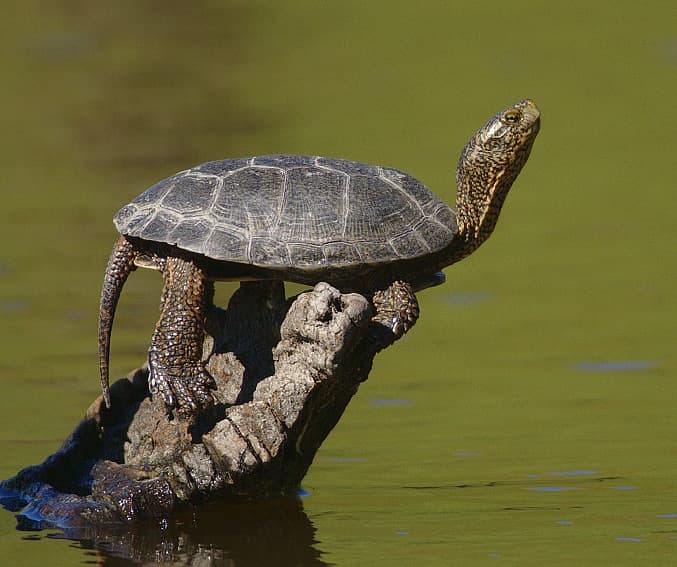
Actinemys marmorata
The western pond turtle (Actinemys marmorata), also known as the Pacific pond turtle, is a species of turtle endemic to the western coast of the United States and Mexico. It is characterized by its low, broad, smooth carapace and yellowish plastron, and it plays a significant role in its ecosystem as an omnivore, consuming insects, crayfish, and plant matter.

African spurred tortoise
The African spurred tortoise, also known as the sulcata tortoise, is the largest mainland tortoise in Africa and the third largest globally. It inhabits the arid regions bordering the Sahara Desert and the Sahel. This species is distinctive for its large size, furrowed scales, and its ability to dig extensive burrows for thermoregulation.