
Abyssinian woodpecker
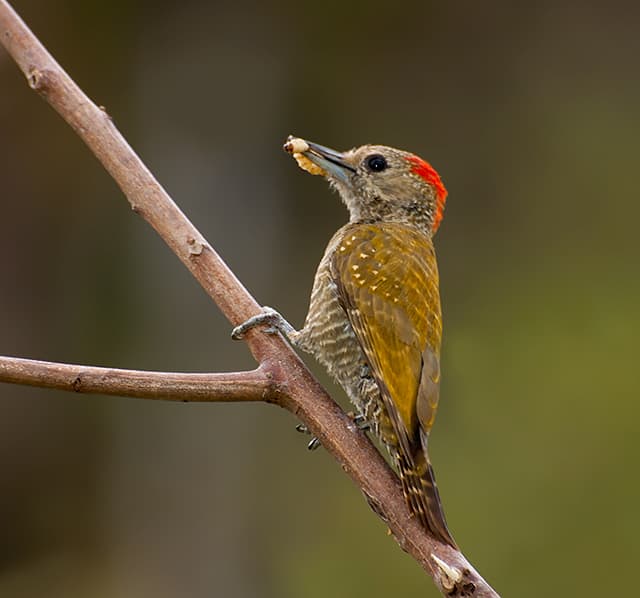
The Abyssinian woodpecker is a very small bird native to the Ethiopian Highlands, found in Eritrea and Ethiopia. It is characterized by its golden yellow back and mantle, bright red rump, barred wings and tail, and pale underparts heavily streaked with black. Males are further distinguished by a red nape and crown.
Key Facts
- ›Endemic to the Ethiopian Highlands in Eritrea and Ethiopia.
- ›Distinctive golden yellow back and mantle with a bright red rump.
- ›Males have a red nape and crown.
- ›Inhabits juniper woods, Hagenia forest, and areas with Euphorbia, typically between 1,600 and 3,000 meters.
- ›Probes for food among moss growing on trees.
- ›Classed as Least Concern by the IUCN, though its population is thought to be decreasing.

Golden-Backed Woodpecker, Golden-Mantled Woodpecker
Africa
Juniper Woods, Hagenia Forest, Areas With Euphorbia, Wooded Savanna
Golden Yellow Back and Mantle, Bright Red Rump, Barred Wings and Tail, Pale Underparts Heavily Streaked With Black, Striped Head, Red Nape and Crown, Brown Stripe Through the Eye
Insects
Probes for food among moss growing on trees
About Abyssinian woodpecker
The Abyssinian woodpecker, scientifically known as Dendropicos abyssinicus, is a small bird species belonging to the woodpecker family, Picidae. It is also recognized by the common names golden-backed woodpecker and golden-mantled woodpecker. This species is native to Africa, specifically found within Eritrea and Ethiopia, where it is endemic to the Ethiopian Highlands.
Description and Identification
A defining characteristic of the Abyssinian woodpecker is its striking plumage. It possesses a golden yellow back and mantle, complemented by a bright red rump. The wings and tail are barred, while its underparts are pale and heavily streaked with black. The head features a striped pattern, and a notable distinguishing feature for males is the presence of a red nape and crown. A brown stripe running through the eye and the golden mantle help differentiate it from its close relative, the cardinal woodpecker.
Distribution and Habitat
The Abyssinian woodpecker's range is confined to the Ethiopian Highlands. It is found in areas north to central Eritrea and the Degua Tembien mountains in Ethiopia, extending east to Harar and the River Alata. This species prefers habitats such as juniper woods and Hagenia forest, often found in association with Euphorbia plants. It typically resides at altitudes ranging from 1,600 to 3,000 meters, occasionally venturing higher, and has also been observed in wooded savanna at lower elevations.
Habits and Ecology
Much of the biology and ecology of the Abyssinian woodpecker remains poorly understood. It is described as an unobtrusive bird that forages by probing for food amongst mosses growing on trees. The nesting period is believed to likely occur between December and May, though detailed information on its reproductive behavior is scarce.
Conservation Status
The Abyssinian woodpecker is currently classified as Least Concern on the IUCN Red List. This classification is due to its extensive geographic range. However, there are concerns that its population is decreasing and its range is contracting, largely attributed to the ongoing clearance of woodlands within its habitat.
Source: Wikipedia ↗
Frequently Asked Questions
What are the distinctive physical characteristics of the Abyssinian woodpecker?
The Abyssinian woodpecker is very small with a long, broad bill. It features a golden yellow back and mantle, a bright red rump, and barred wings and tail. Its underparts are pale and heavily streaked with black, and its head is striped. Males are identifiable by a red nape and crown.
Where is the Abyssinian woodpecker found?
This species is endemic to the Ethiopian Highlands, occurring in Eritrea and Ethiopia. Its range extends north to central Eritrea, east to Harar in Ethiopia, and along the River Alata.
What kind of habitat does the Abyssinian woodpecker prefer?
It primarily inhabits juniper woods and Hagenia forest, as well as areas with Euphorbia, typically at elevations between 1,600 and 3,000 meters. It has also been observed in wooded savanna at lower altitudes.
How does the Abyssinian woodpecker find its food?
The Abyssinian woodpecker is an unobtrusive bird that probes for food among moss growing on trees. Specific details about its diet are not extensively documented.
What is the conservation status of the Abyssinian woodpecker?
The Abyssinian woodpecker is currently classified as Least Concern by the IUCN due to its very large range. However, its population is thought to be decreasing and its range contracting due to ongoing woodland clearance.
Related Woodpecker species

Arabian woodpecker
The Arabian woodpecker is a species found exclusively in the Sarawat Mountains of Saudi Arabia and Yemen, making it the sole woodpecker to breed on the Arabian Peninsula. This bird, approximately 18 cm in length, is characterized by its brownish head with a red crown patch in males, olive-grey streaked plumage, and a grey underpart with a red-suffused belly. It inhabits various woodland environments, from sea level up to 2,800 meters, feeding primarily on insect grubs and spiders.
Little woodpecker
The little woodpecker (Veniliornis passerinus) is a small South American bird found in a wide variety of wooded habitats, generally avoiding dense forest interiors. Males and females share similar plumage, with males displaying red on their heads. This adaptable species is widespread across the continent and is currently listed as Least Concern.

Beautiful woodpecker
The beautiful woodpecker is a species endemic to Colombia, found primarily in the Magdalena River valley. This bird is characterized by its striking plumage, with males and females differing in head patterns, and it feeds on a mixed diet of insects and fruits, foraging high in forest canopies. Its conservation status is assessed as Least Concern.