
Little woodpecker
The little woodpecker (Veniliornis passerinus) is a small South American bird found in a wide variety of wooded habitats, generally avoiding dense forest interiors. Males and females share similar plumage, with males displaying red on their heads. This adaptable species is widespread across the continent and is currently listed as Least Concern.
Key Facts
- ›Found in most mainland South American countries, excluding Chile, Suriname, and Uruguay.
- ›Measures approximately 14 to 15 cm in length and weighs between 24 to 37 grams.
- ›Males have a red forehead, crown, and nape, while females are grayish olive-brown with indistinct white spots.
- ›Diet consists of various adult and larval insects, including ants, termites, and beetles.
- ›Nests are excavated by the male in trees, palms, or bamboo, typically 5 to 13 meters above the ground.
- ›Listed as Least Concern by the IUCN due to its large range and stable population.
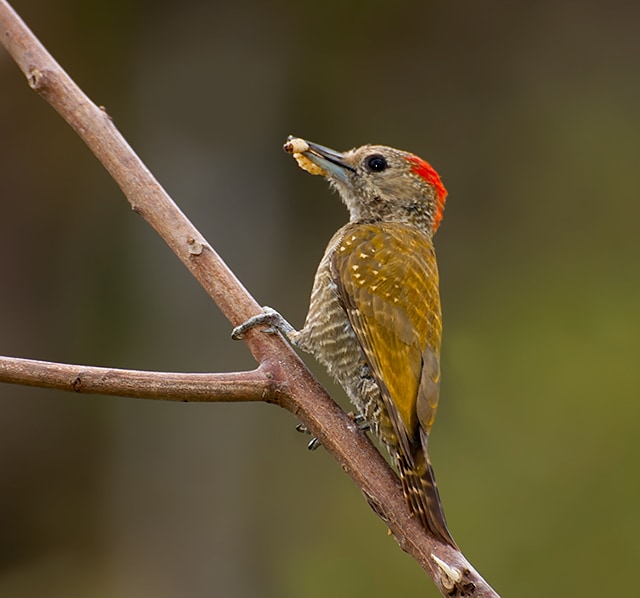
Little Woodpecker
South America
Cloudforest Edges, VáRzea Forest Edges, Riparian Forest Edges, Gallery Forest With Bamboo, Deciduous Woodland, Mangroves, Secondary Forest, Wooded Savanna, Caatinga
- Males have red on head
- Females have indistinct white spots on head where males are red
- Pale barring on chin and throat
- Pale barring on rump
- Narrow whitish bars on flight feathers
- Pale spots on wing coverts
Insects, Ants, Termites, Beetles
- Forages at all forest levels
- Pecks and hammers on trunks, branches, and bamboo nodes
- Feeds singly, in pairs, small groups, and mixed-species flocks
Excavated Holes In Stubs, Excavated Holes In Palms, Excavated Holes In Bamboo
High-Pitched 'Ki, Ki, Ki, Ki', High-Pitched 'Wi-Wi-Wi-Wi-Wi-Wi-Wi', 'Wicka' Calls, 'Wik-Wik-Wik' Calls, Drums
About Little woodpecker
The little woodpecker, scientifically known as Veniliornis passerinus, is a small bird belonging to the woodpecker family, Picidae. It is a widespread species found throughout most of mainland South America, with the notable exceptions of Chile, Suriname, and Uruguay. This adaptable bird thrives in a variety of wooded habitats, though it generally prefers the edges of forests rather than their interiors. Its preferred environments include the edges of cloudforests, várzea forests, and riparian forests, as well as gallery forests with bamboo, deciduous woodlands, mangroves, secondary forests, wooded savannas, and caatinga.
Description and Identification
Measuring approximately 14 to 15 cm in length and weighing between 24 to 37 grams, the little woodpecker exhibits sexual dimorphism in its plumage, particularly on its head. Males of the nominate subspecies possess a striking red forehead, crown, and nape, with dark feather bases visible. Females, in contrast, are grayish olive-brown with indistinct white spots in the areas where males display red. Both sexes share a brownish-olive face with pale barring on the chin and throat. Their upperparts are typically bronzy olive-green with red feather tips and pale barring on the rump, while their underparts are dark olive narrowly barred with buffish white. The iris is deep brown, the beak is blackish with a paler mandible, and the legs are dark gray. Juveniles are duller overall.
Behavior and Ecology
The little woodpecker is a year-round resident across its range and does not undertake seasonal migrations. It forages actively at all forest levels, from the undergrowth to the canopy, showing a particular fondness for bamboo. It can be observed feeding alone, in pairs, in small groups, or as part of mixed-species foraging flocks. Its diet primarily consists of various adult and larval insects, including ants, termites, and beetles. The species is also known for its vocalizations, which include high-pitched calls described as 'ki, ki, ki, ki' or 'wi-wi-wi-wi-wi-wi-wi', as well as 'wicka' or 'wik-wik-wik' sounds, and it also drums.
Reproduction
The nesting season for the little woodpecker varies depending on the geographic location, occurring from September to December in French Guiana and from October to March in Argentina. The male is responsible for excavating the nest hole, which is typically situated 5 to 13 meters above the ground in a stub, palm, or bamboo. Information regarding the typical clutch size, incubation period, and time to fledging is not widely documented. Both parents share the responsibility of provisioning the nestlings.
Conservation Status
The International Union for Conservation of Nature (IUCN) has assessed the little woodpecker as a species of Least Concern. This classification is due to its extremely large range and a population that is believed to be stable. No immediate threats to the species have been identified, and it is generally considered not uncommon and an adaptable species capable of utilizing a variety of wooded habitats.
Source: Wikipedia ↗
Frequently Asked Questions
What is the scientific name of the little woodpecker?
The scientific name of the little woodpecker is Veniliornis passerinus. Historically, it has also been placed in the genus Dryobates by some taxonomic systems.
Where can the little woodpecker be found?
This species is distributed across most of South America, inhabiting a wide array of wooded environments from forest edges to savannas. It is absent from Chile, Suriname, and Uruguay.
What does the little woodpecker eat?
The diet of the little woodpecker is varied and includes many types of insects, both in their adult and larval stages. Ants, termites, and beetles are among its known food sources.
How can I identify a male little woodpecker?
Male little woodpeckers are distinguished by the presence of red coloration on their forehead, crown, and nape. Females are generally grayish olive-brown and lack this prominent red head coloration.
What is the nesting behavior of the little woodpecker?
The male little woodpecker excavates nest holes, typically in tree stubs, palms, or bamboo, at heights of 5 to 13 meters. Both parents are involved in feeding the young once they hatch.
What sounds does the little woodpecker make?
The little woodpecker is known to produce high-pitched calls, often described as 'ki, ki, ki, ki' or 'wi-wi-wi-wi-wi-wi-wi'. It also makes 'wicka' or 'wik-wik-wik' sounds and drums.
Related Woodpecker species

Abyssinian woodpecker
The Abyssinian woodpecker is a very small bird native to the Ethiopian Highlands, found in Eritrea and Ethiopia. It is characterized by its golden yellow back and mantle, bright red rump, barred wings and tail, and pale underparts heavily streaked with black. Males are further distinguished by a red nape and crown.
Yellow-crested woodpecker
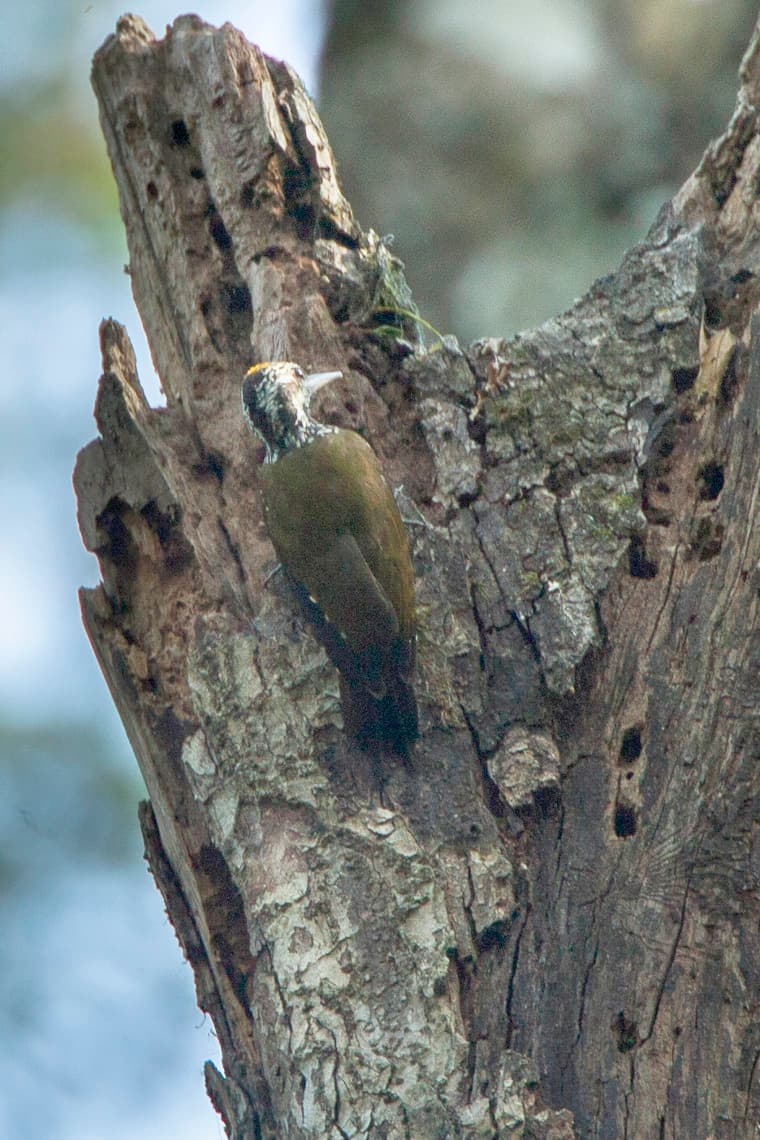
The yellow-crested woodpecker, also known as the golden-crowned woodpecker, is a species found in wet tropical forests across equatorial Central and Western Africa. Measuring between 22 to 25 cm, males are distinguished by a small golden patch on their crown, while females lack this feature. They are known for their distinctive drumming and vocalizations, and primarily feed on insects found in the forest canopy.

Scaled piculet
The scaled piculet (Picumnus squamulatus) is a small bird found in Colombia and Venezuela, belonging to the woodpecker family. It is characterized by its small size, olive-brown upperparts with a scaly appearance, and distinctive markings on its crown, which differ between males and females and vary among subspecies. This species inhabits a range of semi-open to open landscapes and feeds primarily on small insects.