
American three-toed woodpecker
The American three-toed woodpecker is a medium-sized woodpecker found in North American coniferous forests. It is characterized by its black and white plumage, with males displaying a distinctive yellow cap. These birds are strongly associated with insect-infested trees, often following disturbances like forest fires.
Key Facts
- ›Length ranges between 21-23 cm and wingspan between 37-39 cm.
- ›Males average 58.3 g, females average 52 g.
- ›Maximum lifespan in the wild is 6 years.
- ›Adults are black and white, with males having a yellow cap.
- ›Breeds in coniferous forests across western Canada, Alaska, and parts of the United States.
- ›Relies on insect-infested trees, often found after forest fires or flooding.

American Three-Toed Woodpecker
North America
Three Toes, Yellow Cap
Wood-Boring Beetle Larvae, Insects, Fruit, Tree Sap
Forage On Conifers, Search For Wood-Boring Beetle Larvae, Move Into Areas With Insect-Infested Trees
Nest Cavity In A Dead Conifer, Live Tree, Pole
About American three-toed woodpecker
The American three-toed woodpecker (Picoides dorsalis) is a medium-sized woodpecker native to North America, belonging to the family Picidae. This species is distinguished by its characteristic three toes, a feature shared with its close relatives. It closely resembles the black-backed woodpecker and was formerly considered the same species as the Eurasian three-toed woodpecker.
Description and Characteristics
Adult American three-toed woodpeckers measure between 21 to 23 cm in length, with a wingspan of 37 to 39 cm. Males are slightly larger, averaging 58.3 grams, while females average around 52 grams. Their plumage is predominantly black and white, with the head, wings, and rump being black, and the throat to belly being white. The flanks are adorned with black bars, and the back features black barring on a white background. The tail is black, with the outer feathers barred with black. A notable feature of the adult male is a distinctive yellow cap.
Habitat and Distribution
This woodpecker's breeding habitat is primarily coniferous forests found across western Canada, Alaska, and the western and northeastern United States. They have also been noted on rare occasions in the upper peninsula of Michigan and the northernmost parts of Wisconsin and Minnesota. The species is strongly associated with disturbed, old-growth forests and particularly favors areas with active spruce beetle infestations, as beetle-infested trees are crucial for the cavities they excavate and for other species that rely on these cavities.
Diet and Foraging Behavior
The American three-toed woodpecker forages on conifers, actively searching for wood-boring beetle larvae and other insects. Their diet can also include fruit and tree sap. These birds are known to move into areas with a high concentration of insect-infested trees, often following natural disturbances such as forest fires or flooding. In regions where they overlap with the black-backed woodpecker, the latter species may outcompete them for habitat.
Reproduction and Lifespan
During the breeding season, the female American three-toed woodpecker lays between 3 to 7 eggs, with an average clutch size of 4. These eggs are deposited in a nest cavity excavated in a dead conifer, though sometimes a live tree or a pole may be used. The pair excavates a new nest each year. The maximum lifespan recorded for this species in the wild is 6 years. While generally permanent residents, northern populations may migrate south during winter, and individuals at higher elevations may descend to lower altitudes.
Source: Wikipedia ↗
Frequently Asked Questions
What is the size of an American three-toed woodpecker?
The American three-toed woodpecker typically measures between 21 to 23 cm in length, with a wingspan ranging from 37 to 39 cm. Males are slightly heavier than females, averaging about 58.3 grams compared to the female's average of 52 grams.
What colors are American three-toed woodpeckers?
Adult American three-toed woodpeckers are primarily black and white. They are black on the head, wings, and rump, and white from the throat to the belly. The flanks feature black barring, and the back is also white with black bars. Adult males are distinguished by a yellow cap on their head.
Where do American three-toed woodpeckers live?
These woodpeckers inhabit coniferous forests across western Canada, Alaska, and the western and extreme northeastern United States. They have also been observed breeding on rare occasions in the upper peninsula of Michigan, and the far north of Wisconsin and Minnesota.
What do American three-toed woodpeckers eat?
Their primary diet consists of wood-boring beetle larvae and other insects found within conifers. They may also supplement their diet with fruit and tree sap.
What is the lifespan of an American three-toed woodpecker?
The maximum recorded lifespan for an American three-toed woodpecker in the wild is 6 years. This species is generally a permanent resident in its habitat.
What kind of nests do they build?
American three-toed woodpeckers excavate a new nest cavity each year, typically in a dead conifer tree. Occasionally, they may nest in a live tree or a pole. The female lays between 3 to 7 eggs, most commonly 4.
Related Woodpecker species

Black woodpecker
The Black Woodpecker is the largest woodpecker species in Europe, easily recognizable by its entirely black plumage and striking red crown. Found in mature forests across the northern Palearctic, this non-migratory bird plays a crucial role in its ecosystem by excavating tree cavities that serve as homes for numerous other species. Its diet primarily consists of carpenter ants, and its powerful hammering ability allows it to access prey deep within trees.
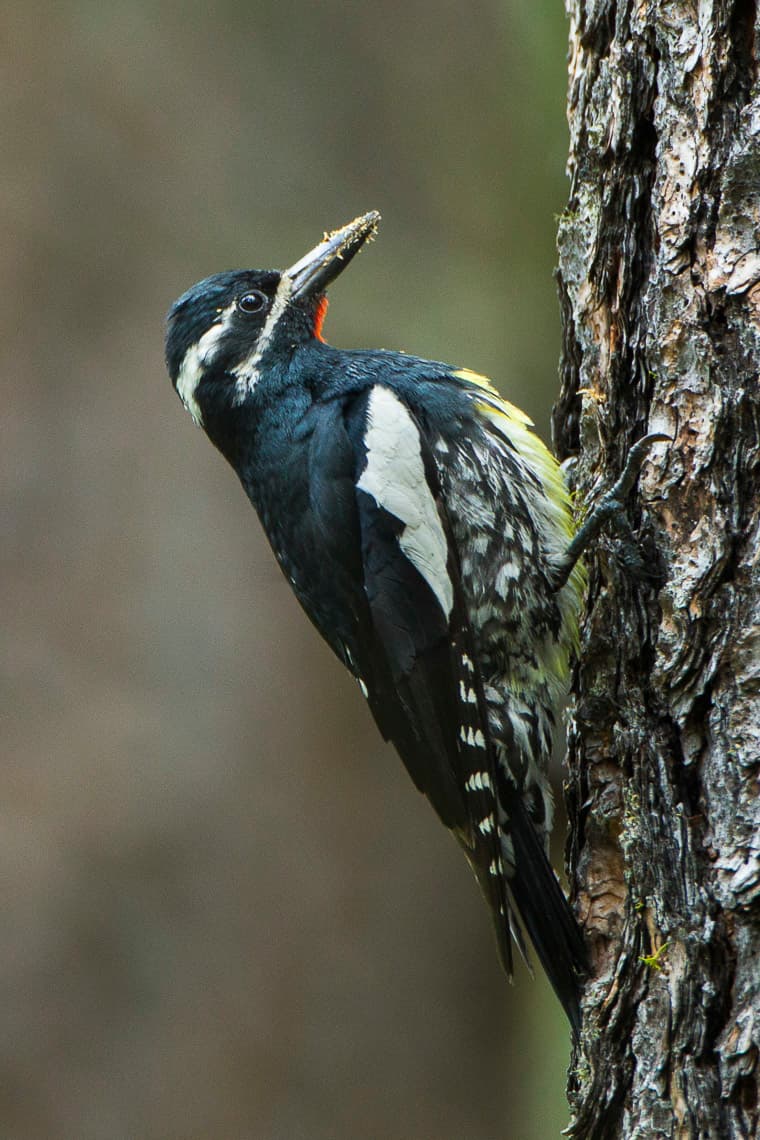
Williamson's sapsucker
Williamson's sapsucker is a medium-sized woodpecker found in open, conifer-forested areas across western North America, from northern Mexico to British Columbia. It is known for its striking sexual dimorphism, with males being iridescent black with a red chin and yellow belly, while females are predominantly black with a pale yellow breast. These birds primarily feed on sap and insects, and excavate new nesting cavities annually.

Eurasian wryneck
The Eurasian wryneck is a migratory woodpecker species found predominantly in temperate regions of Europe and Asia, wintering in tropical Africa and southern Asia. It is characterized by its thrush-like body shape, unique snake-like head-twisting ability used as a defense mechanism, and a diet primarily consisting of ants and other insects.