
Eurasian wryneck
The Eurasian wryneck is a migratory woodpecker species found predominantly in temperate regions of Europe and Asia, wintering in tropical Africa and southern Asia. It is characterized by its thrush-like body shape, unique snake-like head-twisting ability used as a defense mechanism, and a diet primarily consisting of ants and other insects.
Key Facts
- ›Measures approximately 16-18 cm in length with a body shape resembling a thrush more than a typical woodpecker.
- ›Possesses a unique ability to twist its head almost 180 degrees, often accompanied by hissing, as a defense display.
- ›Primarily feeds on ants and other insects, foraging on the ground and in decaying wood.
- ›Nests in pre-existing holes in trees, crevices, or burrows, and lays a clutch of seven to ten white eggs.
- ›Is the only European woodpecker known to undertake long-distance migrations.
- ›Listed as 'Least Concern' by the IUCN due to a large population and wide distribution, though some European populations are declining.

Northern Wryneck
Europe, Asia, Africa
Open Countryside, Woodland, Orchards, Parkland, Gardens, Heaths, Hedgerows, Deciduous Woodland, Coniferous Forests
- Ability to turn head through almost 180 degrees
- Snake-like head twisting display
- Thrush-like body shape
- Shorter, less dagger-like bill than other woodpeckers
Ants, Insects, Beetles, Moths, Spiders, Woodlice
- Forages on the ground with short hops
- Clings to tree trunks, sometimes using tail as a prop
- Uses rapid extension and retraction of tongue to pick up prey
- Catches insects on the wing
Pre-Existing Hole In A Tree Trunk, Crevice In A Wall, Hole In A Bank, Sand Martin's Burrow, Nesting Box
Harsh, Shrill Notes, Staccato 'Tuck' Alarm Call, Hissing Sound When Disturbed
About Eurasian wryneck
The Eurasian wryneck (Jynx torquilla), also known as the northern wryneck, is a distinctive member of the woodpecker family, notably differing from its relatives in its body shape, which is more akin to a thrush, and its unique behavioral adaptations. This species is primarily found breeding across temperate Europe and Asia, with most populations undertaking significant migratory journeys to winter in tropical Africa and southern Asia. A resident population also exists in northwestern Africa.
Description and Behavior
Eurasian wrynecks typically measure between 16 and 18 cm in length, possessing bills that are shorter and less dagger-like than those of typical woodpeckers. Their upperparts are characterized by a cryptic pattern of pale brown, mottled with rufous and blackish bars and streaks, while their underparts are creamy white, speckled with brown. A defining characteristic is their remarkable ability to rotate their necks, turning their heads through nearly 180 degrees. This snake-like head-twisting, often accompanied by hissing, is employed as a threat display when the bird feels threatened, particularly when defending its nest. They may also feign death as a survival tactic.
Habitat and Diet
This species prefers open countryside, parkland, gardens, orchards, and hedgerows, especially areas with older trees. While they inhabit deciduous woodlands and, in some northern regions, coniferous forests, they tend to avoid wet ground. Their diet is predominantly composed of ants and other insects, which they find in decaying wood or forage for on the ground. They are adept at picking up prey with a rapid tongue extension and can sometimes catch insects in flight.
Breeding and Conservation
The Eurasian wryneck nests in a variety of locations, including pre-existing tree cavities, wall crevices, bank holes, or even old burrows. They do not construct their own nests but lay a clutch of typically seven to ten white eggs. Both parents share incubation and chick-rearing duties. Despite its wide distribution and large estimated population, the Eurasian wryneck is listed as 'Least Concern' by the IUCN. However, certain European populations, such as those in the United Kingdom and Switzerland, have been observed to be declining, leading to conservation efforts like the provision of nest boxes in suitable habitats.
Source: Wikipedia ↗
Frequently Asked Questions
What is the scientific name for the Eurasian wryneck?
The scientific name for the Eurasian wryneck is Jynx torquilla. The genus name 'Jynx' comes from the Ancient Greek name for this bird, while 'torquilla' is derived from the Medieval Latin word 'torquere,' meaning to twist, referring to its distinctive head movements.
What does the Eurasian wryneck look like?
The Eurasian wryneck is a slim, elongated bird measuring 16-18 cm. Its upperparts are mottled pale brown with rufous and blackish bars and streaks, while its underparts are creamy white with brown speckles. It has a shorter bill than most woodpeckers and a body shape more similar to a thrush.
Where does the Eurasian wryneck live?
This species breeds in temperate regions of Europe and Asia. Most populations migrate to winter in tropical Africa and southern Asia, although some populations in northwestern Africa are resident.
What is the main diet of the Eurasian wryneck?
The primary food source for the Eurasian wryneck consists of ants and other insects. They find their prey in decaying wood and also forage on the ground.
How does the Eurasian wryneck defend itself?
When disturbed, particularly at the nest, the Eurasian wryneck employs a unique defense mechanism. It twists its head in a snake-like manner and emits a hissing sound. It may also feign death, appearing to hang limply with its eyes closed.
Related Woodpecker species

European green woodpecker
The European green woodpecker is a large woodpecker characterized by its vibrant green upperparts, pale yellowish-green underparts, red crown, and a distinct black moustachial stripe. Primarily found across Europe and parts of western Asia, this shy bird is more often heard than seen, known for its loud, distinctive calls. It predominantly forages for ants on the ground, a behavior that sets it apart from many other woodpecker species.
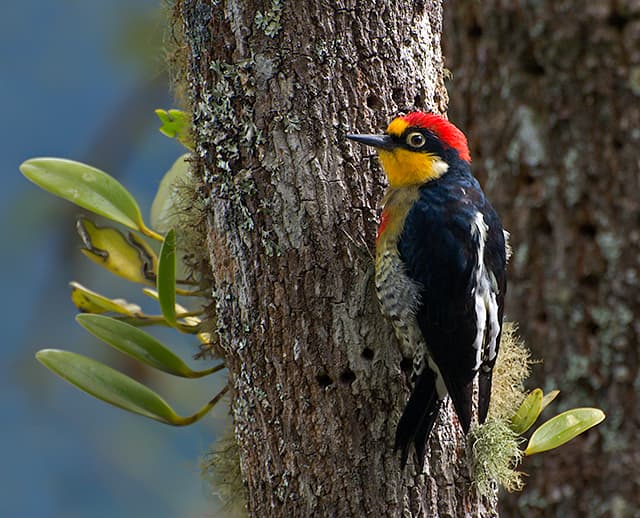
Yellow-fronted woodpecker
The yellow-fronted woodpecker is a colorful bird found in eastern South America, specifically in Brazil, Paraguay, and northeastern Argentina. It inhabits subtropical and tropical lowland forests, as well as degraded former forest areas. This species is characterized by its distinctive yellow fore-crown and throat, with males having a red crown and nape.

White woodpecker
The White woodpecker is a striking South American bird recognized by its bright white plumage, black wings, and a small, distinct yellow eye patch. It inhabits wooded grasslands and various open woodland environments across a wide range of South America, from Suriname and French Guiana down to Argentina. This species is noted for its varied diet and adaptability to different habitats, including urban areas.