
Ashy woodpecker
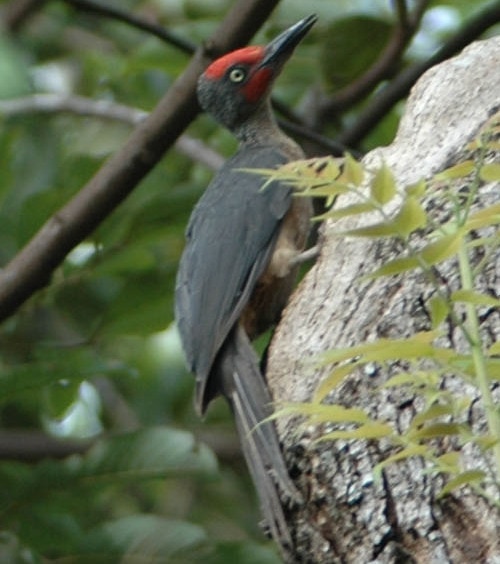
The Ashy woodpecker is a large bird species found exclusively on the island of Sulawesi and its surrounding Indonesian islands. It inhabits tropical lowland and montane forests, preferring dense woodland but also appearing in secondary forests and savanna patches. This species is characterized by its grey plumage, a distinctive red facial marking in males, and a long black bill.
Key Facts
- ›Endemic to Sulawesi and surrounding Indonesian islands.
- ›Inhabits tropical moist lowland and montane forests.
- ›Males have a red face, while females have an entirely grey head.
- ›Feeds primarily on termites, caterpillars, and other insects.
- ›Nests in dead trees or dead sections of living trees.
- ›Typically lays two to three eggs.
Ashy Woodpecker
Indonesia, Sulawesi
Tropical Moist Lowland Forests, Tropical Moist Montane Forests, Secondary Forest, Forest Patches In Savannah
Grey, Buff, Grey-Brown, Dark Slate Grey, Red
Red Face, Grey Head, Long Black Bill, Yellow Iris, Grey Eye-Ring
Termites, Caterpillars, Insects, Arthropods
Forages on trees, often on trunks, Breaks into termite nests on the ground
Dead Trees, Dead Sections of Living Trees
Laughing Calls, Tuk Tuk Tuk, Drumming
About Ashy woodpecker
The Ashy woodpecker (Mulleripicus fulvus) is a species of bird belonging to the woodpecker family, Picidae. It is exclusively found in Indonesia, being endemic to the island of Sulawesi and its surrounding archipelagoes, including Lembeh, Togian, Banggai, Muna, and Buton islands.
Habitat and Distribution
This woodpecker thrives in tropical moist lowland and montane forests. While it prefers closed forest environments, it can also adapt to secondary forests and pockets of woodland within savanna landscapes. The Ashy woodpecker is found from sea level up to elevations of 2,000 meters (6,600 ft).
Physical Characteristics
Adult Ashy woodpeckers are sizable birds, measuring approximately 40 cm (16 inches) in length. Males are distinguished by a striking red coloration on their face extending to the mid-crown, with the back of the head and neck being grey. The throat, front of the neck, and belly are a buff color, while the rest of the back and wings are a grey-brown to dark slate grey. They possess a long, black bill and yellow eyes encircled by a grey eye-ring. Females exhibit a similar plumage but lack the red facial markings; their heads are entirely grey, with faint spotting except on the forehead. A recognized subspecies, M. f. wallacei, found in southern Sulawesi, features red on the face that covers more of the head and has slightly longer wings and tail, though a shorter bill.
Diet and Foraging
The primary diet of the Ashy woodpecker consists of termites, caterpillars, and other insects and arthropods. They are often observed foraging on tree trunks, and are known to break into termite nests that may be located on the ground.
Reproduction
Information regarding the nesting habits of the Ashy woodpecker is limited. However, observations indicate that they excavate nest holes in dead trees or within the dead sections of living trees. The male is reported to undertake the majority of the digging effort. Typically, a clutch consists of two to three eggs.
Vocalizations
The calls of the Ashy woodpecker include a distinctive laughing sound, described as 'hew-hew-hew-hew-hew', and a 'tuk tuk tuk' sound, which are noted as being muffled rather than loud. During the breeding season, they also engage in drumming behavior.
Conservation Status
The Ashy woodpecker is considered to be of Least Concern by the IUCN. The species is not uncommon, and its population is currently considered secure. They are assumed to be non-migratory.
Source: Wikipedia ↗
Frequently Asked Questions
Where is the Ashy woodpecker found?
The Ashy woodpecker is endemic to Sulawesi and its surrounding islands in Indonesia. It can be found in various forest types, from sea level up to 2,000 meters.
What does the Ashy woodpecker look like?
This is a large woodpecker, measuring about 40 cm in length. Males have a red face and grey head, while females have an entirely grey head. Their plumage is generally grey with buff-colored undersides, and they possess a long black bill and yellow eyes.
What is the diet of the Ashy woodpecker?
The Ashy woodpecker primarily feeds on termites, caterpillars, and other insects and arthropods. They forage on trees, often seen on trunks, and may also break into termite nests found on the ground.
What kind of nests do Ashy woodpeckers build?
Ashy woodpeckers create nesting holes in dead trees or in the dead sections of living trees. The male typically undertakes most of the digging work for the nest.
What are the vocalizations of the Ashy woodpecker?
Their calls include a laughing sound described as 'hew-hew-hew-hew-hew' and a 'tuk tuk tuk' sound, though these are noted as muffled rather than loud. They also engage in drumming during the breeding season.
Related Woodpecker species

Japanese pygmy woodpecker
The Japanese pygmy woodpecker is a small woodpecker species found in coniferous and deciduous forests across East Asia, including Russia, China, Korea, and Japan. It is characterized by its grey-brown crown, white supercilium, and dark brown back with white barring. This species is known for its varied diet of invertebrates and berries, as well as its distinctive high-pitched call and rapid drumming.

Luzon flameback
The Luzon flameback is a large woodpecker species native to the northern Philippine islands of Luzon, Polillo, Catanduanes, and Marinduque. It is characterized by its vibrant red back and yellowish belly, with males displaying a striking red crest and females a more subdued black one. This species inhabits tropical lowland and montane forests.

Northern sooty woodpecker
The Northern sooty woodpecker is a bird species found in the Philippines, inhabiting tropical lowland and montane forests. Distinguishable by its darker gray plumage and the male's burgundy facial markings, this species is typically observed alone or in pairs. Its primary diet is believed to consist of invertebrates, and it nests in tree cavities.