
Japanese pygmy woodpecker
The Japanese pygmy woodpecker is a small woodpecker species found in coniferous and deciduous forests across East Asia, including Russia, China, Korea, and Japan. It is characterized by its grey-brown crown, white supercilium, and dark brown back with white barring. This species is known for its varied diet of invertebrates and berries, as well as its distinctive high-pitched call and rapid drumming.
Key Facts
- ›Found in coniferous and deciduous forests in Russia, China, Korea, and Japan.
- ›Measures 13–15 cm (5.1–5.9 in) in length.
- ›Males have a small red mark on the side of their nape, which females lack.
- ›Feeds on invertebrates like spiders, caterpillars, ants, and aphids, as well as berries.
- ›Nests are excavated in dead branches.
- ›Classified as a least-concern species by the IUCN due to its large range and stable population.

Pygmy Woodpecker
Russia, China, Korea, Japan
Coniferous Forests, Deciduous Forests, Lowland Forests, Upland Forests, Riverine Forests, Parks, Gardens
White Supercilium, White Moustachial Stripe, Male Red Nape Mark
Invertebrates, Spiders, Caterpillars, Ants, Aphids, Berries
Searching On Trees
Dead Branches
High "Tsi-Tsi-Tsi", Khit Notes, Kzz Notes
About Japanese pygmy woodpecker
The Japanese pygmy woodpecker, scientifically known as Yungipicus kizuki, is a small bird belonging to the woodpecker family. This species is distributed across a significant portion of East Asia, inhabiting coniferous and deciduous forests in regions including Russia, China, Korea, and Japan. It has also been observed in parks and gardens, indicating a degree of adaptability to human-modified landscapes.
Description and Identification
Adult Japanese pygmy woodpeckers typically measure between 13 to 15 centimeters in length. Their plumage features a distinct grey-brown crown, complemented by a prominent white supercilium that extends from above the eye to the neck and breast. The back is dark brown with characteristic white barring, and the wings and tail are also brownish-black with white markings. A key sexual dimorphism is present: males possess a small red marking on the side of their nape, which is absent in females. Females, incidentally, tend to have slightly longer beaks, wings, and tails than males. Juveniles may exhibit streaking on their throat. The species displays a general trend of becoming smaller and darker from the northern to the southern extents of its range.
Behavior and Diet
The Japanese pygmy woodpecker is often observed in pairs or as part of mixed-species foraging flocks. Its diet primarily consists of invertebrates found on trees, such as spiders, caterpillars, ants, and aphids. Berries also form a part of its dietary intake. Its vocalizations include a high-pitched "tsi-tsi-tsi" call, and it produces a quick drumbeat in short bursts. The breeding season commences in March in the southern parts of its Japanese range and extends to late May in the northern areas. Nesting involves excavating a hole in a dead branch, where a clutch of five to seven white eggs is laid. Incubation lasts for 12 to 14 days, and the young fledge approximately three weeks after hatching.
Distribution and Conservation
This woodpecker's range extends across Korea, northeastern China, southeastern Siberia, Sakhalin, Japan, and the Ryukyu Islands, reaching elevations up to 2,100 meters. Given its extensive distribution and a population that is considered stable, the International Union for Conservation of Nature (IUCN) has classified the Japanese pygmy woodpecker as a species of Least Concern. This status reflects a healthy population that is not currently facing significant threats to its survival across its broad geographic area.
Source: Wikipedia ↗
Frequently Asked Questions
What is the scientific name of the Japanese pygmy woodpecker?
The scientific name of the Japanese pygmy woodpecker is Yungipicus kizuki. It has also been previously placed in the genera Dendrocopos and Picoides.
What does the Japanese pygmy woodpecker look like?
It has a grey-brown crown, a white supercilium extending to the neck and breast, and dark brown upperparts with white bars. The breast and belly can have variable streaks. Males are distinguished by a small red mark on the side of their nape.
Where can the Japanese pygmy woodpecker be found?
This woodpecker inhabits Korea, northeastern China, southeastern Siberia, Sakhalin, Japan, and the Ryukyu Islands. It is found in a variety of coniferous and deciduous forests, as well as parks and gardens.
What does the Japanese pygmy woodpecker eat?
Its diet consists of invertebrates such as spiders, caterpillars, ants, and aphids. It also consumes berries.
How does the Japanese pygmy woodpecker make its nest?
The Japanese pygmy woodpecker excavates a nest hole in a dead branch. The eggs are white, and a clutch typically contains five to seven eggs.
What is the conservation status of the Japanese pygmy woodpecker?
The Japanese pygmy woodpecker is listed as a least-concern species by the International Union for Conservation of Nature (IUCN). This is attributed to its large geographic range and a population that is considered stable.
Related Woodpecker species
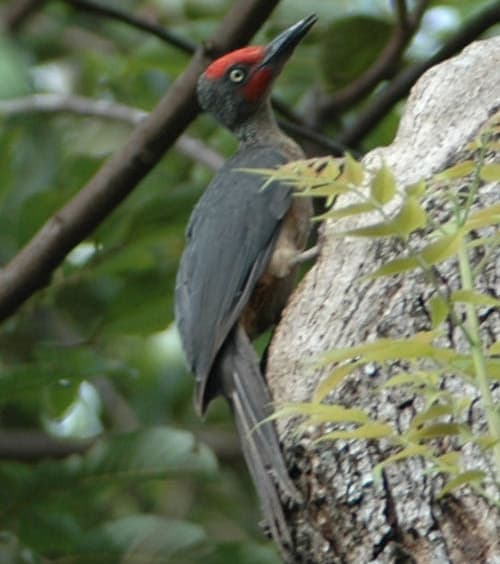
Ashy woodpecker
The Ashy woodpecker is a large bird species found exclusively on the island of Sulawesi and its surrounding Indonesian islands. It inhabits tropical lowland and montane forests, preferring dense woodland but also appearing in secondary forests and savanna patches. This species is characterized by its grey plumage, a distinctive red facial marking in males, and a long black bill.
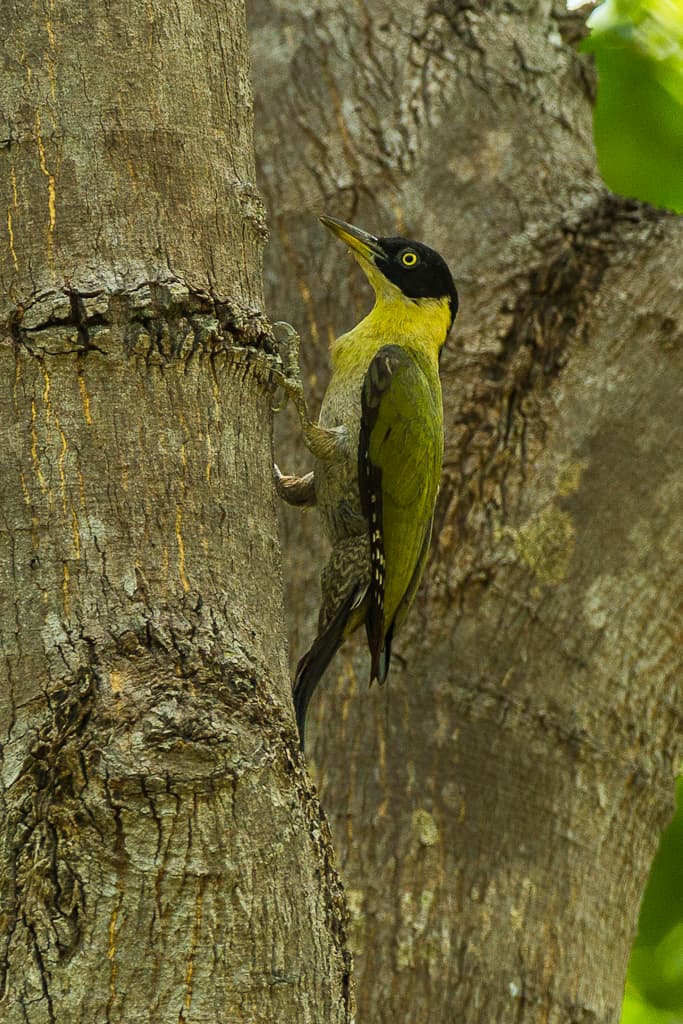
Black-headed woodpecker
The black-headed woodpecker is a medium-sized bird found in Cambodia, Laos, Myanmar, Thailand, and Vietnam, inhabiting deciduous and coniferous forests. It is characterized by its distinct plumage, including a black face, yellow throat, green wings, and a red lower back, with males possessing a red crown and females a black one. This species is insectivorous, primarily feeding on termites and ants, and is known for its loud, yelping vocalizations.

Black woodpecker
The Black Woodpecker is the largest woodpecker species in Europe, easily recognizable by its entirely black plumage and striking red crown. Found in mature forests across the northern Palearctic, this non-migratory bird plays a crucial role in its ecosystem by excavating tree cavities that serve as homes for numerous other species. Its diet primarily consists of carpenter ants, and its powerful hammering ability allows it to access prey deep within trees.