
Bar-bellied woodpecker
The bar-bellied woodpecker (Veniliornis nigriceps) is a species of bird found in the montane forests of Bolivia, Colombia, Ecuador, and Peru. This species is characterized by its olive-brown plumage with distinctive dark olive bars on its underparts, and differences in head coloration between males and females. It inhabits humid to wet forests, often favoring areas with dense undergrowth and bamboo.
Key Facts
- ›Inhabits humid to wet montane forests and elfin forests.
- ›Found at elevations typically between 2,600 and 3,600 meters.
- ›Males have red on their forehead to nape, while females have a black crown and golden nape.
- ›Forages at all forest levels, often in dense undergrowth and mixed-species flocks.
- ›Its IUCN conservation status is Least Concern.
- ›Vocalizations include high-pitched 'kee' notes, 'chik', and descending 'kzzrr' sounds.
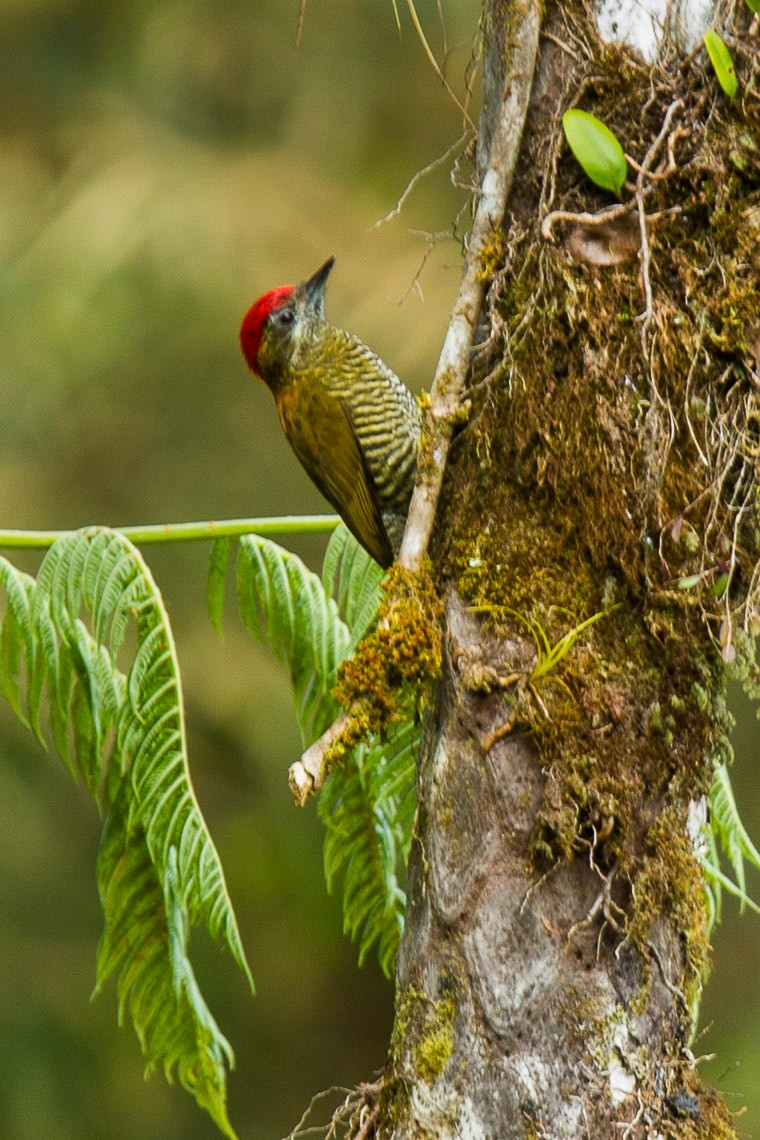
Bar-Bellied Woodpecker
Bolivia, Colombia, Ecuador, Peru
Montane Forest, Elfin Forest, Polylepis Woodland, Forest With Dense Undergrowth, Bamboo Thickets
Thin white stripes behind and below the eye, Males with red forehead to nape, Females with black crown and golden nape, Dark olive bars on underparts
Pecks and Flakes Bark, Probes Among Moss Patches, Forages At All Forest Levels, Spends Time In Dense Undergrowth, Joins Mixed-Species Foraging Flocks
- Up to c. 25 high-pitched 'kee' notes, rising before dropping
- Soft 'chik' notes
- High descending 'kzzrr' notes
About Bar-bellied woodpecker
The bar-bellied woodpecker, scientifically known as Veniliornis nigriceps, is a species inhabiting the high-altitude forests of South America. It is found in Bolivia, Colombia, Ecuador, and Peru, primarily within humid to wet montane and elfin forests.
Taxonomy and Classification
This species is typically placed in the genus Veniliornis, though some taxonomic systems, such as the American Ornithological Society and Clements taxonomy, have moved species from Veniliornis into the genus Dryobates. Three subspecies are recognized: the nominate nigriceps, equifasciatus, and pectoralis. These subspecies exhibit minor variations in plumage patterns, particularly in the width of underpart barring and female crown coloration.
Physical Description
Adult bar-bellied woodpeckers measure between 17 to 20 cm in length and weigh between 39 to 46 grams. A key distinguishing feature between sexes is head coloration: males display red from forehead to nape, while females possess a black crown and a golden nape. Both sexes share a dark olive-brown face with subtle white stripes, and their mantle and back are dark olive with a bronze tinge. Their underparts are buffish-white, marked by prominent dark olive bars. The iris is deep red to brown, the beak is gray to blue-gray, and the legs are gray to olive-gray. Juveniles are generally duller and greener than adults.
Distribution and Habitat
The bar-bellied woodpecker's range extends across the Andes of Colombia, Ecuador, and Peru, with the nominate subspecies reaching as far south as central Bolivia. They thrive in humid to wet montane forests and elfin forests, often preferring areas with dense undergrowth, especially Chusquea bamboo. Their elevational distribution is typically between 2,600 and 3,600 meters, though they can be found as low as 2,000 meters and as high as 4,000 meters in Ecuador.
Behavior and Ecology
This species is a year-round resident throughout its range, with no significant elevational movements recorded. Bar-bellied woodpeckers forage actively at all forest levels but spend considerable time in dense undergrowth. They are often observed singly or in pairs and regularly join mixed-species foraging flocks. Their foraging techniques include pecking and flaking bark, and probing mossy areas. Details regarding their specific diet are not well-documented.
Reproduction and Vocalization
The breeding season varies by region, occurring in February and March in Ecuador, April and May in Bolivia, and including August in Peru. Beyond these temporal details, little is known about their breeding biology. Vocalizations are infrequent but distinct, consisting of up to 25 high-pitched 'kee' notes that rise before dropping, as well as softer 'chik' and high descending 'kzzrr' notes.
Conservation Status
The bar-bellied woodpecker is assessed as Least Concern by the IUCN. While its exact population size is unknown, the population trend is believed to be stable. No immediate threats have been identified, and the species benefits from its occurrence in several protected areas. It is considered rare to uncommon in parts of its range and may be occasionally overlooked due to its unobtrusive habits and low densities.
Source: Wikipedia ↗
Frequently Asked Questions
What is the scientific name of the bar-bellied woodpecker?
The scientific name of the bar-bellied woodpecker is Veniliornis nigriceps. Depending on taxonomic classification, it may also be placed in the genus Dryobates.
Where is the bar-bellied woodpecker found?
The bar-bellied woodpecker is distributed across Bolivia, Colombia, Ecuador, and Peru. Its subspecies inhabit different regions within these countries, primarily along the eastern slopes of the Andes.
What are the key physical differences between male and female bar-bellied woodpeckers?
The primary difference lies in their head plumage. Males are red from the forehead to the nape, while females have a black crown and a golden nape. Otherwise, adults of both sexes share similar plumage patterns.
What kind of habitat does the bar-bellied woodpecker prefer?
This woodpecker prefers humid to wet montane forests and elfin forests. It often seeks out landscapes with dense undergrowth, particularly areas dominated by Chusquea bamboo.
What is the conservation status of the bar-bellied woodpecker?
The bar-bellied woodpecker is listed as Least Concern by the IUCN. Its population is believed to be stable, and no immediate threats have been identified.
Related Woodpecker species

Striped woodpecker
The striped woodpecker is a bird species found in Argentina, Bolivia, and Chile, inhabiting semi-open to open forests, woodlands, and even gardens. It is characterized by its black and white striped plumage, with males and females differing slightly in head coloration, particularly the nape. This species primarily feeds on insects and excavates nest cavities in trees or cacti.

Andean flicker
The Andean flicker is a distinctive woodpecker species found in the open, high-altitude landscapes of South America, including the páramo and puna. It is characterized by its terrestrial foraging behavior, colonial nesting in earthen banks, and a varied vocal repertoire. This species is widespread across several Andean countries and is currently listed as Least Concern.

Mottled piculet
The mottled piculet is a small bird found in the Atlantic Forest and related habitats across southeastern Brazil, Uruguay, and northeastern Argentina. It is characterized by its olive-brown plumage with buff or rusty tinges, and males display a red patch on their forehead. This species primarily feeds on insect larvae found in dense vegetation.