
Mottled piculet
The mottled piculet is a small bird found in the Atlantic Forest and related habitats across southeastern Brazil, Uruguay, and northeastern Argentina. It is characterized by its olive-brown plumage with buff or rusty tinges, and males display a red patch on their forehead. This species primarily feeds on insect larvae found in dense vegetation.
Key Facts
- ›Found in Argentina, Brazil, and Uruguay.
- ›Typically measures 10-11 cm in length and weighs 11-12 g.
- ›Males have a red forehead patch; females have white spots on the cap.
- ›Inhabits lowland evergreen Atlantic forest, Araucaria forest, and scrubland.
- ›Feeds on insect larvae extracted from thin branches, vines, and bamboo.
- ›Vocalizations include a repetitive 'seep' or 'cheep' and a shrill alarm call.

Mottled Piculet
Argentina, Brazil, Uruguay
Lowland Evergreen Atlantic Forest, Araucaria Forest, Gallery Forest, Bamboo Thickets, Scrubland, Wooded Savannah
Red Patch On Forehead, White Spots On Cap, Black Cap and Nape, White Spots On Rest of Cap
Insect Larvae
- Forages in dense understory vegetation
- Forages in trees up to 8m
- Takes insect larvae from thin branches, vines, and bamboo stems
- Usually forages alone
- Will join mixed-species foraging flocks
- Repetitive 'seep' or 'cheep'
- Brief trill
- Occasional humming sound
- Shrill cricket-like whistling alarm call
- Irregular drumming pattern of two to four rapid strikes
About Mottled piculet
Mottled Piculat
The mottled piculet (Picumnus nebulosus) is a species of bird belonging to the woodpecker family (Picidae), found in the southeastern regions of South America. Its geographic range encompasses parts of Argentina, Brazil, and Uruguay, where it inhabits a variety of forest types and scrublands.
Description and Identification
This small woodpecker typically measures between 10 and 11 cm in length, with adults weighing between 11 and 12 grams. Adult males are distinguished by a black cap and nape, a notable red patch on the forehead, and white spots elsewhere on the cap. Their facial features are predominantly dark olive-brown with some white. The hindneck and upperparts are a warm olive-brown, often with a buff or rusty hue on the back. Flight feathers are dark brown to blackish, featuring pale edges on the secondaries and tertials. The tail is black, with specific white markings on the feathers. Chin and throat are white with fine black barring, transitioning to a buffish-brown breast that may show dark streaks. The belly is pale buff, and the flanks are a richer buff marked with wide blackish streaks. Their eyes are brown, the beak is black with a gray base to the mandible, and the legs are gray. Adult females share similar plumage but lack the red forehead patch, instead displaying white spots throughout the cap.
Juveniles are generally duller than adults, possessing a dull brown crown with pale buffish streaks.
Distribution and Habitat
The mottled piculet has an almost unique distribution, primarily found from the state of Paraná in southeastern Brazil, extending south through eastern Uruguay and into the Misiones and Corrientes provinces of Argentina. Its preferred habitats include lowland evergreen Atlantic forest and Araucaria forest. It also adapts to gallery forests, bamboo thickets, scrubland, and wooded savannah. While it is most commonly found at elevations up to 1,100 meters, it has been observed as high as 1,400 meters.
Behavior and Ecology
Movement
The species is largely sedentary, though some minor elevational movements are suspected.
Feeding
Mottled piculets forage within dense understory vegetation and in trees, reaching heights of up to approximately 8 meters above the ground. Their diet consists of insect larvae, which they extract from thin branches, vines, and bamboo stems. They typically forage alone but are known to join mixed-species foraging flocks.
Breeding
The breeding season for the mottled piculet occurs between October and December. However, little else is currently known about its breeding biology.
Vocalizations
Their vocalizations are fairly limited, consisting of a repetitive "seep" or "cheep" sound, which can sometimes form a brief trill. An occasional humming sound is also noted. The alarm call is a shrill, cricket-like whistling. They also engage in drumming, particularly on bamboo, producing an irregular pattern of two to four rapid strikes.
Conservation Status
The International Union for Conservation of Nature (IUCN) has assessed the mottled piculet as Near Threatened. This classification is due to its somewhat limited range and an unknown population size that is believed to be decreasing. Key threats identified include urbanization, industrialization, agricultural expansion, colonization, and associated road-building. The species is considered local and uncommon in Argentina and Uruguay, while it is reported as more common in Brazil.
Source: Wikipedia ↗
Frequently Asked Questions
What is the scientific name of the mottled piculet?
The scientific name of the mottled piculet is Picumnus nebulosus. It belongs to the woodpecker family Picidae, within the subfamily Picumninae.
Where is the mottled piculet found?
The mottled piculet is distributed across southeastern Brazil, eastern Uruguay, and northeastern Argentina, specifically in provinces like Misiones and Corrientes. Its range is considered somewhat limited.
What does the mottled piculet eat?
This species primarily consumes insect larvae. It forages in dense vegetation, taking its food from thin branches, vines, and bamboo stems.
What are the key threats to the mottled piculet?
The mottled piculet faces threats from urbanization, industrialization, agricultural expansion, colonization, and associated road construction. These factors contribute to its declining population and Near Threatened conservation status.
What are the distinguishing features of the mottled piculet?
Adult males have a distinctive red patch on their forehead and a black cap, while females have white spots on their cap. Their plumage is generally olive-brown with buff or rusty tinges on the back.
Related Woodpecker species

Rusty-necked piculet
The rusty-necked piculet is a small woodpecker species, approximately 10 cm in length, inhabiting the seasonally flooded várzea forests along the Brazilian-Bolivian border, specifically the Rio Guaporé region. It is distinguished by the male's unique black crown with reddish-orange tips and the female's solid black crown, with both sexes exhibiting rusty buff to buff-brown on the sides and back of their neck and a pale stripe behind the eye.
Fire-bellied woodpecker
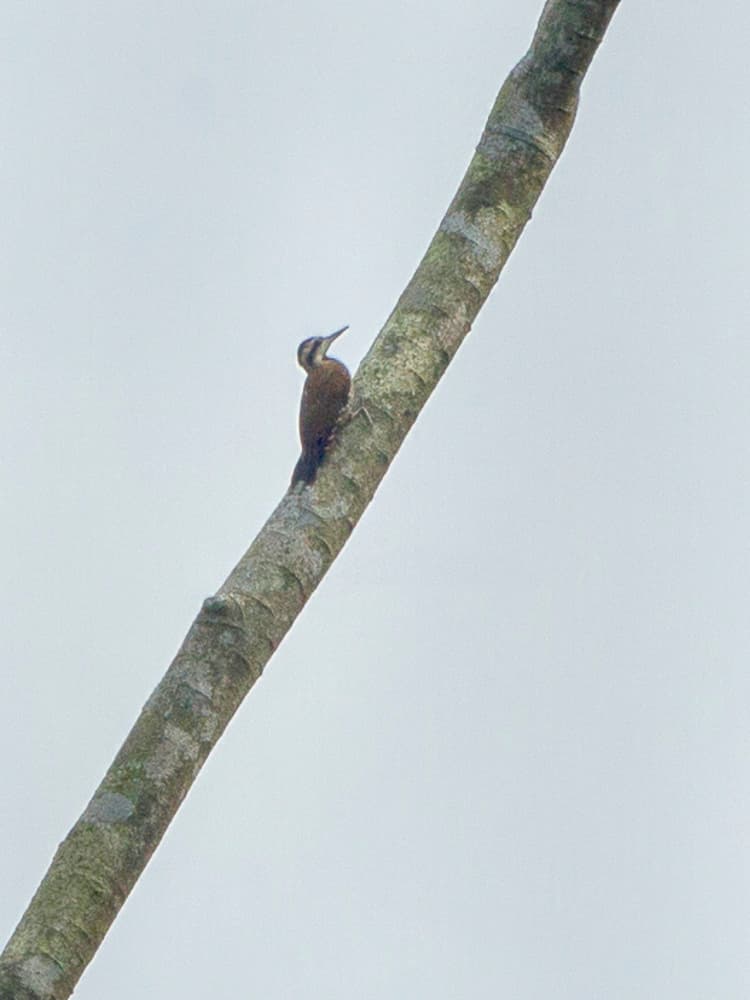
The fire-bellied woodpecker is a bird species found across tropical West Africa, inhabiting various wooded environments from primary rainforest edges to savannahs. It is characterized by its olive-bronze upperparts, crimson rump, and a striking scarlet belly, with males displaying a red crown and females a black one. This species is common and its population is considered stable or increasing, leading to a 'least concern' conservation status.

White woodpecker
The White woodpecker is a striking South American bird recognized by its bright white plumage, black wings, and a small, distinct yellow eye patch. It inhabits wooded grasslands and various open woodland environments across a wide range of South America, from Suriname and French Guiana down to Argentina. This species is noted for its varied diet and adaptability to different habitats, including urban areas.