
Blond-crested woodpecker
The Blond-crested Woodpecker is a striking bird found in the forests, savannas, and orchards of Argentina, Brazil, and Paraguay. This species is characterized by its pale creamy buff to yellowish white head and long, pointed crest, contrasting with its black mantle and underparts. It primarily feeds on ants and termites, often foraging in pairs or small groups.
Key Facts
- ›Inhabits humid forests, gallery forests, savannas, caatinga, and orchards.
- ›Diet consists mainly of arboreal ants, carpenter ants, and termites, supplemented with fruits and berries.
- ›Forages by gleaning, probing, pecking, and hammering, typically in the middle to canopy levels of trees.
- ›Males have a bright red malar area and cheek, while females have black streaks instead.
- ›Nests are excavated in trees or arboreal ant nests.
- ›Considered Least Concern by the IUCN, though its population is believed to be decreasing.

Yellow-Crested Woodpecker
South America
Long, pointed crest, Bright red malar area and cheek in males, Black streaks on malar and cheek in females, Black mantle, Pale lower back and rump
Ants, Carpenter Ants, Termites, Fruits, Berries
Gleaning, Probing, Pecking, Hammering, Forages In Pairs Or Small Groups
Excavated Nest Cavity In A Tree, Arboreal Ant Nest
- Resonant loud 'tsew' or 'wee' repeated up to seven times
- Well-spaced series of 'wheep' notes
- Aggressive 'tttrrr'
- Raucous 'wícket wícket'
- Weak, evenly pitched short drum rolls
About Blond-crested woodpecker
The Blond-crested Woodpecker (Celeus flavescens) is a species of bird belonging to the woodpecker family, Picidae. This species is native to South America, with its range encompassing Argentina, Brazil, and Paraguay. It is typically found in the interior and edges of humid forests, as well as gallery forests, savannas, caatinga, and orchards.
Description and Identification
Adult Blond-crested Woodpeckers measure approximately 27 to 30 cm (11 to 12 inches) in length. A notable characteristic is their pale creamy buff to yellowish white head, which features a long, pointed crest. The mantle and upper back are black, contrasting with a buffish white to pale yellow lower back and rump. Flight feathers are black with narrow white bars. Males are distinguished by a wide, bright red malar area and cheek, which can sometimes extend around the eye and onto the lower forehead. Females, in contrast, have black streaks instead of red on the malar and cheek, and lack red coloration elsewhere on the head.
Diet and Behavior
The diet of the Blond-crested Woodpecker primarily consists of arboreal ants, carpenter ants, and termites. They also supplement their diet with fruits and berries. Foraging typically occurs at the middle level to the canopy of the forest, but they also forage on the ground. Their feeding methods include gleaning, probing, pecking, and hammering to extract insects. They are generally observed feeding in pairs or small groups.
Reproduction and Habitat
The species excavates its nest cavity in a tree or an arboreal ant nest. The breeding season varies geographically, occurring between April and June in eastern Brazil and between October and November in Argentina. The Blond-crested Woodpecker is a year-round resident throughout its range.
Conservation Status
The International Union for Conservation of Nature (IUCN) has assessed the Blond-crested Woodpecker as Least Concern. Despite its broad distribution, the population size is not precisely known and is believed to be decreasing. No immediate threats have been identified, and the species is generally not uncommon, being locally fairly common and present in several protected areas.
Source: Wikipedia ↗
Frequently Asked Questions
What is the scientific name of the Blond-crested Woodpecker?
The scientific name of the Blond-crested Woodpecker is *Celeus flavescens*. This binomial name was established by Johann Friedrich Gmelin in 1788.
Where can the Blond-crested Woodpecker be found?
The Blond-crested Woodpecker has a range that includes Argentina, Brazil, and Paraguay. It inhabits various environments from humid forests to savannas and orchards within these regions.
What does the Blond-crested Woodpecker eat?
The primary diet of the Blond-crested Woodpecker consists of arboreal ants, carpenter ants, and termites. They also consume fruits and berries, though in lesser quantities.
How does the Blond-crested Woodpecker forage for food?
This woodpecker forages at middle to canopy levels of forests, and also on the ground. Its feeding methods include gleaning, probing, pecking, and hammering to extract insects.
What are the distinctive physical features of the Blond-crested Woodpecker?
Adults of both sexes typically have a pale creamy buff to yellowish white head with a long, pointed crest. Males are distinguished by a wide bright red malar area and cheek, while females have black streaks in these areas.
What is the conservation status of the Blond-crested Woodpecker?
The Blond-crested Woodpecker is listed as Least Concern by the IUCN. However, its population size is unknown and is believed to be decreasing, with no immediate threats identified.
Related Woodpecker species

Ochre-backed woodpecker
The ochre-backed woodpecker is a species found exclusively in Brazil, inhabiting humid forests, savannas, and orchards. Adults are characterized by their buffy to ochre heads and crests, with variable black markings on cinnamon-buff upperparts, and sooty underparts. They are known for their arboreal ant diet and distinctive calls.

Kaempfer's woodpecker
Kaempfer's woodpecker, also known as the Piauí woodpecker, is a species endemic to Brazil. This bird is characterized by its rufous-red head with a bushy crest and a yellow to creamy buff back with black bars. Its diet primarily consists of ants found in bamboo, and it inhabits areas associated with bamboo growth in Cerrado and babassu palm forests.
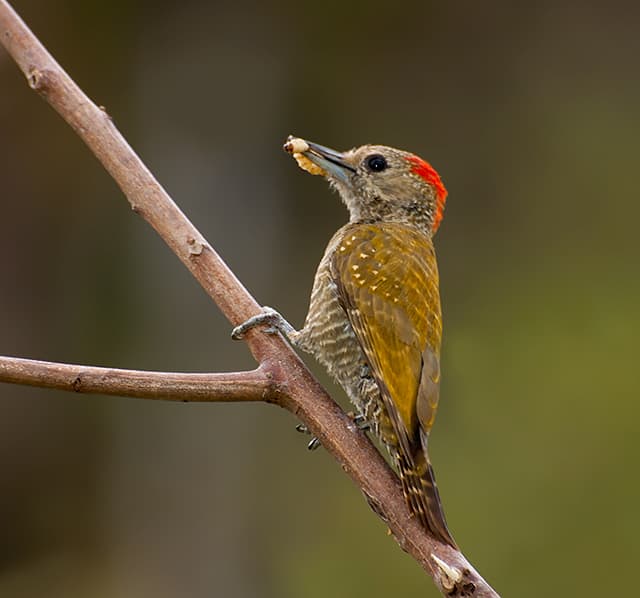
Little woodpecker
The little woodpecker (Veniliornis passerinus) is a small South American bird found in a wide variety of wooded habitats, generally avoiding dense forest interiors. Males and females share similar plumage, with males displaying red on their heads. This adaptable species is widespread across the continent and is currently listed as Least Concern.