
Brown-eared woodpecker
The brown-eared woodpecker (Pardipicus caroli) is a species of bird native to the African tropical rainforest. This relatively shy bird is characterized by its distinct plumage, including a buff supercilium and rufous-brown patch behind the eye, and is found in dense forests, plantations, and riverine areas across numerous African countries.
Key Facts
- ›Native to the African tropical rainforest, with a wide distribution across many countries.
- ›Distinguished by a buff supercilium and a rufous-brown patch behind the eye.
- ›Males have a red hind-crown, which is absent in females.
- ›Inhabits dense tropical forests, plantations, riverine forests, and grassy woodlands.
- ›Forages for ants and other small invertebrates among vines and undergrowth.
- ›Conservation status is listed as 'least concern'.

Pardipicus Caroli
Africa
Tropical Rainforest, Primary Forest, Secondary Forest, Plantations, Riverine Forests, Grassy Woodland
Buff Supercilium, Rufous-Brown Patch Behind the Eye, Red Hind-Crown
Ants, Small Invertebrates
Forages Among Vines, Forages In Undergrowth
About Brown-eared woodpecker
The brown-eared woodpecker, scientifically known as Pardipicus caroli, is a bird species belonging to the family Picidae. It is a resident of the African tropical rainforests and is considered a common species in many parts of its extensive range. The International Union for Conservation of Nature (IUCN) has classified its conservation status as 'least concern', reflecting its stable population.
Description and Identification
This woodpecker exhibits distinct plumage. Adult males are identifiable by a dark brown fore-crown and a notable red hind-crown, a feature absent in females, though both sexes are similar in other respects. Both share a buff supercilium and a large patch of rufous-brown color situated behind the eye and extending over the ear coverts. The upperparts, including the mantle, back, and wings, are a consistent olive-brown, while the tail is deep brown with white speckling on its outer feathers. The facial and throat areas are an olive-green, speckled with white. The breast and belly present an olive-green base streaked with buff, yellow, or white. The bird possesses a long, bluish-grey beak, olive-colored legs, and chestnut irises.
Distribution and Habitat
The brown-eared woodpecker is found across a wide swathe of Africa, with recorded occurrences in countries such as Angola, Cameroon, the Central African Republic, the Republic of the Congo, the Democratic Republic of the Congo, Ivory Coast, Equatorial Guinea, Gabon, Ghana, Guinea, Guinea-Bissau, Kenya, Liberia, Nigeria, Sierra Leone, South Sudan, Tanzania, Uganda, and Zambia. Its preferred habitat consists of dense tropical forests, encompassing both primary and secondary growth, particularly areas characterized by dangling vines and thick undergrowth. The species also frequents plantations, riverine forests, and more open environments that feature grassy woodland.
Behavior and Ecology
Described as a rather shy bird, the brown-eared woodpecker engages in foraging for ants and other small invertebrates. Its feeding behavior involves searching among vines and the dense undergrowth of its forest habitat.
Source: Wikipedia ↗
Frequently Asked Questions
What are the key physical characteristics of the brown-eared woodpecker?
The brown-eared woodpecker has a buff supercilium and a prominent rufous-brown patch behind the eye and over the ear coverts. Its mantle, back, and wings are olive-brown, and the tail is deep brown with white speckling on the outer feathers. The face and throat are olive-green speckled with white, while the breast and belly are olive green streaked with buff, yellow, or white.
How does the male brown-eared woodpecker differ from the female?
The primary difference between the sexes is the crown coloration. The male brown-eared woodpecker possesses a dark brown fore-crown and a distinct red hind-crown, whereas the female lacks the red coloration on the hind-crown.
What is the typical habitat of the brown-eared woodpecker?
This species is found in dense tropical forests, including both primary and secondary growth, especially areas with dangling vines and thick regrowth. It also adapts to habitats such as plantations, riverine forests, and more open locations with grassy woodland.
What does the brown-eared woodpecker eat and how does it find food?
The brown-eared woodpecker primarily forages for ants and other small invertebrates. It typically searches for its food among the vines and within the undergrowth of its forest habitat.
What is the conservation status of the brown-eared woodpecker?
The International Union for Conservation of Nature (IUCN) has rated the conservation status of the brown-eared woodpecker as 'least concern'. This indicates that the species is widespread and common in some areas, with no immediate threats to its population.
Related Woodpecker species

Guadeloupe woodpecker
The Guadeloupe woodpecker (Melanerpes herminieri), also known locally as Tapeur, is a medium-sized, entirely black bird endemic to the Guadeloupe archipelago. It inhabits tropical rainforests and has adapted to more open forest areas due to urbanization. This species is notable for its distinct drumming, solitary nature, and unique adaptations for absorbing impact when pecking wood.

Sind woodpecker
The Sind woodpecker is a medium-sized bird found in Pakistan, India, and southern Iran. It is characterized by its black and white plumage, distinct white shoulder patches, and a thin moustachial stripe. This species primarily inhabits dry forests, shrublands, and wetlands.
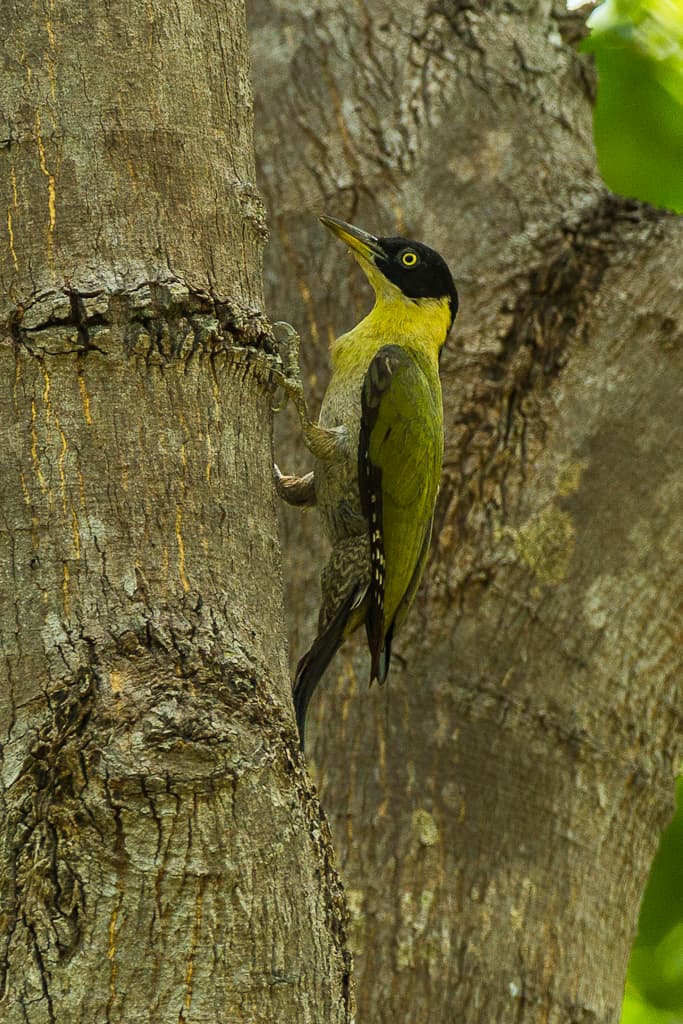
Black-headed woodpecker
The black-headed woodpecker is a medium-sized bird found in Cambodia, Laos, Myanmar, Thailand, and Vietnam, inhabiting deciduous and coniferous forests. It is characterized by its distinct plumage, including a black face, yellow throat, green wings, and a red lower back, with males possessing a red crown and females a black one. This species is insectivorous, primarily feeding on termites and ants, and is known for its loud, yelping vocalizations.