
Black-headed woodpecker
The black-headed woodpecker is a medium-sized bird found in Cambodia, Laos, Myanmar, Thailand, and Vietnam, inhabiting deciduous and coniferous forests. It is characterized by its distinct plumage, including a black face, yellow throat, green wings, and a red lower back, with males possessing a red crown and females a black one. This species is insectivorous, primarily feeding on termites and ants, and is known for its loud, yelping vocalizations.
Key Facts
- ›Inhabits deciduous and coniferous forests across Southeast Asia.
- ›Adults have distinctive black faces, yellow throats, and green wings.
- ›Males have red crowns, while females have entirely black crowns.
- ›Primarily insectivorous, feeding on termites, ants, and other invertebrates.
- ›Known for loud, yelping songs resembling laughter.
- ›Classified as Least Concern, but populations are declining due to habitat destruction.
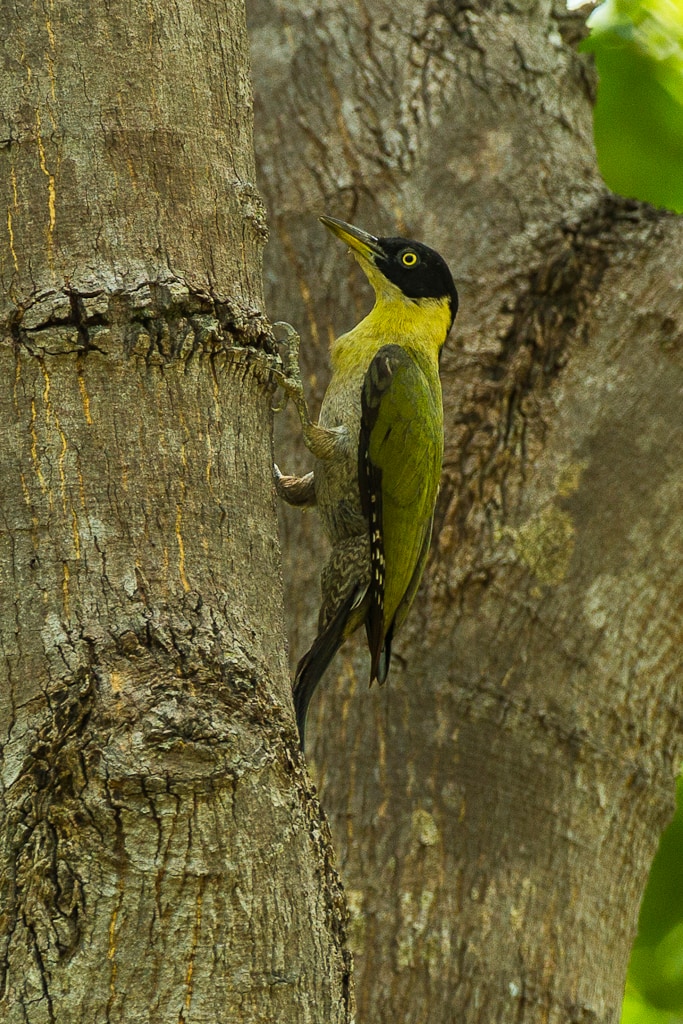
Black-Headed Woodpecker
Asia
Deciduous Forests, Coniferous Forests, Dry Dipterocarp Forests, Semi-Evergreen Forests, Riverine Forests, Savanna Forests
Black face, Yellow throat, Green wings, Red lower back, White stomach, White/yellow eyes, Thin white line from eye to neck, Red crown, Black crown
Termites, Ants, Insects, Invertebrates
Glean insects on the bark of trees
Within Trees
- Loud series of yelps resembling laughter
- Rapidly repeated yelps with an emphasized first note
About Black-headed woodpecker
The black-headed woodpecker (Picus erythropygius) is a medium-sized bird belonging to the woodpecker family, Picidae. It is found across Southeast Asia, with populations in Cambodia, Laos, Myanmar, Thailand, and Vietnam. This species typically inhabits the mid-story and sub-canopy of various forest types, including deciduous, coniferous, dry dipterocarp, semi-evergreen, riverine, and savanna forests.
Description and Identification
Adult black-headed woodpeckers measure approximately 33 cm in height and weigh between 100 and 135 grams. Their plumage is notably distinct: they possess a black face, a yellow throat, green wings, a red lower back, and a white stomach. Their eyes are white or yellow, and some individuals exhibit a thin white line extending from their eye to their neck. A key sexual dimorphism is present in their crowns; males sport a red crown, while females have a completely black crown. Juveniles are less vividly colored than adults, with juvenile males showing fewer red feathers on their heads.
Taxonomy and Subspecies
As a member of the genus Picus, the black-headed woodpecker has historically been considered closely related to the European green woodpecker (P. viridis) and the grey-headed woodpecker (P. canus), though recent studies have begun to challenge these phylogenetic links. Two subspecies are recognized: Picus erythropygius nigrigenis, found in Myanmar and Northwest Thailand, identifiable by its black bill, and Picus erythropygius erythropygius, inhabiting Northeast Thailand and Indochina, which is distinguished by its white bill.
Behavior and Ecology
These woodpeckers are primarily insectivorous, foraging by gleaning insects from tree bark. Their diet predominantly consists of termites, but they also consume ants and other insects and invertebrates. Their vocalizations are characterized by loud, yelping calls that resemble laughter, often described as rapidly repeated "ka-tek-a-tek-a-tek-a-tek" or "cha-cha-cha, cha-cha-cha," with the initial note being emphasized. Black-headed woodpeckers are generally found in mixed-species flocks, which can include species like white-crested laughingthrushes and greater racket-tailed drongos. These larger flock sizes are thought to reduce predator vigilance, allowing more time for foraging.
Reproduction and Conservation
Reproduction in black-headed woodpeckers occurs between February and June, with nests typically constructed within trees. They lay clutches of about 3 to 4 eggs. Observations in a wildlife sanctuary in Chiang Mai indicated nest occupancy in May. While the species is currently classified as Least Concern, its populations are declining due to habitat destruction driven by human settlements and agricultural expansion. In recognition of its vulnerability, the Thai government declared the black-headed woodpecker a protected wildlife species in 2003. The species is also present in numerous wildlife sanctuaries across Thailand.
Source: Wikipedia ↗
Frequently Asked Questions
What does the black-headed woodpecker look like?
Adult black-headed woodpeckers are about 33 cm tall and feature a black face, yellow throat, green wings, and a red lower back, with a white stomach. Males are distinguished by a red crown, while females have a completely black crown.
Where can I find black-headed woodpeckers?
These woodpeckers are found in Cambodia, Laos, Myanmar, Thailand, and Vietnam. They prefer the mid-story and sub-canopy of deciduous and coniferous forests, including dry dipterocarp, semi-evergreen, riverine, and savanna forests.
What do black-headed woodpeckers eat?
Like most woodpeckers, they are insectivorous and glean insects from tree bark. Their primary food source is termites, but they also consume ants and other insects and invertebrates.
What sounds do black-headed woodpeckers make?
Their vocalization is described as a loud series of yelps that sound similar to laughing. These rapid yelps, often transcribed as "ka-tek-a-tek-a-tek-a-tek" or "cha-cha-cha, cha-cha-cha," emphasize the first note.
What is the conservation status of the black-headed woodpecker?
The black-headed woodpecker is currently classified as Least Concern by conservation authorities. However, its populations are experiencing a decrease, largely attributed to habitat destruction from human settlements and agricultural expansion.
Are there different types of black-headed woodpeckers?
Yes, there are two recognized subspecies: Picus erythropygius nigrigenis, found in Myanmar and Northwest Thailand, which has a black bill, and Picus erythropygius erythropygius, found in Northeast Thailand and Indochina, which has a white bill.
Related Woodpecker species
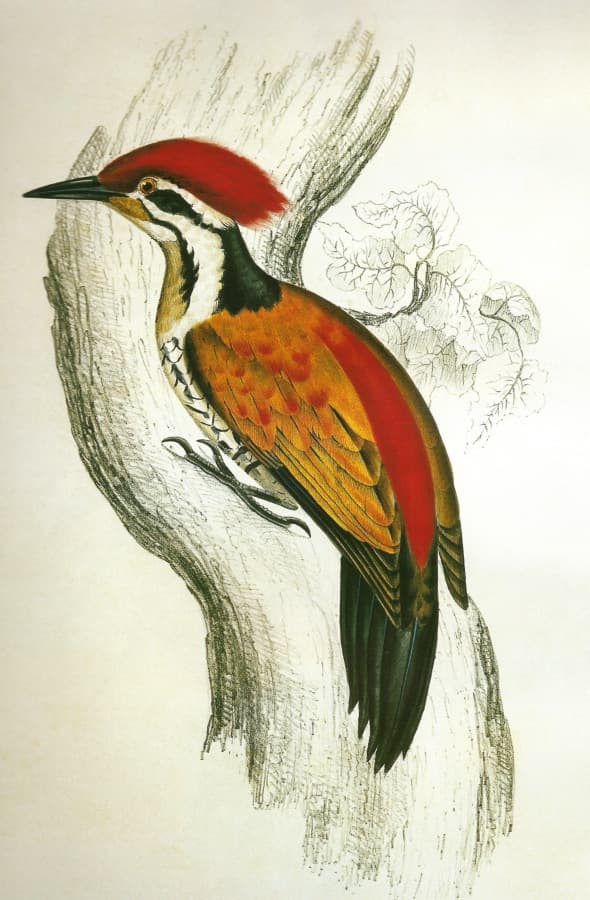
Himalayan flameback
The Himalayan flameback is a woodpecker species found across the Indian subcontinent, primarily inhabiting Himalayan sal forests and other tropical and subtropical woodlands. It is characterized by its black hind neck, distinctive throat markings, and coppery-brown to red wings. While not currently threatened, deforestation poses a potential risk to its populations.

Japanese pygmy woodpecker
The Japanese pygmy woodpecker is a small woodpecker species found in coniferous and deciduous forests across East Asia, including Russia, China, Korea, and Japan. It is characterized by its grey-brown crown, white supercilium, and dark brown back with white barring. This species is known for its varied diet of invertebrates and berries, as well as its distinctive high-pitched call and rapid drumming.

Brown-eared woodpecker
The brown-eared woodpecker (Pardipicus caroli) is a species of bird native to the African tropical rainforest. This relatively shy bird is characterized by its distinct plumage, including a buff supercilium and rufous-brown patch behind the eye, and is found in dense forests, plantations, and riverine areas across numerous African countries.