
Sind woodpecker
Not Evaluated
The Sind woodpecker is a medium-sized bird found in Pakistan, India, and southern Iran. It is characterized by its black and white plumage, distinct white shoulder patches, and a thin moustachial stripe. This species primarily inhabits dry forests, shrublands, and wetlands.
Key Facts
- ›Resembles the Syrian woodpecker but is slightly smaller.
- ›Males possess a red crown, while females have an all-black crown.
- ›Feeds mainly on insects, including woodboring beetles, larvae, spiders, and ants.
- ›Breeds between March and April, with both parents involved in raising young.
- ›Nests are excavated in tree holes by the breeding pair.
- ›Population trend is generally stable, though it is rare in its Indian range.

Sind Woodpecker
Pakistan, India, Iran
Tropical and Subtropical Dry Forests, Riverine Forests, Thorny Shrub-Lands, Dry Scrub-Lands, Wetlands, Rural Gardens, Plantations
Thin Moustachial Stripe, Extensive White Feathers On the Back, Large White Shoulder Patches, White Bars On Black Feathers, Red Under-Tail Coverts
Insects, Woodboring Beetles, Larvae, Spiders, Ants
Tree Holes
About Sind woodpecker
The Sind Woodpecker
The Sind woodpecker, scientifically known as Dendrocopos assimilis, is a distinctive bird species belonging to the woodpecker family, Picidae. It is a resident species found across parts of South Asia and the Middle East, primarily in the Sindh province of Pakistan, the westernmost regions of India, and southern Iran. This woodpecker is notable for its striking black and white plumage, which sets it apart in its natural environment.
Description and Identification
Visually, the Sind woodpecker shares similarities with the Syrian woodpecker but is slightly smaller, typically measuring between 20 and 22 cm in length. Key identifying features include a thin moustachial stripe, prominent white shoulder patches, and white bars adorning its black feathers. Males are distinguished by a red crown accented with a fine black line on the sides, whereas females possess an entirely black crown. Both sexes share a white forehead. A characteristic feature, common to many Dendrocopos species, is the presence of red under-tail coverts. In most of its geographic range, the Sind woodpecker is the only black and white woodpecker present, although it overlaps with the yellow-crowned woodpecker in specific areas of east-central Pakistan and westernmost India.
Distribution and Habitat
This species is found in a variety of natural and semi-natural environments. While they can be observed up to an altitude of 2,200 meters, they also frequent rural gardens and plantations. Their preferred natural habitats include tropical and subtropical dry forests, riverine forests, thorny shrub-lands, and dry scrub-lands. They are also associated with wetlands, such as freshwater springs and oases, indicating a reliance on water sources within their territories.
Diet and Foraging
The diet of the Sind woodpecker is predominantly insectivorous. They consume a range of invertebrates, with a particular focus on woodboring beetles and their larvae. Spiders and ants also form a significant part of their food intake. They forage by tapping and probing into wood and bark to locate their prey.
Reproduction and Life Cycle
The breeding season for the Sind woodpecker typically spans from March to April. These birds are monogamous, with both parents actively participating in the incubation of eggs and the subsequent care of their young. They excavate their nest holes in tree cavities. A clutch usually consists of 3 to 5 eggs, which are incubated by both parents. The chicks hatch approximately 12 days after incubation begins, and they fledge, or become capable of flying, around 20 days later. After fledging, the young birds disperse to establish their own territories.
Conservation Status and Threats
The global population of the Sind woodpecker has not yet been evaluated by conservation organizations. However, the species' population trend is generally considered stable. While locally common throughout much of its range, it is notably rare within its limited territory in India. A primary threat to the Sind woodpecker is deforestation, which directly impacts its habitat availability and the food sources it relies upon. The average lifespan of an individual is recorded at approximately 5.2 years.
Source: Wikipedia ↗
Frequently Asked Questions
What are the key differences between the Sind woodpecker and the Syrian woodpecker?
The Sind woodpecker is slightly smaller than the Syrian woodpecker. It also features a thin moustachial stripe, more extensive white feathers on its back, and a smaller beak compared to its Syrian counterpart.
Where can the Sind woodpecker be found?
This species is native to the Sindh province of Pakistan, the far west of India, and southern Iran. They are found in various habitats including dry forests, shrublands, and near wetlands.
What does the Sind woodpecker eat?
The diet of the Sind woodpecker primarily consists of insects. This includes woodboring beetles, their larvae, spiders, and ants, which they forage for in their habitat.
When is the breeding season for the Sind woodpecker?
The breeding season for the Sind woodpecker typically occurs between March and April. Both parents are monogamous and share responsibilities in raising the young.
What are the nesting habits of the Sind woodpecker?
Sind woodpeckers are cavity nesters, excavating their nest holes in trees. Both members of the breeding pair work together to create these nesting sites.
What is the conservation status and population trend of the Sind woodpecker?
The global population of the Sind woodpecker has not been formally evaluated. However, the general population trend is reported as stable, though the species is considered rare in its Indian range.
Related Woodpecker species

Brown-eared woodpecker
The brown-eared woodpecker (Pardipicus caroli) is a species of bird native to the African tropical rainforest. This relatively shy bird is characterized by its distinct plumage, including a buff supercilium and rufous-brown patch behind the eye, and is found in dense forests, plantations, and riverine areas across numerous African countries.
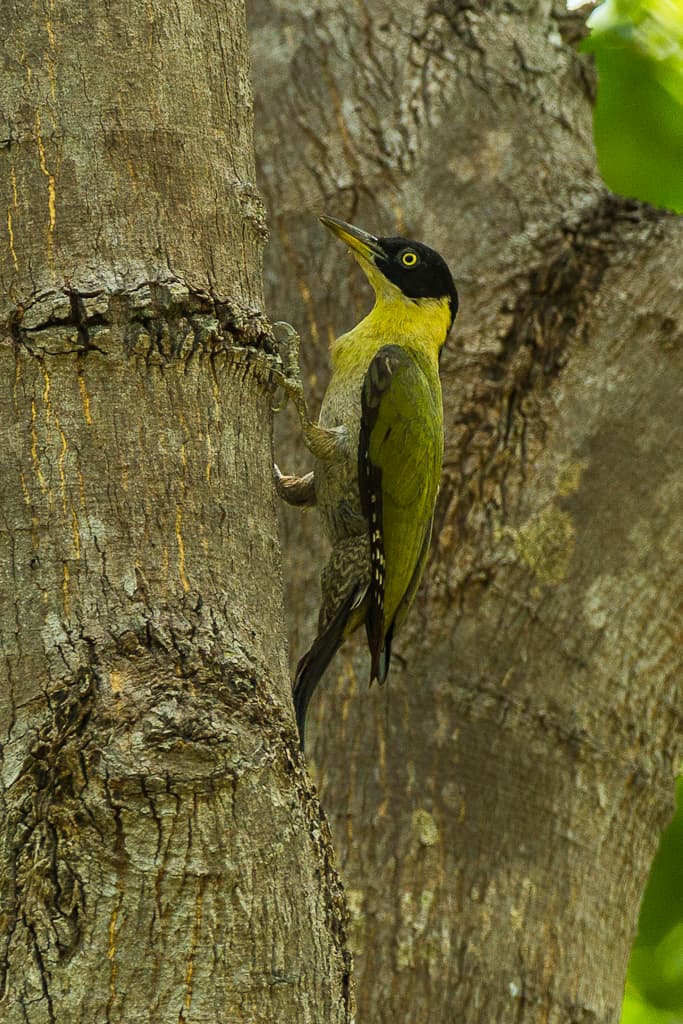
Black-headed woodpecker
The black-headed woodpecker is a medium-sized bird found in Cambodia, Laos, Myanmar, Thailand, and Vietnam, inhabiting deciduous and coniferous forests. It is characterized by its distinct plumage, including a black face, yellow throat, green wings, and a red lower back, with males possessing a red crown and females a black one. This species is insectivorous, primarily feeding on termites and ants, and is known for its loud, yelping vocalizations.

Japanese pygmy woodpecker
The Japanese pygmy woodpecker is a small woodpecker species found in coniferous and deciduous forests across East Asia, including Russia, China, Korea, and Japan. It is characterized by its grey-brown crown, white supercilium, and dark brown back with white barring. This species is known for its varied diet of invertebrates and berries, as well as its distinctive high-pitched call and rapid drumming.