
Cardinal woodpecker
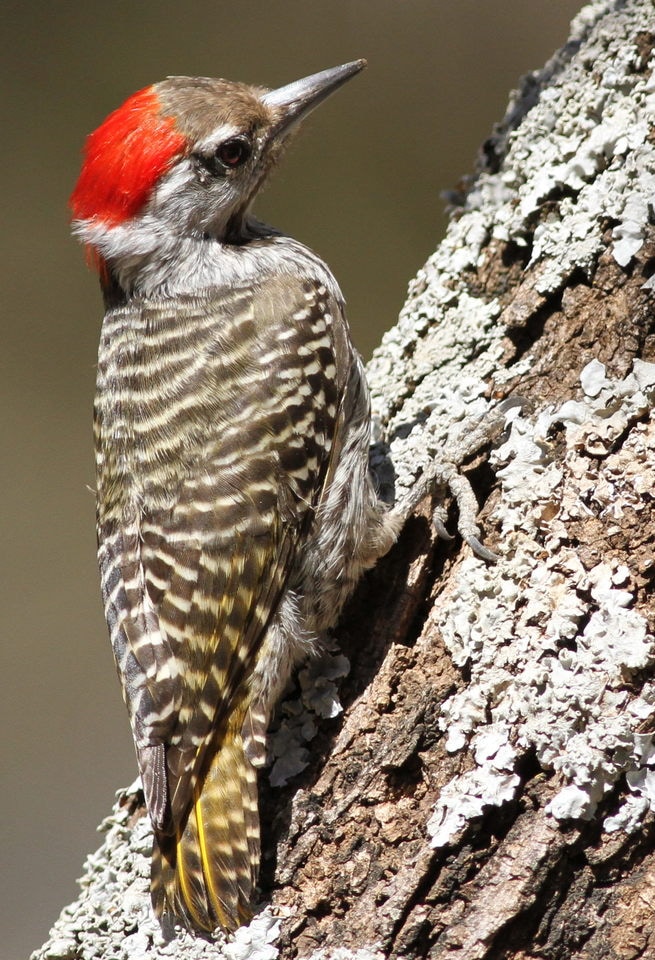
The cardinal woodpecker is a common and widespread resident breeder found across much of sub-Saharan Africa. This small woodpecker inhabits diverse environments, from dense forests to thorn bushes, and is easily identified by its distinctive call. Both sexes and juveniles can be distinguished by their head patterns, with males typically sporting a red hind crown.
Key Facts
- ›Widespread and common resident breeder in sub-Saharan Africa.
- ›Found in habitats ranging from dense forest to thorn bush.
- ›Distinguished by sex and age through head patterns.
- ›Feeds primarily on tree-boring insects extracted with a long tongue.
- ›Nests in unlined tree holes, often excavating a new one each season.
- ›Conservation status is 'least concern' due to its wide range and commonality.
Sub-Saharan Africa, Western Africa, Central Africa, Eastern Africa, Southern Africa
Dense Forest, Thorn Bush, Lower Storeys of Trees, Shrubs, Vines, Maize Stalks, Reeds
Sex- and Age-Distinguishable Head Patterns, Conspicuous Black Malar Stripe, Small Crest Raised When Excited, Long, Adhering Tongue
Tree-Boring Insects
- Extracts insects from holes in wood or bark using adhering tongues
- Forages in lower storeys of trees and among shrubs and vines
- Pecks rapidly
- Probes dense vegetation
- Clambers along and hangs from small twigs
Tree Hole
Call Notes, High-Pitched Krrrek-Krrrek-Krrrek, Drums Softly
About Cardinal woodpecker
The cardinal woodpecker, scientifically known as Dendropicos fuscescens, is a common and widely distributed bird species found throughout much of sub-Saharan Africa. Its adaptability allows it to thrive in a broad spectrum of habitats, from dense forests to sparser thorn bush environments. The species is notably vocal, with its distinctive call notes serving as a key identifier. Furthermore, the cardinal woodpecker exhibits sexual dimorphism in its head patterns, allowing for easy differentiation between males and females.
Description and Identification
Physically, the cardinal woodpecker is a small bird, measuring approximately 14 to 15 centimeters from bill tip to tail. Its body shape is typical of woodpeckers, featuring a straight, pointed bill, stiff tail feathers for support, and zygodactyl feet. The back plumage is a dull olive, adorned with paler dots and bands, while the underparts are white and heavily streaked with black. The rump is tawny, and a prominent black malar stripe separates the white throat and face. The fore crown is olive brown. A small crest atop the head can be raised when the bird is excited. Adult males possess a red hind crown and nape, whereas females have a dark hind crown and black nape. Juvenile males share the red hind crown but have a black nape.
Distribution and Habitat
The cardinal woodpecker's native range covers tropical regions of western and central Africa, encompassing a vast number of countries. They are found in a wide array of environments, demonstrating a preference for areas with sufficient trees and vegetation for foraging and nesting.
Behavior and Ecology
These woodpeckers are often observed in small family groups or may associate with mixed-species flocks. Their foraging behavior primarily takes place in the lower sections of trees, as well as among shrubs and vines. They are adept at pecking rapidly and probing dense vegetation, often clambering along or hanging from small twigs. Like other woodpeckers, they are insectivores, using their specialized, adhering tongues to extract insects from wood or bark. The species frequently drums softly, and its characteristic call is a high-pitched "krrrek-krrrek-krrrek."
Breeding Habits
The breeding season for cardinal woodpeckers typically occurs in spring or early summer. A notable aspect of their nesting behavior is the excavation of a new breeding cavity each season, a process that can take several weeks. These nest entrances are usually oval-shaped and positioned around two meters above the ground. The nest itself is unlined, save for wood chippings. Females lay between one and three glossy white eggs at one-day intervals, and incubation begins with the first egg. Both parents share responsibilities for incubation, brooding, and feeding the chicks. The incubation period lasts approximately 12 days, with fledglings leaving the nest after about 27 days. Parental care continues for an additional 8–10 weeks. The scaly-throated honeyguide is known to be a nest parasite of this species.
Conservation Status
The cardinal woodpecker boasts an extremely wide geographic range and is considered common throughout most of its distribution. No significant threats have been identified, leading the International Union for Conservation of Nature (IUCN) to classify its conservation status as 'least concern'.
Source: Wikipedia ↗
Frequently Asked Questions
What is the scientific name for the cardinal woodpecker?
The scientific name for the cardinal woodpecker is Dendropicos fuscescens. It was first formally described in 1818 by Louis Pierre Vieillot.
What are the distinguishing features of a cardinal woodpecker?
Cardinal woodpeckers are small, measuring about 14 to 15 cm in length. They have a dull olive back with paler dots and bands, white underparts heavily streaked with black, and a tawny rump. Sexes and juveniles are identifiable by their head patterns, with males often having a red hind crown.
What do cardinal woodpeckers eat?
Their primary diet consists of tree-boring insects. They use their long, adhering tongues to extract these insects from holes in wood or bark.
Where are cardinal woodpeckers found?
This species is native to tropical parts of western and central Africa, with a range spanning numerous countries including Angola, Ethiopia, Kenya, and South Africa. They inhabit a variety of habitats, from dense forests to thorn bushes.
How do cardinal woodpeckers nest?
Cardinal woodpeckers nest in tree holes, which are typically unlined except for wood chippings. They often excavate a new cavity each breeding season, with the entrance hole usually situated about 2 meters from the ground.
What is the conservation status of the cardinal woodpecker?
The cardinal woodpecker is listed as 'least concern' by the IUCN. This is due to its extremely wide range and its common presence throughout much of its distribution.
Related Woodpecker species

Chestnut-colored woodpecker
The Chestnut-colored woodpecker is a medium-sized bird found in the humid forests of Middle America, from Mexico to Panama. It is characterized by its rufous-chestnut upperparts, black-marked underparts, and a distinctive pointed crest. Primarily feeding on ants and termites, this species plays a role in forest ecosystems despite facing threats from habitat loss.

Arrowhead piculet
The Arrowhead piculet is a small bird belonging to the woodpecker family, characterized by its distinctive plumage and a varied diet. It is found in the Guianas region of South America, inhabiting a range of environments from mangroves to montane forests.

Bearded woodpecker
The bearded woodpecker is a large African bird characterized by its striking black and white head with a distinct black moustache and eye-stripe, contrasting with a brownish, barred body. It inhabits a wide variety of wooded environments across tropical central Africa and is considered a fairly common species with a 'least concern' conservation status.