
Chestnut-colored woodpecker
The Chestnut-colored woodpecker is a medium-sized bird found in the humid forests of Middle America, from Mexico to Panama. It is characterized by its rufous-chestnut upperparts, black-marked underparts, and a distinctive pointed crest. Primarily feeding on ants and termites, this species plays a role in forest ecosystems despite facing threats from habitat loss.
Key Facts
- ›Found on the Caribbean side of Middle America, from southern Mexico to Panama.
- ›Primarily inhabits humid evergreen and semi-deciduous forests, but also mangroves and coastal scrub.
- ›Feeds mainly on ants and termites, supplemented by other insects and fruit.
- ›Characterized by rufous-chestnut upperparts, black-marked chestnut underparts, and a pointed crest.
- ›Breeding season varies across its range; both sexes excavate nest cavities, usually in trees.
- ›Assessed as Least Concern by the IUCN, but population is believed to be decreasing due to habitat loss.

Belize, Costa Rica, Guatemala, Honduras, Mexico, Nicaragua, Panama
Humid Evergreen Forests, Semi-Deciduous Forests, Mangroves, Coastal Scrub
Rufous-Chestnut, Cinnamon-Buff, Black, Dull Ochraceous, Tawny, Red
- Pointed crest
- Rufous-chestnut upperparts with black bars
- Chestnut underparts with black 'v' or 'u' shapes
- Males have red on face and throat
Ants, Termites
Forages In Canopy and Subcanopy, Forages Lower At Forest Edges, Pecks Into Tunnels, Pries Off Bark
Tree Cavities
- Falling skeew succeeded by a nasal keh, keh, keh
- Sharp 2-part wi-kah
- Nasal peahh
- Short series of rapid hollow taps
About Chestnut-colored woodpecker
The Chestnut-colored woodpecker (Celeus castaneus) is a species of bird belonging to the woodpecker family, Picidae. It is a resident bird found on the Caribbean side of Middle America, with its range extending from southern Mexico down through Belize, Guatemala, Honduras, Nicaragua, and Costa Rica, into Panama.
Description and Identification
This woodpecker measures between 21.5 and 25 cm in length and weighs 80 to 105 grams. A key characteristic is its pointed crest atop a dull ochraceous or tawny head. The upperparts are a rufous-chestnut color, featuring black bars on the back and rump. The underparts are chestnut and heavily marked with distinctive black 'V' or 'U' shapes. Males display bright red coloration from their lores to behind the eye and down to the throat, while females lack this red plumage. The bill is ivory-yellow with a blue-green tinge, the iris is chestnut or garnet brown, and the legs are dark olive to grayish.
Habitat and Distribution
The Chestnut-colored woodpecker primarily inhabits the interior and edges of humid evergreen and semi-deciduous forests. It can also be found in mangroves and coastal scrub areas, showing a preference for dense foliage. Its altitudinal range spans from sea level up to 1,000 meters in Mexico and 750 meters in Costa Rica.
Behavior and Diet
These woodpeckers are year-round residents within their range. Their diet consists mainly of ants and termites, though they also consume other insects and fruit. They typically forage alone or in pairs, seeking food in the canopy and subcanopy, and sometimes lower down at forest edges by pecking into tunnels and prying off bark.
Breeding and Vocalizations
The breeding season for the Chestnut-colored woodpecker varies across its geographic distribution, generally occurring between February and August. Both sexes participate in excavating nest cavities, which are most commonly found in trees. While few active nests have been described in detail, one documented clutch contained four eggs. Their vocalizations include a descending 'skeew' followed by a nasal 'keh, keh, keh,' a 'sharp 2-part wi-kah,' and a 'nasal peahh.' They also produce a 'short series of rapid hollow taps' when drumming.
Conservation Status
The International Union for Conservation of Nature (IUCN) has assessed the Chestnut-colored woodpecker as Least Concern. Despite having a large range and an estimated population of at least 50,000 mature individuals, the population is believed to be decreasing. The primary threat identified is habitat loss and degradation, which affects this species as it does other forest-dwelling birds.
Source: Wikipedia ↗
Frequently Asked Questions
What is the scientific name of the Chestnut-colored woodpecker?
The scientific name of the Chestnut-colored woodpecker is Celeus castaneus. This binomial nomenclature is used to classify this specific species within the broader scientific community.
Where is the Chestnut-colored woodpecker found geographically?
The Chestnut-colored woodpecker is distributed on the Caribbean side of Middle America. Its range extends from southern Veracruz in Mexico southward through Belize, Guatemala, Honduras, Nicaragua, and Costa Rica, reaching into Panama's Bocas del Toro Province.
What are the primary food sources for the Chestnut-colored woodpecker?
The primary diet of the Chestnut-colored woodpecker consists of ants and termites. They also consume smaller quantities of other insects and some fruit, foraging in the forest canopy and subcanopy.
What are the distinctive physical features of the Chestnut-colored woodpecker?
Adult Chestnut-colored woodpeckers measure 21.5 to 25 cm long and have rufous-chestnut upperparts with black bars on the back. Their underparts are chestnut heavily marked with black 'V' or 'U' shapes. Both sexes possess a dull ochraceous to tawny head with a pointed crest, with males having red on their face and throat while females lack red.
What is the conservation status of the Chestnut-colored woodpecker?
The Chestnut-colored woodpecker is listed as Least Concern by the IUCN. Although it has a large range and a substantial population, its numbers are believed to be declining due to habitat loss and degradation.
What types of habitats does the Chestnut-colored woodpecker prefer?
This species primarily inhabits the interior and edges of humid evergreen and semi-deciduous forests. It can also be found in mangroves and coastal scrub, showing a preference for dense foliage even at the forest's edge.
Related Woodpecker species
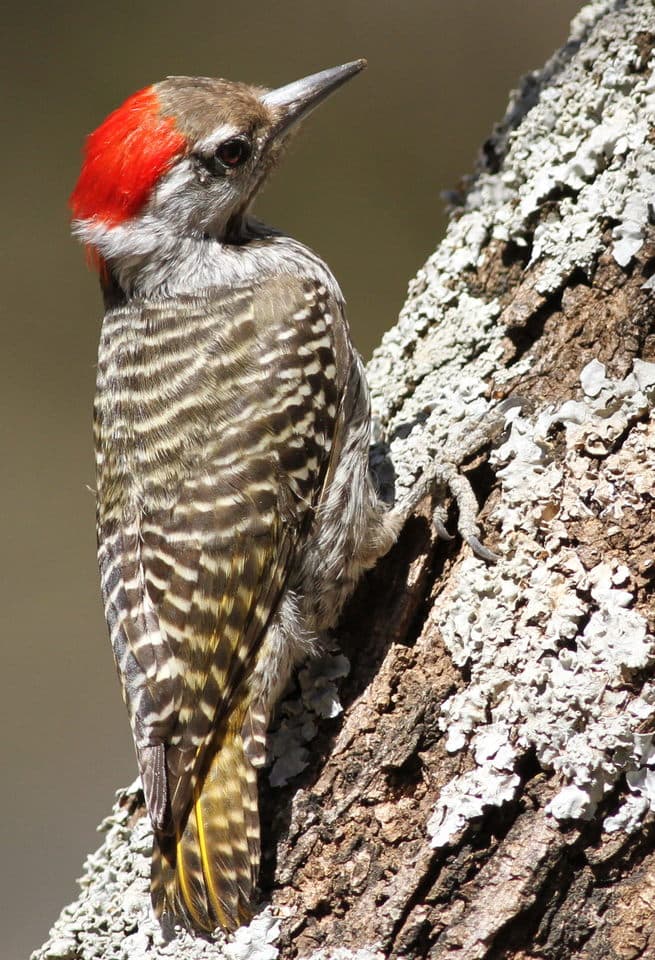
Cardinal woodpecker
The cardinal woodpecker is a common and widespread resident breeder found across much of sub-Saharan Africa. This small woodpecker inhabits diverse environments, from dense forests to thorn bushes, and is easily identified by its distinctive call. Both sexes and juveniles can be distinguished by their head patterns, with males typically sporting a red hind crown.
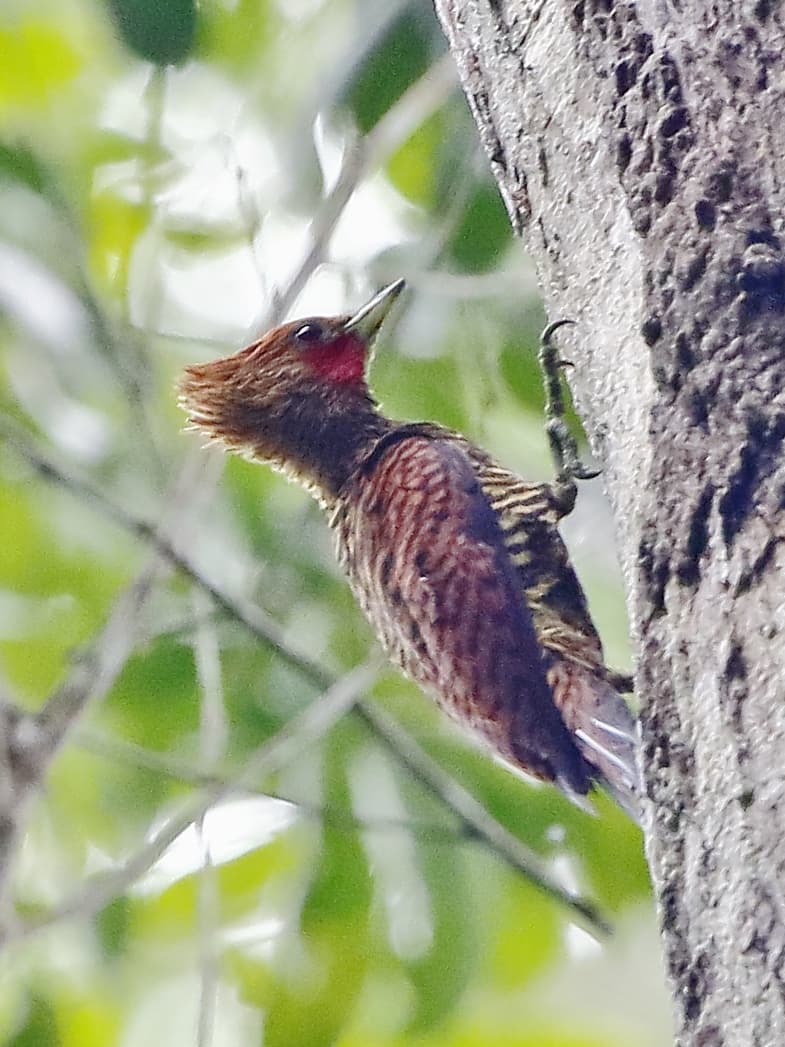
Waved woodpecker
The Waved Woodpecker (Celeus undatus) is a species found across much of northern South America, inhabiting various wooded landscapes from rainforest edges to savannas. It is characterized by its rufous-chestnut plumage, often marked with wavy black bars, and a distinctive crest. Primarily feeding on ants and termites, this species excavates its nest cavities in trees.

Yucatan woodpecker
The Yucatan woodpecker is a small bird found in the dry forests and shrublands of the Yucatán Peninsula and surrounding areas in Belize and Mexico. It is characterized by its light gray underparts, black and white barred back, and a distinctive red cap on males. This species is known for its unique vocalizations and its ability to forage in degraded habitats.