
Bearded woodpecker
The bearded woodpecker is a large African bird characterized by its striking black and white head with a distinct black moustache and eye-stripe, contrasting with a brownish, barred body. It inhabits a wide variety of wooded environments across tropical central Africa and is considered a fairly common species with a 'least concern' conservation status.
Key Facts
- ›Grows to a length of approximately 25 cm, making it one of Africa's larger woodpeckers.
- ›Features a distinctive head pattern with a black moustache, black eye-stripe, and black crown against white facial markings.
- ›Males possess a red hind crown, a feature absent in females.
- ›Inhabits diverse wooded areas, including Brachystegia and Acacia woodlands, gallery forest fringes, and brushland.
- ›Feeds primarily on insects, larvae, spiders, caterpillars, ants, and occasionally small reptiles.
- ›Nests are excavated in dead wood, typically up to 20 meters above the ground.

Namaqua Woodpecker
Africa
Woodland With Sizeable Trees, Brachystegia Woodland, Euphorbia Woodland, Acacia Woodland, Gallery Forest Fringes, Brushland
Black Moustache, Broad Black Eye-Stripe, Black Crown, White Supercilium, Red Hind Crown
Insects, Insect Larvae, Spiders, Caterpillars, Ants, Geckos, Small Lizards
Forages In Pairs, Communicates Vocally While Foraging, Flicks Wings When Calling, Spends Long Periods On Single Trees, Hammers, Probes, and Pecks At Wood, Gleans Insects From Bark
Dead Wood
Communicative Calls, Loud Drumming On Branches, Drum-Roll Finishing With Four Taps
About Bearded woodpecker
The bearded woodpecker (Chloropicus namaquus) is a prominent bird species found across tropical central Africa, recognized for its striking appearance and adaptability to various wooded environments. It is one of the larger woodpeckers on the continent, typically reaching about 25 cm in length.
Description and Identification
This species boasts a highly distinctive head pattern, featuring a prominent black moustache, a broad black eye-stripe, and a black crown that contrasts sharply with a white supercilium, face, chin, and throat. The mantle is black, and the rest of the upper parts are yellowish-brown with fine white barring. The tail is brown with white barring and yellowish shafts. Its underparts are grey, also finely barred with white. The beak is large and greyish-black, with grey legs and red eyes. Adult males are further distinguished by a red hind crown, a feature absent in females. Juveniles share similarities with adults but tend to have a greener tinge to their upper parts and more diffused barring, with both sexes showing some red on the crown and nape.
Distribution and Habitat
The bearded woodpecker enjoys an extensive geographic range, inhabiting numerous countries throughout tropical central Africa. Its presence spans from Angola and Botswana in the south to Kenya and Ethiopia in the north, and eastward into Mozambique and Zimbabwe. It is a common sight in a wide array of habitat types, including woodlands characterized by sizeable trees, Brachystegia woodlands, Euphorbia and Acacia woodlands, as well as the fringes of gallery forests and brushland. The species is found from lowlands up to elevations of approximately 3,000 meters.
Ecology and Behavior
Bearded woodpeckers are often observed foraging in pairs, communicating through vocalizations and wing-flicking while calling. Each individual bird dedicates considerable time to a single tree, meticulously hammering, probing, and pecking to uncover food, and gleaning any insects it encounters before moving to a new, often distant, tree. Their diet primarily consists of insects and their larvae, spiders, caterpillars, and ants, though they have also been known to prey on geckos and small lizards. A notable behavior is their loud drumming on branches, typically concluding each drum-roll with four distinct taps. They excavate their nest holes in dead wood, often at heights up to 20 meters above the ground. Both parents share incubation duties, which last thirteen days, and care for the chicks for approximately four weeks until they leave the nest.
Conservation Status
The International Union for Conservation of Nature (IUCN) has assessed the bearded woodpecker's conservation status as 'Least Concern,' reflecting its wide range and relatively common occurrence across its habitat.
Source: Wikipedia ↗
Frequently Asked Questions
What are the key physical characteristics of the bearded woodpecker?
The bearded woodpecker is distinguished by its black and white head, featuring a prominent black moustache and eye-stripe, set against a white supercilium and face. Its body is brownish with narrow white barring on the upperparts and underparts. Males can be identified by a red hind crown.
Where is the bearded woodpecker found?
This species has a very wide distribution across tropical central Africa. It is found in numerous countries including Angola, Botswana, Kenya, Mozambique, South Africa, Tanzania, and Zimbabwe, among others.
What kind of habitats does the bearded woodpecker prefer?
Bearded woodpeckers are adaptable and inhabit a range of wooded environments. These include woodlands with large trees, Brachystegia woodland, Euphorbia and Acacia woodlands, the edges of gallery forests, and brushland. They are found from lowlands up to significant altitudes.
What does the bearded woodpecker eat?
Their diet consists mainly of insects and their larvae, spiders, caterpillars, and ants. They have also been observed catching small geckos and lizards.
How does the bearded woodpecker forage for food?
They often forage in pairs, communicating vocally and flicking their wings. Individuals spend considerable time on a single tree, using their beaks to hammer, probe, and glean insects before moving to another tree.
Where do bearded woodpeckers build their nests?
The bearded woodpecker excavates its nest hole in dead wood. These nesting sites can be found at heights of up to 20 meters above the ground.
What is the breeding behavior of the bearded woodpecker?
Both parents participate in incubation, which lasts for thirteen days. They also share in caring for the chicks, which remain in the nest for approximately four weeks.
Related Woodpecker species
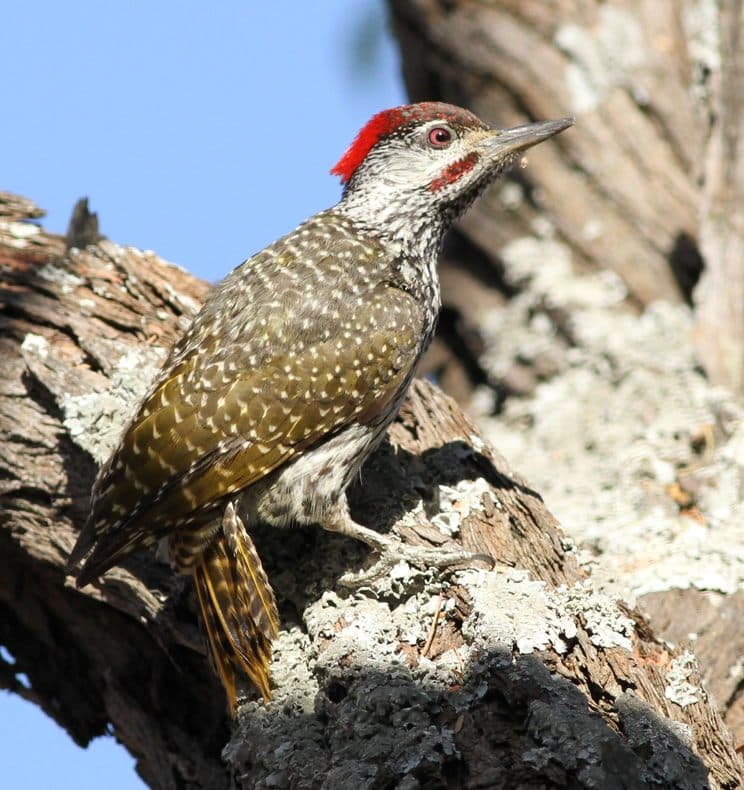
Golden-tailed woodpecker
The golden-tailed woodpecker is a species of bird found in woodlands and forests south of the equator, extending into parts of Africa. It is distinguished by its barred, greenish upper plumage, streaked underparts, and a characteristic strident call. This woodpecker primarily feeds on ants and termites, foraging by probing and gleaning, and excavates its nests in trees.
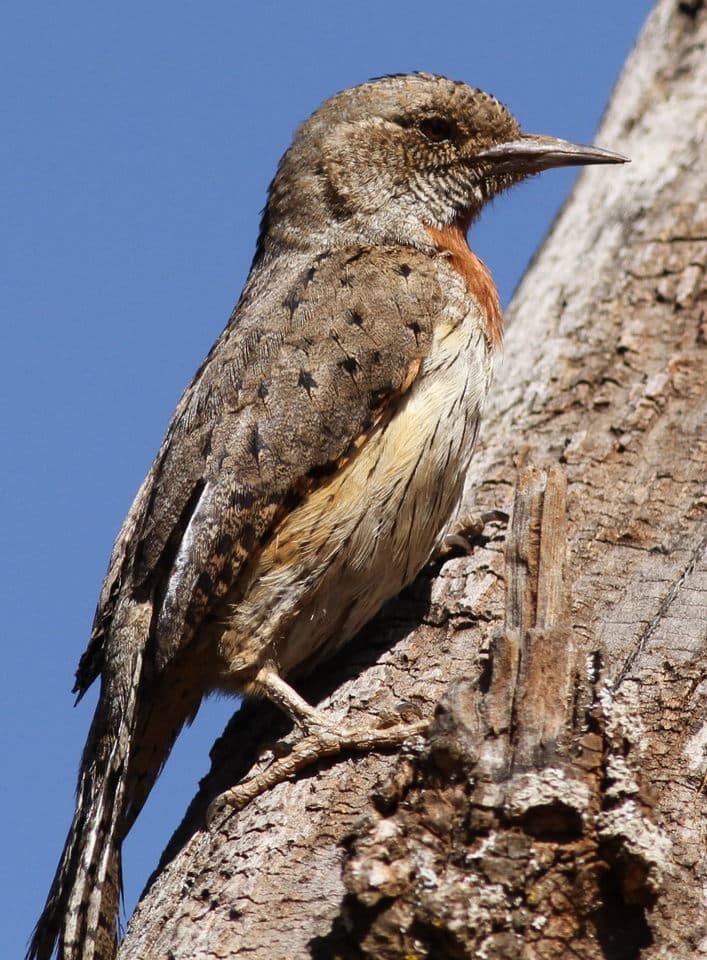
Red-throated wryneck
The red-throated wryneck is a slim, elongated bird found in sub-Saharan Africa, recognized by its cryptic plumage of greys and browns. It is a member of the woodpecker family, distinguished by its habit of twisting its neck when agitated. Primarily feeding on ants, it nests in pre-existing holes and is considered a species of least concern due to its large and increasing population.
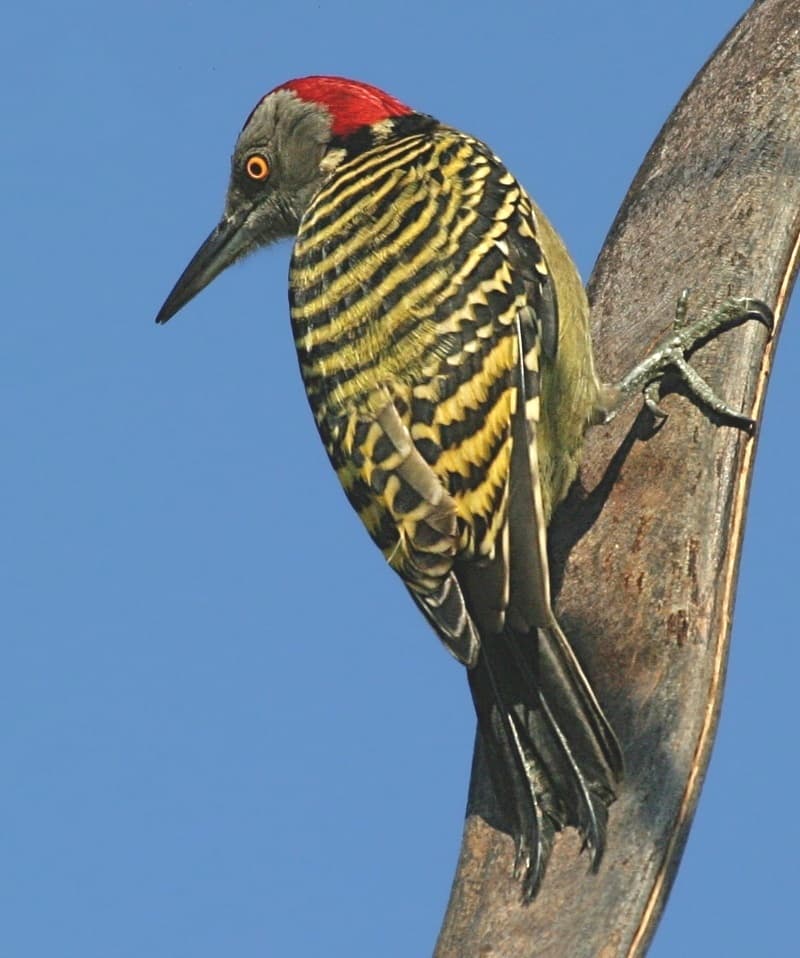
Hispaniolan woodpecker
The Hispaniolan woodpecker is a medium-sized, gold and black barred bird found exclusively on the island of Hispaniola. This species is known for its social behavior and distinctive vocalizations, inhabiting a variety of forest types, plantations, and even urban parks across both Haiti and the Dominican Republic.