
Chestnut woodpecker
The chestnut woodpecker is a bird species found across much of mainland South America and Trinidad. It is characterized by its chestnut plumage, a bright red malar area in males, and a distinctive call. This species primarily inhabits forests and secondary growth areas, where it forages for ants and termites.
Key Facts
- ›Found in every mainland South American country except Argentina, Chile, Paraguay, and Uruguay, as well as Trinidad.
- ›Males possess a prominent bright red malar area and cheek, while females lack this coloration.
- ›Primarily feeds on ants and termites, supplemented by fly larvae and fruit.
- ›Excavates nest cavities in dead trees or stubs.
- ›Its territorial call is described as a descending 'wewa ew-ew-ew-ew-ew-ew' or a sarcastic-sounding 'har-hahaha'.
- ›Assessed by the IUCN as a species of least concern, despite a believed decreasing population trend.

South America, Trinidad
Forests, Terra Firme Forests, Gallery Forests, VáRzea Forests, Secondary Forests, Cocoa Plantations, Other Plantations
Chestnut, Red, Buffish Cream, Deep Rufous-Chestnut, Cream-Buff, Blackish Brown, White, Blackish, Rufous
- Bright Red Malar Area and Cheek
- Buffish Cream Forehead, Crown, and Crest
- Deep Chestnut Brown Head, Chin, and Throat
- Rufous-Chestnut Upperparts With Cream-Buff Rump
- White Spots On Wing Coverts
- Rufous On Outermost Tail Feathers
Ants, Termites
- Gleaning from trees
- Breaking open arboreal termitaria
- Forages singly, in pairs, or small loose groups
- Frequently joins mixed species feeding flocks
Dead Tree Cavities, Stub Cavities
Descending 'Wewa Ew-Ew-Ew-Ew-Ew-Ew', Sarcastic-Sounding 'Har-Hahaha', Rattling Screeches, Grating 'WháA-Jer', 'Wick-Wick-Wick-Wick-Wick', Mellow 'Gwarrr', Nasal 'Kyeenh', Double Rap Drum
About Chestnut woodpecker
The chestnut woodpecker, scientifically known as Celeus elegans, is a striking bird species found across a wide expanse of South America, from eastern Venezuela and Guyana southwards through Brazil and into northern Bolivia, as well as on the island of Trinidad. This species is a member of the Picidae family and is distinguished by its predominantly chestnut plumage, with males featuring a vibrant red malar stripe.
Habitat and Distribution
This woodpecker inhabits the interior and edges of various forest types, including dense and lighter forests, as well as terra firme, gallery, and várzea forests. It also adapts to secondary forests and agricultural areas like cocoa plantations. Its elevational range varies across its distribution, extending from sea level up to 1,100 meters (3,600 feet) in some regions.
Behavior and Diet
The chestnut woodpecker is a resident bird, remaining in its territory year-round. Its diet primarily consists of ants and termites, though fly larvae and fruit are also part of its sustenance. Foraging occurs from the understory to the sub-canopy, typically on tree trunks and large limbs, where it gleans prey or breaks open termitaria. They are often observed foraging alone, in pairs, or in small groups, and will readily join mixed-species feeding flocks.
Reproduction and Vocalizations
Breeding typically occurs in April and May in certain regions, with breeding seasons extending into January and February in others. The chestnut woodpecker excavates its nest cavity in dead trees or stubs. A clutch usually comprises three eggs. The species is known for its diverse vocalizations, including a descending territorial call described as 'wewa ew-ew-ew-ew-ew-ew' or a 'har-hahaha', along with various rattling screeches and softer calls. Their drumming is a distinct double rap, 'dop-dop', produced frequently by both sexes during the breeding season.
Conservation Status
The chestnut woodpecker is currently assessed as a species of least concern by the IUCN. Despite its extensive range, its population size is not precisely known and is believed to be in decline. No immediate threats have been identified, and the species can be found in numerous protected areas across its range.
Source: Wikipedia ↗
Frequently Asked Questions
What is the scientific name of the chestnut woodpecker?
The scientific name of the chestnut woodpecker is Celeus elegans.
Where is the chestnut woodpecker found?
The chestnut woodpecker is distributed across South America, excluding Argentina, Chile, Paraguay, and Uruguay, and is also found on Trinidad.
What does the chestnut woodpecker eat?
Its primary diet consists of ants and termites. It also consumes fly larvae and fruits.
How does the chestnut woodpecker forage for food?
It forages by gleaning from trees and by breaking open arboreal termitaria, typically from the understory to the sub-canopy.
What are the nesting habits of the chestnut woodpecker?
The chestnut woodpecker excavates a nest cavity in a dead tree or stub. A typical clutch size consists of three eggs.
What are the characteristic sounds of the chestnut woodpecker?
Its territorial call is a descending 'wewa ew-ew-ew-ew-ew-ew' or 'har-hahaha'. It also produces rattling screeches, a 'wick-wick-wick-wick-wick' sound, a mellow 'gwarrr', and a nasal 'kyeenh'.
What is the conservation status of the chestnut woodpecker?
The chestnut woodpecker is listed as a species of least concern by the IUCN. However, its population size is unknown and is believed to be decreasing.
Related Woodpecker species

Yellow-throated woodpecker
The yellow-throated woodpecker (Piculus flavigula) is a species of bird found across South America, inhabiting mature forests and forest edges. Males and females exhibit distinct head plumage, with males typically displaying red and yellow, while females have a more golden-yellow crown. Its diet is known to include ants, and it excavates nest cavities in tree branches or stubs.
Rufous-headed woodpecker
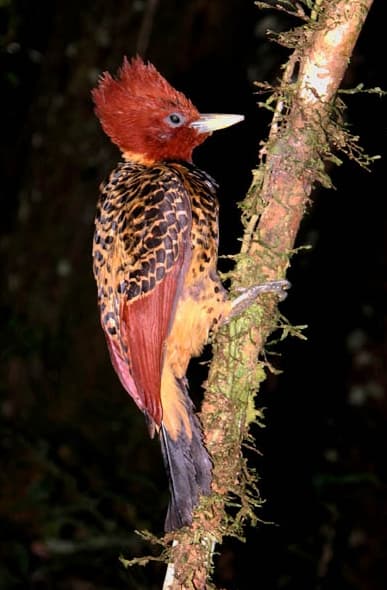
The Rufous-headed woodpecker is a species of bird found in the humid tropical rainforests of Bolivia, Brazil, Ecuador, and Peru, often near rivers and on their islands. It is distinguished by its rufous-chestnut head, with males also displaying a deep red malar patch and crest. This woodpecker primarily feeds on bamboo ants and is known for its loud, squealing song.
Yellow-crested woodpecker
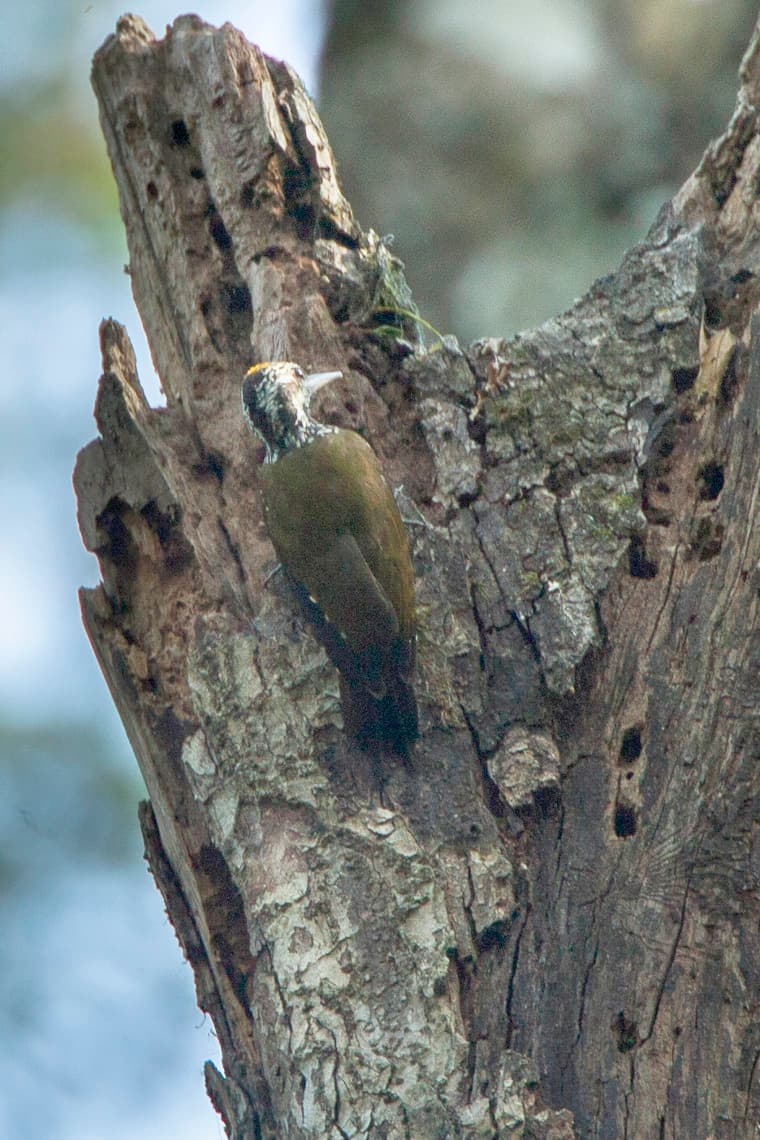
The yellow-crested woodpecker, also known as the golden-crowned woodpecker, is a species found in wet tropical forests across equatorial Central and Western Africa. Measuring between 22 to 25 cm, males are distinguished by a small golden patch on their crown, while females lack this feature. They are known for their distinctive drumming and vocalizations, and primarily feed on insects found in the forest canopy.