
Rufous-headed woodpecker
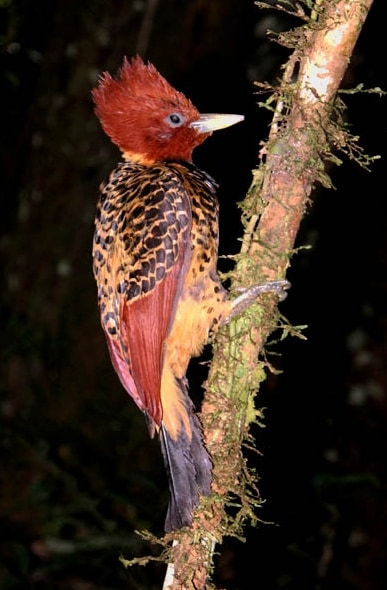
The Rufous-headed woodpecker is a species of bird found in the humid tropical rainforests of Bolivia, Brazil, Ecuador, and Peru, often near rivers and on their islands. It is distinguished by its rufous-chestnut head, with males also displaying a deep red malar patch and crest. This woodpecker primarily feeds on bamboo ants and is known for its loud, squealing song.
Key Facts
- ›Found in Bolivia, Brazil, Ecuador, and Peru.
- ›About 26 to 28 cm (10 to 11 in) in length.
- ›Males have a deep red malar patch and crest; females lack this red coloration.
- ›Primarily feeds on bamboo ants and other insects found by probing and pecking.
- ›Inhabits humid tropical rainforests, often near rivers and associated with bamboo or Cecropia trees.
- ›IUCN status is Least Concern, though population size and trend are unknown.
Bolivia, Brazil, Ecuador, Peru
Humid Tropical Rainforest, Riverine Habitats, Bamboo Thickets
Rufous-Chestnut, Red, Cream-Buff, Black, Cinnamon-Yellow, Brownish-Black
Rufous-Chestnut Head, Deep Red Malar Patch, Bushy Red Crest
Bamboo Ants, Insects
Probing, Forceful Pecking, Forages At All Forest Levels, Forages On Fallen Logs
Dead Snags, Live Trees
- Loud squealing 'Skweeah' song
- Bubbling 'Kluh-kluh-kluh-kluh-kluh' series
- Mewing chuckle 'Wur-hee-hrr-hrr-hrr'
- Harsh squawks when agitated
- Loud, evenly pitched drumming rolls on hollow bamboo
About Rufous-headed woodpecker
The Rufous-headed woodpecker (Celeus spectabilis) is a striking bird species found in the humid tropical rainforests of South America, specifically in eastern Ecuador, northeastern Peru, southeastern Peru, Brazil's Acre state, and northern Bolivia. This species typically inhabits areas along rivers and on their islands, often associating with bamboo thickets or landscapes featuring Cecropia trees.
Description and Identification
Adult Rufous-headed woodpeckers measure approximately 26 to 28 cm in length. The most distinguishing feature is their rufous-chestnut head. Adult males possess a vibrant deep red malar patch and a prominent, bushy crest, while females lack the red malar and have at most a trace of red on their crest. Both sexes share a cream-buff patch on the neck that extends down the side of the breast, contrasting with a black lower throat and breast. Their upper back is creamy buff to pale cinnamon-yellow with very wide black bars, while the lower back and rump are yellow-buff to cinnamon-buff. The wings feature black coverts with cream-buff edges and narrow bars, and their primaries are brownish-black with rufous bases. The iris of their eyes is a deep red-brown, and their legs are olive green to grayish. Juveniles resemble adults but have darker bills and more blackish coloration on the front of their heads.
Behavior and Ecology
The Rufous-headed woodpecker is a year-round resident within its range. Its diet is believed to consist mainly of bamboo ants, though other insects are likely consumed. Foraging occurs singly or in pairs at various levels of the forest, including on fallen logs. They employ probing and forceful pecking techniques to uncover prey within tree trunks, branches, and bamboo.
Vocalizations are notable and include a loud, squealing song, a mewing chuckle, and harsh squawks when agitated. Their drumming on hollow bamboo produces loud, evenly pitched rolls. Breeding information is limited; the known breeding season in Peru spans at least from June to August. Nests have been observed in dead snags and live trees, with one instance of a male provisioning a single chick.
Distribution and Habitat
The nominate subspecies, C. s. spectabilis, is found in eastern Ecuador and northeastern Peru. The subspecies C. s. exsul inhabits southeastern Peru, Brazil's Acre state, and the Beni and Cochabamba departments of northern Bolivia. They are usually found at elevations up to about 300 meters.
Conservation Status
The International Union for Conservation of Nature (IUCN) has assessed the Rufous-headed woodpecker as Least Concern. Despite having a fairly large range, its population size and trend are not precisely known. No immediate threats have been identified, although it is considered generally rare in Brazil and its strict habitat requirements and low density suggest it may warrant further conservation consideration.
Source: Wikipedia ↗
Frequently Asked Questions
What are the main physical characteristics of the Rufous-headed woodpecker?
The Rufous-headed woodpecker measures about 26 to 28 cm long and has a rufous-chestnut head. Adult males are distinguished by a deep red malar patch and a prominent red crest, while females have less or no red on their head.
Where is the Rufous-headed woodpecker located?
This species is found in the humid tropical rainforests of eastern Ecuador, northeastern Peru, southeastern Peru, Brazil's Acre state, and northern Bolivia. They typically inhabit areas along rivers and on their islands.
What does the Rufous-headed woodpecker eat?
It is believed to feed mainly on bamboo ants, but its diet likely includes other insects as well. It forages by probing and forcefully pecking at tree trunks, branches, and bamboo.
What are the sounds made by the Rufous-headed woodpecker?
Its vocalizations include a loud squealing song, a mewing chuckle, and harsh squawks when agitated. It also produces loud drumming rolls on hollow bamboo.
What is the conservation status of the Rufous-headed woodpecker?
The Rufous-headed woodpecker is assessed by the IUCN as Least Concern. However, its population size and trend are not known, and it is considered rare in some parts of its range.
Related Woodpecker species

Chestnut woodpecker
The chestnut woodpecker is a bird species found across much of mainland South America and Trinidad. It is characterized by its chestnut plumage, a bright red malar area in males, and a distinctive call. This species primarily inhabits forests and secondary growth areas, where it forages for ants and termites.

Chestnut-colored woodpecker
The Chestnut-colored woodpecker is a medium-sized bird found in the humid forests of Middle America, from Mexico to Panama. It is characterized by its rufous-chestnut upperparts, black-marked underparts, and a distinctive pointed crest. Primarily feeding on ants and termites, this species plays a role in forest ecosystems despite facing threats from habitat loss.

Cream-colored woodpecker
The cream-colored woodpecker is a South American bird species known for its predominantly yellowish plumage, long crest, and black tail. It inhabits various humid forest environments across much of mainland South America, excluding the southern cone. Primarily feeding on ants and termites, it plays a role in its ecosystem by breaking into arboreal nests for food.