
Common flameback
The common flameback, also known as the common goldenback, is a small woodpecker found across South and Southeast Asia. It is characterized by its spotted underside and, in males, a bright red crest, while females have a black crest with white streaks. This species inhabits a variety of environments, from open forests to mangroves, and is primarily an insectivore.
Key Facts
- ›Found throughout South and Southeast Asia, from India to the Greater Sunda Islands.
- ›Males have a bright red crest; females have a black crest with white streaks.
- ›Primarily an insectivore, with a diet mainly consisting of ants.
- ›Forages by gleaning and probing rather than extensive wood pecking.
- ›Nests in tree holes, often in fruit trees or coconut palms.
- ›Possesses a distinctive loud, high-pitched 'kow-kowp' rattle call.
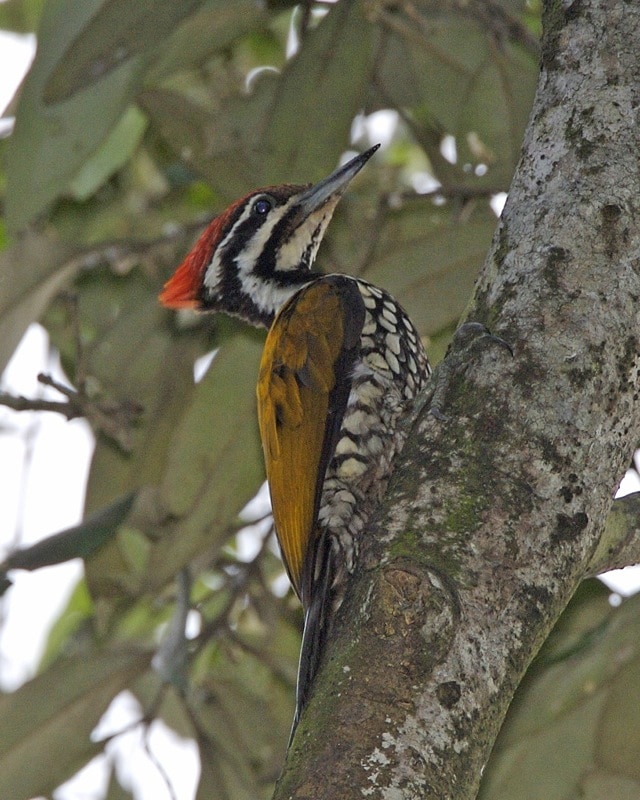
Common Goldenback
South Asia, Southeast Asia
Moist Open Forests, Scrublands, Mangroves, Pine Forests
Males have a bright red crest, Females have a black crest with white streaks, White supercilium, cheek stripe, and throat, Spotted black and white underside, Smaller bill than Greater Flameback, Black nape, Red rump
Ants, Insects, Invertebrates
Gleaning, Probing, Hammering At Bark, Hawking Slow-Flying Insects
Holes In Fruit Trees, Holes In Coconut Palms, Stumps of Trees
Loud, High-Pitched 'Kow-Kowp' Rattle Call, 'Wicka Call', 'Kow Call', 'Kowp Call', 'Rattle Call'
About Common flameback
The common flameback (Dinopium javanense), also recognized as the common goldenback, is a medium-sized woodpecker native to South and Southeast Asia. This species is distinguished by its plumage, with males featuring a striking red crest and females a black crest marked with white streaks. Both sexes exhibit a white supercilium, cheek stripe, and throat, contrasting with a black nape and a spotted black and white underside.
Habitat and Distribution
Common flamebacks inhabit a diverse range of environments, including moist open forests, scrublands, and mangroves. While they generally prefer lowlands, they can be found at altitudes up to 1700 meters in India, where they may inhabit pine forests. Their geographic distribution spans from the Western Ghats in India eastward through Southeast Asia to the Indochinese peninsula and several of the Greater Sunda Islands.
Behavior and Diet
This species is known for its relatively quiet nature, producing various vocalizations including a distinctive loud, high-pitched 'kow-kowp' rattle. Foraging behavior typically involves gleaning and probing for insects on trees, with less emphasis on wood pecking compared to other woodpeckers. Their diet consists primarily of ants and other tree-crawling invertebrates. Males and females often forage on separate trees, maintaining contact.
Reproduction
Common flamebacks nest in cavities, commonly found in fruit trees, coconut palms, or tree stumps. They lay clutches of two or three eggs. Details regarding specific mating displays or rituals are varied in accounts, with some suggesting minimal displays beyond a male's raised crest during copulation, while others describe more elaborate courtship behaviors involving crest-raising, bowing, and head swinging.
Source: Wikipedia ↗
Frequently Asked Questions
What is the scientific name of the common flameback?
The scientific name of the common flameback is Dinopium javanense. It belongs to the family Picidae, which includes all woodpeckers.
Where can the common flameback be found?
The common flameback has a wide distribution across South and Southeast Asia. Its range extends from the Western Ghats in India eastward to the Indochinese peninsula and includes several of the Greater Sunda Islands like Sumatra and Java.
What does the common flameback eat?
The common flameback is a strict insectivore. Its primary diet consists of ants, but it also consumes other tree-crawling invertebrates and may hawk slow-flying insects out of the air.
How does the common flameback forage for food?
Unlike many woodpeckers, the common flameback rarely engages in extensive wood pecking. It is more adapted to gleaning and probing for insects on tree bark and branches, often remaining motionless for periods before rapidly pecking at its prey.
What are the nesting habits of the common flameback?
Common flamebacks nest in holes found in fruit trees, coconut palms, or stumps of similar tree varieties. They typically lay a clutch of 2 or 3 eggs.
How can I distinguish a male common flameback from a female?
The primary visual difference between male and female common flamebacks is the crest color. Males sport a bright red crest, while females have a black crest adorned with white streaks.
Related Woodpecker species

Cuban green woodpecker
The Cuban green woodpecker (Xiphidiopicus percussus), also known as carpintero verde, is the only species in its genus and is a widespread and common woodpecker found exclusively in Cuba. This medium-sized, colorful bird inhabits various forests and woodlands, and is characterized by its olive-green upperparts, yellow streaked underparts, and a distinctive red breast patch.

Chilean flicker
The Chilean flicker is a medium-sized woodpecker species found in central and southern Chile and southwestern Argentina. It primarily inhabits semi-open to open landscapes and feeds almost exclusively on ants found on the ground. This species is characterized by its dark slate gray head in males, buffish underparts with blackish brown barring, and a white rump.
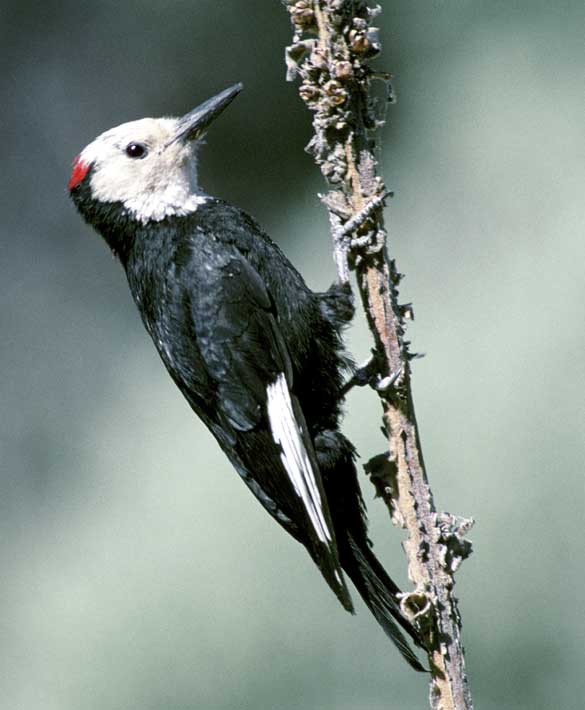
White-headed woodpecker
The White-headed Woodpecker is a non-migratory species found in the mountainous pine forests of western North America, ranging from British Columbia to southern California. It is distinguished by its entirely black body and striking white head, with males also featuring a red spot on the back of their heads.