
Dot-fronted woodpecker
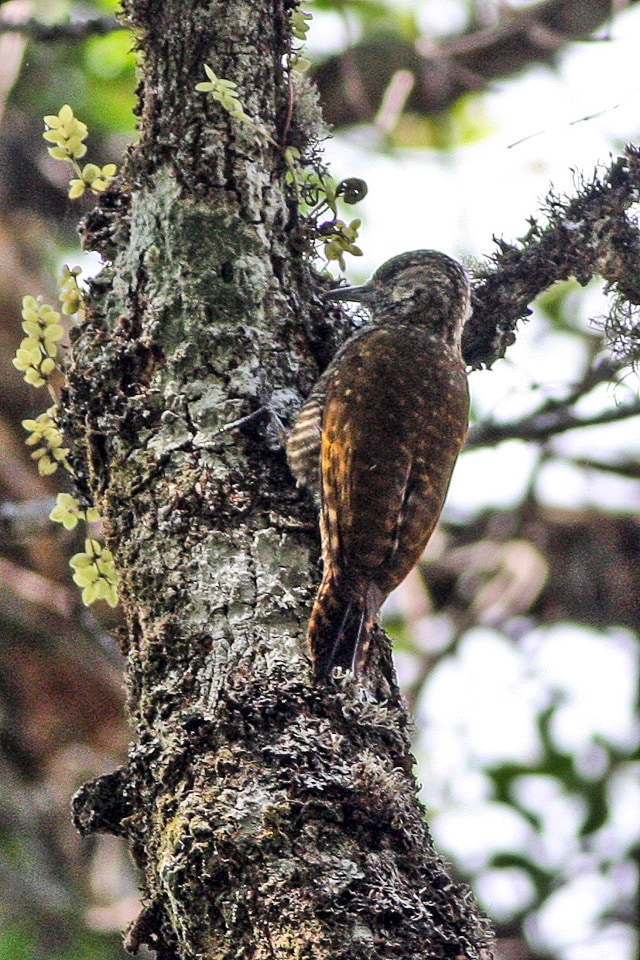
The dot-fronted woodpecker (Veniliornis frontalis) is a species found in Argentina and Bolivia, inhabiting dry montane woodlands and humid forests. Measuring approximately 16 cm in length, it is characterized by its olive to gray-brown forehead with white spots, and males display red on their crown and nape.
Key Facts
- ›Found in Argentina and Bolivia, east of the Andes.
- ›Approximately 16 cm long and weighs 30-40 grams.
- ›Males have a distinctive red crown and nape with white-spotted forehead.
- ›Inhabits dry montane woodland, humid forest, and transition zones.
- ›Its diet has not been described.
- ›Assessed as Least Concern by the IUCN, but population is believed to be decreasing.
Argentina, Bolivia
- Dry Montane Woodland
- Humid Forest
- Transition Zone Between Woodlands and Humid Forests
Olive, Gray-Brown, White, Red, Yellowish Olive, Golden, Pale Bars, Streaks, Brown, Yellow-Green, Dark Brown, Yellow Wash, Whitish Bars
- Males have a red crown and nape
- Males have an olive to gray-brown forehead with many white spots
- Females have an olive-brown forehead to nape with white spots
- Thin white supercilium
- Thin white 'moustache'
Forages Near the Ground, Forages On Tree Trunks, Forages On Small Branches
Dead Tree Cavities
Series of 8-10 'JuíC!' Or 'JíC!' Calls, Rather Harsh 'WíK!'
About Dot-fronted woodpecker
The dot-fronted woodpecker (Veniliornis frontalis) is a species of bird found in the woodpecker family, Picidae. It is primarily found on the eastern slopes of the Andes mountains, distributed across parts of Bolivia and Argentina. This species inhabits a range of environments, including dry montane woodlands, humid forests, and the transitional zones between these habitats.
Description and Identification
Adult dot-fronted woodpeckers measure approximately 16 centimeters (6.3 inches) in length and weigh between 30 to 40 grams. While both sexes share a similar overall olive-brown coloration with white barring on their underparts and olive-brown faces with white supercilia and "moustaches," their head plumage differs. Males are distinguished by a red crown and nape, with an olive to gray-brown forehead marked by numerous white spots. Females, in contrast, have an olive-brown coloration extending from the forehead to the nape, also featuring white spotting throughout.
Distribution and Habitat
The geographic range of the dot-fronted woodpecker extends from the Cochabamba and Santa Cruz departments of Bolivia southward into Tucumán Province in Argentina. It is typically found at elevations up to 2,000 meters (6,600 feet), though it generally prefers lower altitudes. The species is known to inhabit dry montane woodlands, humid forests, and the ecotones that connect these ecosystems.
Behavior and Ecology
Outside of the breeding season, the dot-fronted woodpecker exhibits a tendency to move to lower-lying areas. Foraging typically occurs at lower levels, on tree trunks and smaller branches. The specific dietary habits of this species have not been detailed in available records. The breeding season appears to encompass at least the months of September through November. The only known nest documented was situated in a cavity within a dead tree, approximately 8 meters (25 feet) above the ground. Little else is currently known about its breeding biology.
Vocalizations and Conservation
The vocalizations of the dot-fronted woodpecker include a series of 8–10 calls described as 'juíc!' or 'jíc!', as well as a harsher 'wík!' sound. The International Union for Conservation of Nature (IUCN) has assessed the dot-fronted woodpecker as Least Concern. Despite this classification, the species possesses a somewhat restricted range, and its population size is not precisely known, with estimates suggesting a decreasing trend. While no immediate threats have been identified, the bird is considered generally uncommon, and further research into its ecology and reproduction is deemed necessary.
Source: Wikipedia ↗
Frequently Asked Questions
What is the scientific name of the dot-fronted woodpecker?
The scientific name of the dot-fronted woodpecker is Veniliornis frontalis. Some taxonomic systems have moved this species into the genus Dryobates.
Where can the dot-fronted woodpecker be found?
The dot-fronted woodpecker is located on the east side of the Andes mountains, ranging from departments in Bolivia south to a province in Argentina. It inhabits various forest types within this region.
What are the physical characteristics of the dot-fronted woodpecker?
Adult dot-fronted woodpeckers are about 16 cm long and weigh between 30 to 40 grams. Males and females differ in head plumage; males have a red crown and nape with a spotted forehead, while females have an olive-brown head with white spots throughout.
What is the conservation status of the dot-fronted woodpecker?
The dot-fronted woodpecker is listed as Least Concern by the IUCN. However, its range is somewhat limited, its population size is unknown, and the population is thought to be decreasing.
What does the dot-fronted woodpecker eat?
Specific details about the diet of the dot-fronted woodpecker have not been described in available records. Its foraging behavior involves searching near the ground on tree trunks and small branches.
Related Woodpecker species
Smoky-brown woodpecker
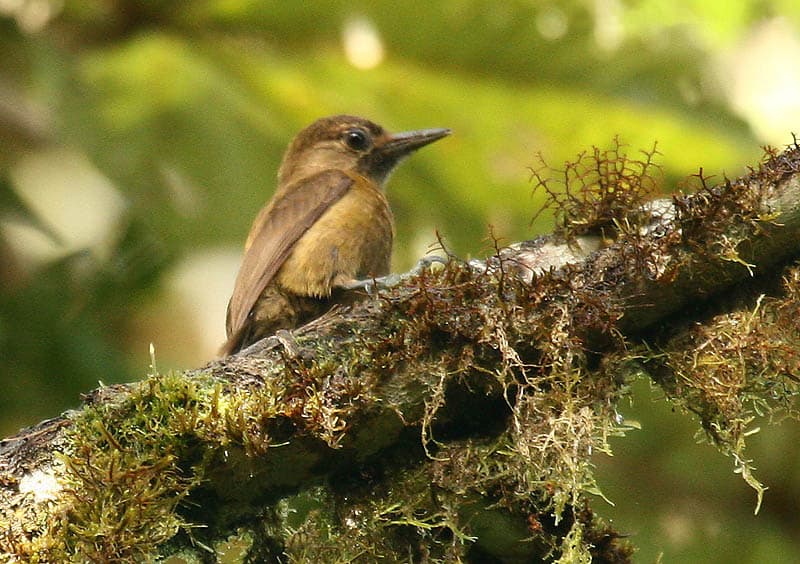
The Smoky-brown woodpecker (Leuconotopicus fumigatus) is a widespread bird species found across Central and South America. This medium-sized woodpecker is characterized by its predominantly olive-brown plumage, with males displaying a red crown and females a dark brown one. It inhabits various wooded environments, from humid forests to dry woodlands and plantations, and primarily feeds on wood-boring beetles.

Fine-barred piculet
The fine-barred piculet is a small bird found in Brazil and Peru, known for its distinctive barring and reddish-orange crown markings in males. It inhabits forests, often near rivers, and forages for insects on branches and vines. While its population size is unknown, it is currently assessed as Least Concern.

Red-headed flameback
The red-headed flameback is a striking woodpecker species endemic to the Philippines, specifically found in the Palawan region. Characterized by its vibrant red head and a golden-yellow back, it inhabits moist lowland forests, including primary and secondary forests, plantations, and clearings with standing trees. This species faces threats primarily from habitat loss.