
Smoky-brown woodpecker
The Smoky-brown woodpecker (Leuconotopicus fumigatus) is a widespread bird species found across Central and South America. This medium-sized woodpecker is characterized by its predominantly olive-brown plumage, with males displaying a red crown and females a dark brown one. It inhabits various wooded environments, from humid forests to dry woodlands and plantations, and primarily feeds on wood-boring beetles.
Key Facts
- ›Found in 15 countries across Central and South America.
- ›Measures approximately 18 cm (7.1 in) in length and weighs 31-50 g.
- ›Males have red on their crown, while females have dark brown.
- ›Inhabits diverse wooded environments including forests, woodlands, and plantations.
- ›Diet consists mainly of adult and larval wood-boring beetles, with some fruit.
- ›Breeding season varies by region, with nests typically excavated in dead wood.
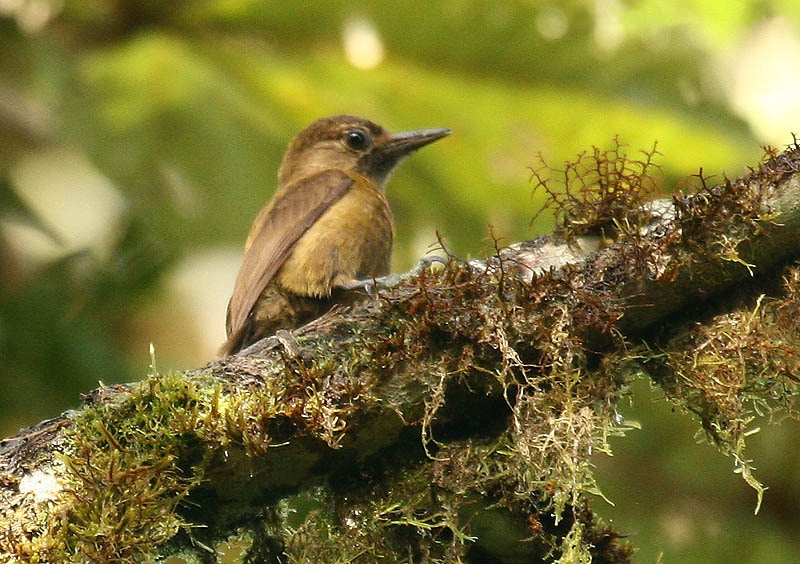
Smoky-Brown Woodpecker
Central America, South America
Humid Forest, Wet Forest, Cloudforest, Dry Montane Woodland, Alder Woodland, Gallery Forest, Secondary Forest, Forest Edges, Coffee Plantations
Olive-Brown, Brown, Red, Dark Brown, White, Black
Male's red crown, Female's dark brown crown, Whitish lores, Thin white supercilium, Black 'moustache' with thin white line above
Wood-Boring Beetles, Fruit
Pecking, Hammering, Probing, Gleaning
Dead Branches, Dead Trunks, Fence Posts
- 'Wick'
- 'Chuk'
- 'Pwik'
- 'Quip'
- High-Pitched and Piping 'Keer-Keer-Keer-Keer'
- Hard, Rolling, Gravelly 'Zur-Zur-Zur-Zur'
- 'Tchk, Tchk Zr-R-R-R Uh Kuh-Kuh-Kuh-Kuh'
- Queaky, Sucking 'Wick-A Wick-A' Or 'Tsewink Tsewink'
About Smoky-brown woodpecker
The Smoky-brown woodpecker, scientifically known as Leuconotopicus fumigatus, is a member of the woodpecker family, Picidae, found across a wide geographical expanse in Central and South America. This species is notable for its consistent presence in various wooded habitats, ranging from humid and wet forests to drier montane woodlands and even agricultural areas like coffee plantations.
Description and Identification
Adult Smoky-brown woodpeckers typically measure around 18 cm (7.1 inches) in length and weigh between 31 and 50 grams. Their plumage is predominantly olive-brown. A key distinguishing feature between sexes lies in their head coloration: males exhibit a striking red crown extending to the nape, while females have a dark brown crown with an olive tinge. Both sexes share a mostly olive-brown face, characterized by whitish lores and a thin white supercilium, often accompanied by a black "moustache" bordered by a fine white line. Their upperparts are generally brown to olive-brown, with a reddish hue on the shoulders. Juveniles are duller and more sooty brown than adults, lacking the red tinge on their back and possessing white bars on some flight feathers. Several subspecies are recognized, exhibiting minor variations in size, wing length, and plumage coloration, particularly around the eyes.
Distribution and Habitat
The Smoky-brown woodpecker's range is extensive, encompassing countries such as Mexico, Belize, Guatemala, Honduras, El Salvador, Nicaragua, Costa Rica, Panama, Colombia, Venezuela, Ecuador, Peru, Bolivia, and Argentina. Its adaptability allows it to thrive in diverse environments, including dense understory at forest edges and gallery forests along rivers. The species occupies a broad altitudinal range, from near sea level in some regions to over 2,800 meters in the Andes.
Behavior and Ecology
This woodpecker is a year-round resident throughout its territory. It is often observed foraging alone, in pairs, or as part of family groups, and frequently joins mixed-species feeding flocks. Its diet is primarily composed of adult and larval wood-boring beetles, supplemented with small amounts of fruit. Foraging typically occurs in the mid and lower levels of the forest, often within dense foliage and vine tangles, though they will also feed in the canopy and on isolated trees. Their primary method of finding food involves pecking and hammering, though they will also probe and glean. The breeding season varies geographically; in Central America, it spans from February to June, while in Venezuela it is February and March, and in Colombia, it occurs from October to April. Both sexes participate in excavating nest cavities, usually in dead wood or occasionally in fence posts, typically situated between 1.5 and 8 meters above the ground. The typical clutch size is four eggs, though details about incubation and parental care are not extensively documented.
Vocalizations and Conservation
The Smoky-brown woodpecker possesses a varied repertoire of sounds, including sharp "wick" and "chuk" calls, a high-pitched "keer-keer-keer-keer," and a rolling "zur-zur-zur-zur." They also produce a "tchk, tchk zr-r-r-r uh kuh-kuh-kuh-kuh" sound and a "queaky, sucking 'wick-a wick-a' or 'tsewink tsewink'" during interactions. Their drumming is described as very rapid, protracted tattoos. The species is classified as Least Concern by the IUCN, with a large estimated population of at least 50,000 mature individuals. Despite this status, the population is believed to be decreasing, though no immediate threats have been identified. The Smoky-brown woodpecker is considered common to uncommon in various parts of its range and is found in numerous protected areas, suggesting it is reasonably secure in the wild.
Source: Wikipedia ↗
Frequently Asked Questions
What is the scientific name of the Smoky-brown woodpecker?
The scientific name of the Smoky-brown woodpecker is Leuconotopicus fumigatus. It has also been classified in the genus Dryobates by some taxonomic systems.
Where can the Smoky-brown woodpecker be found?
This species has a broad distribution across Argentina, Belize, Bolivia, Colombia, Costa Rica, Ecuador, El Salvador, Guatemala, Honduras, Mexico, Nicaragua, Panama, Peru, and Venezuela.
What does the Smoky-brown woodpecker eat?
The primary diet of the Smoky-brown woodpecker consists of adult and larval wood-boring beetles. They also consume small amounts of fruit.
What are the nesting habits of the Smoky-brown woodpecker?
Both male and female Smoky-brown woodpeckers excavate nest cavities, typically in dead branches or trunks, or sometimes in fence posts. Nests are usually situated between 1.5 and 8 meters above the ground.
What is the conservation status of the Smoky-brown woodpecker?
The International Union for Conservation of Nature (IUCN) has assessed the Smoky-brown woodpecker as Least Concern. Despite a large range and population, the population is believed to be decreasing.
Related Woodpecker species
Powerful woodpecker
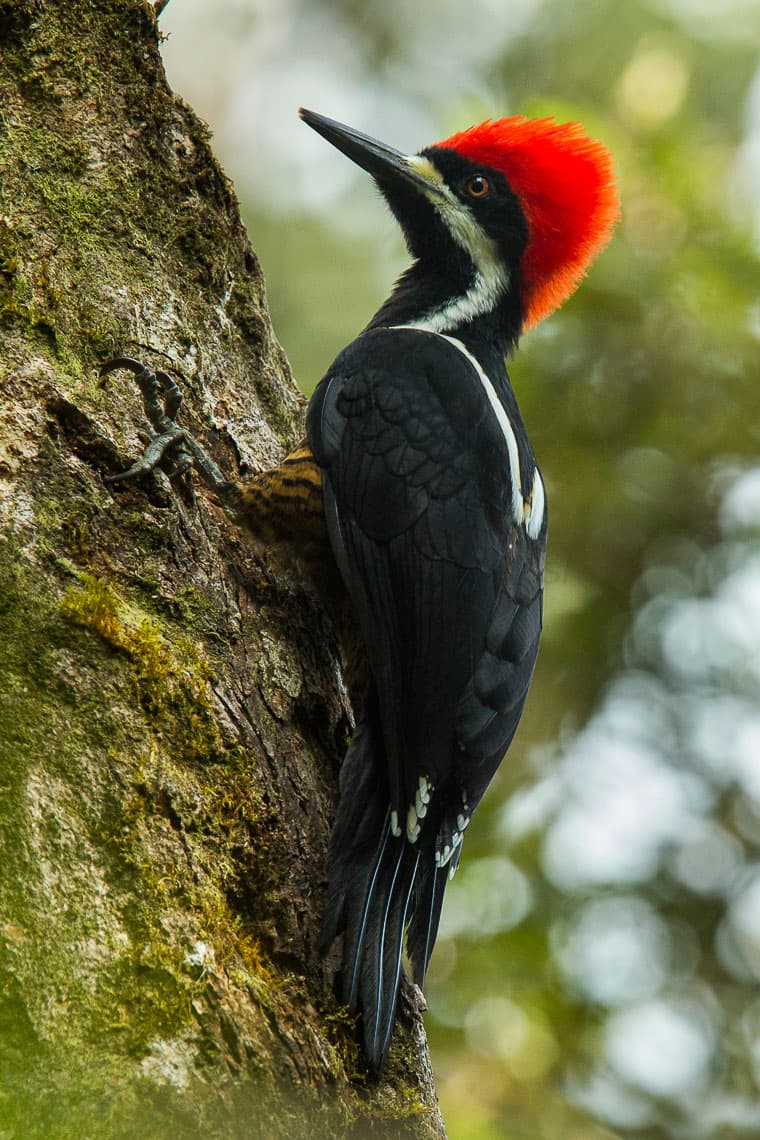
The powerful woodpecker is a large bird found in the montane forests of Colombia, Ecuador, Peru, and Venezuela. It is characterized by its striking black and white facial markings and the male's red head and crest, while females have black heads. This species is a year-round resident that forages at all forest levels.
Dot-fronted woodpecker
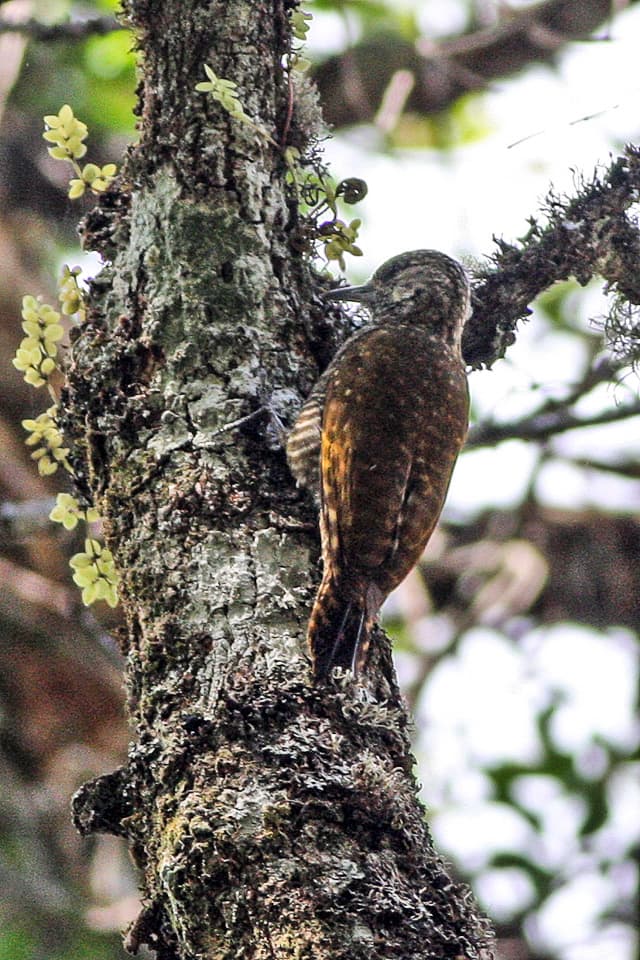
The dot-fronted woodpecker (Veniliornis frontalis) is a species found in Argentina and Bolivia, inhabiting dry montane woodlands and humid forests. Measuring approximately 16 cm in length, it is characterized by its olive to gray-brown forehead with white spots, and males display red on their crown and nape.

Golden-olive woodpecker
The golden-olive woodpecker is a widespread bird species found from Mexico through South America, excluding Chile, Paraguay, and Uruguay. It inhabits a diverse range of wooded environments, from dry thornscrubs to humid rainforests. This species is characterized by its green upperparts with a bronze tinge and buffy yellow underparts with blackish bars, with males and females differing in head plumage.