
Eastern grey woodpecker
The eastern grey woodpecker is a resident bird species found in tropical eastern Africa, known for its insectivorous diet and distinctive plumage. Both males and females share yellowish-green upper parts and a red rump, but males sport a red crown and nape, while females have a plain grey head. This species is considered common and its conservation status is of least concern.
Key Facts
- ›Native to tropical eastern Africa, including Ethiopia, Kenya, South Sudan, Sudan, and Tanzania.
- ›Inhabits humid forests, forest verges, and gallery forests at various altitudes.
- ›Feeds primarily on insects, including moths, centipedes, larvae, and pupae, foraging on trees and the ground.
- ›Adult males have a red crown and nape, distinguishing them from females who have a plain grey head.
- ›Upper body parts are yellowish-green with a red rump and dark brown wings and tail.
- ›Conservation status is 'least concern' due to its large range and common presence.

Grey-Headed Woodpecker, Mountain Gray Woodpecker
Africa
Humid Forests, Forest Verges, Gallery Forests
Red Crown and Nape, Plain Grey Head, Red Rump, Straight Pointed Bill, Stiff Tail, Zygodactyl Feet
Insects, Moths, Centipedes, Larvae, Pupae
Forages On Trees, Forages On the Ground, Taps Or Drums
Regularly Taps Or Drums
About Eastern grey woodpecker
The eastern grey woodpecker (Dendropicos spodocephalus), also known by names such as the grey-headed woodpecker and mountain gray woodpecker, is a species of bird belonging to the woodpecker family, Picidae. This species is a resident breeder, meaning it stays in its territory year-round, and is found across a broad region in tropical eastern Africa. Its range encompasses countries including Ethiopia, Kenya, South Sudan, Sudan, and Tanzania.
Description and Identification
Resembling other woodpeckers, the eastern grey woodpecker possesses a straight, pointed bill, a stiff tail adapted for supporting itself against tree trunks, and zygodactyl feet with two toes pointing forward and two backward. Its long tongue is capable of being extended rapidly to capture insects. A key feature for distinguishing sexes is the head coloration: adult males have a distinct red crown and nape, while females exhibit a plain grey head lacking this red coloration. The upper parts of the body are typically yellowish-green, complemented by a red rump and dark brown wings and tail. The head and underparts are pale grey, with a notable reddish patch on the hinder part of the belly. The beak is dark grey or black, the legs are greenish-grey, and the eyes range from red to brown. Juvenile birds share similarities with females, but their red coloration is paler, and both sexes may show some barring on the flanks and a hint of red on the crown.
Distribution and Habitat
The eastern grey woodpecker thrives in a variety of forest environments within eastern Africa. Its preferred habitats include humid forests, the edges of forests, and gallery forests, which are strips of trees growing along rivers. This species is adaptable and can be found in lowlands as well as at significant altitudes, up to approximately 3,300 meters (10,800 feet) above sea level.
Ecology and Behavior
As an insectivore, the eastern grey woodpecker actively forages for its food, primarily on trees but also on the ground. Its diet consists of insects such as moths, centipedes, and various larvae and pupae. The species is frequently observed and is known for its regular tapping or drumming behavior, characteristic of woodpeckers. Historically, the eastern grey woodpecker and the African grey woodpecker were considered to be the same species, but they are now recognized as distinct.
Conservation Status
The eastern grey woodpecker has been assessed by the International Union for Conservation of Nature (IUCN) and is currently designated as 'least concern.' This status reflects its large geographic range and its status as a fairly common species, indicating that it does not currently face significant threats to its population.
Source: Wikipedia ↗
Frequently Asked Questions
What is the scientific name of the eastern grey woodpecker?
The scientific name of the eastern grey woodpecker is Dendropicos spodocephalus. This binomial name is used to classify it within the woodpecker family, Picidae.
Where is the eastern grey woodpecker found?
The eastern grey woodpecker is native to tropical eastern Africa. Its range includes countries such as Ethiopia, Kenya, South Sudan, Sudan, and Tanzania, where it inhabits various forest types.
What does the eastern grey woodpecker eat?
This species is an insectivore, feeding on a variety of insects. Its diet includes moths, centipedes, larvae, and pupae, which it finds by foraging on trees and sometimes on the ground.
How can I distinguish between a male and female eastern grey woodpecker?
The primary distinction is in their head coloration. Adult males have a red crown and nape, whereas females have a plain grey head without any red markings in that area.
What is the conservation status of the eastern grey woodpecker?
The eastern grey woodpecker is currently listed as 'least concern' by the International Union for Conservation of Nature. This status is attributed to its large geographic range and its common occurrence within that range.
Related Woodpecker species
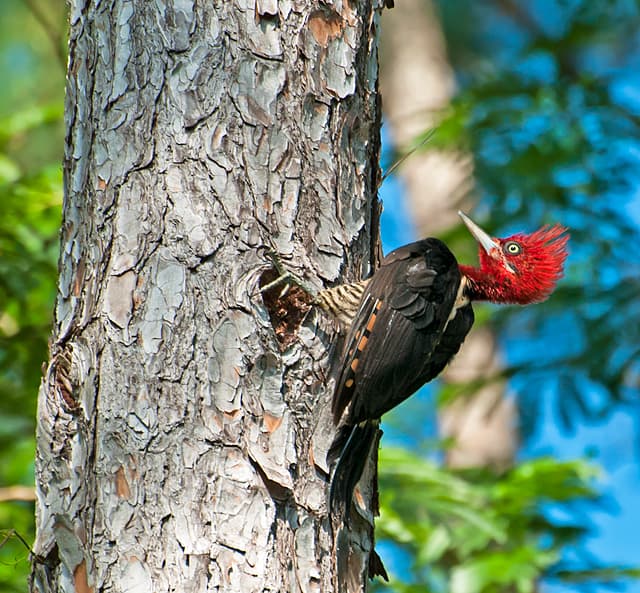
Robust woodpecker
The robust woodpecker is a large woodpecker species found in the humid forests of Argentina, Brazil, and Paraguay. It is characterized by its distinctive red head in males and a prominent whitish stripe in females, along with black and buff-spotted plumage. This species primarily feeds on beetles and forages by pecking and probing tree trunks.
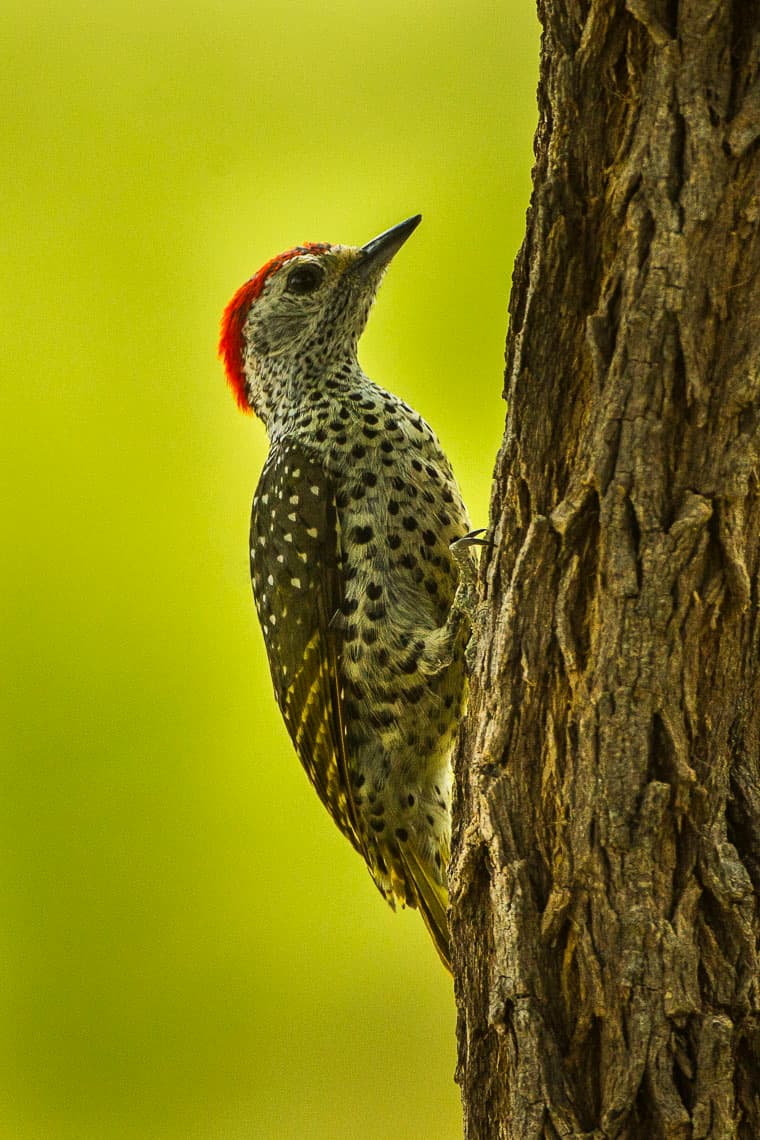
Little green woodpecker
The little green woodpecker is a bird species found across tropical Africa, inhabiting forest edges, clearings, and forest-shrub mosaics. This species is characterized by its yellowish-green or bronze-green upperparts, buff head and neck with brown spots, and olive or blackish beak. It is currently assessed as a least-concern species by the IUCN due to its wide distribution and increasing population.

Arabian woodpecker
The Arabian woodpecker is a species found exclusively in the Sarawat Mountains of Saudi Arabia and Yemen, making it the sole woodpecker to breed on the Arabian Peninsula. This bird, approximately 18 cm in length, is characterized by its brownish head with a red crown patch in males, olive-grey streaked plumage, and a grey underpart with a red-suffused belly. It inhabits various woodland environments, from sea level up to 2,800 meters, feeding primarily on insect grubs and spiders.