
Little green woodpecker
The little green woodpecker is a bird species found across tropical Africa, inhabiting forest edges, clearings, and forest-shrub mosaics. This species is characterized by its yellowish-green or bronze-green upperparts, buff head and neck with brown spots, and olive or blackish beak. It is currently assessed as a least-concern species by the IUCN due to its wide distribution and increasing population.
Key Facts
- ›It is widely distributed in tropical Africa, preferring forest edges, clearings, and forest-shrub mosaics.
- ›The species measures approximately 16 cm (6.3 in) in length and weighs about 54 g (1.9 oz).
- ›Its diet primarily consists of arboreal ants.
- ›The little green woodpecker excavates its nests in the nests of ants and termites.
- ›It is classified as a least-concern species by the IUCN, with a large range and an increasing population.
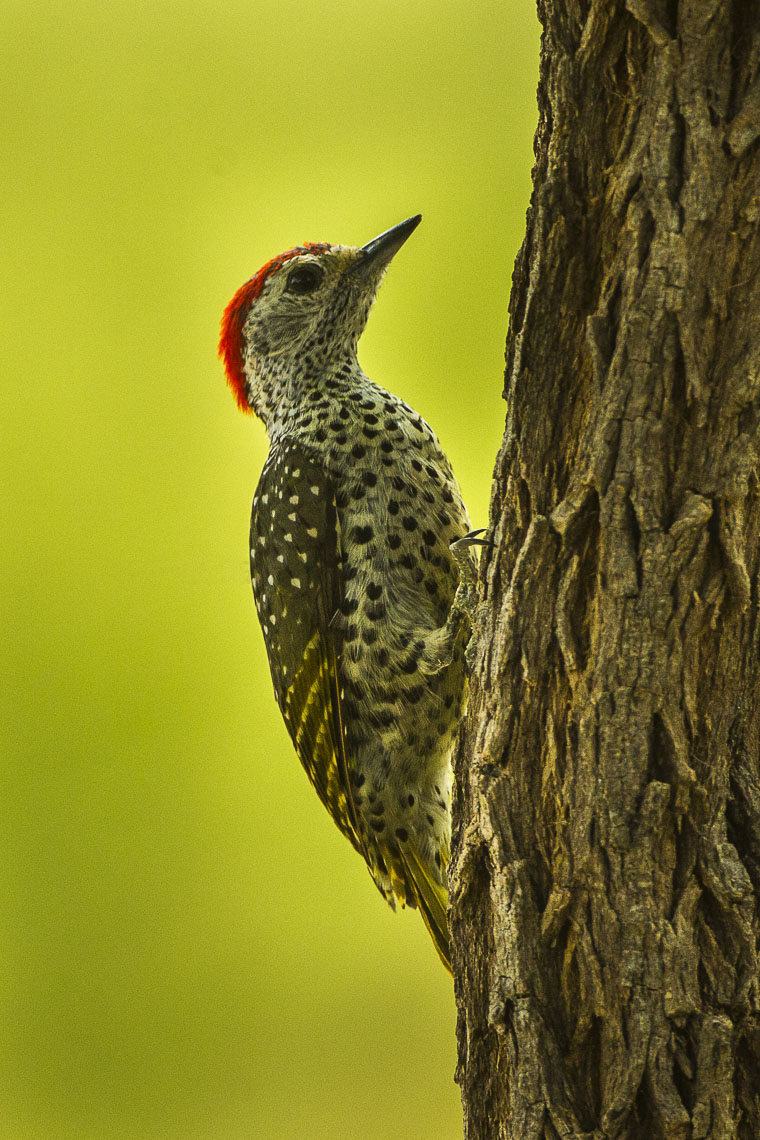
- ›Males have a reddish nape and indistinct reddish color on their crown, while females lack red on the head.
Green-Backed Woodpecker, Little Spotted Woodpecker
Tropical Africa
Forest Edges, Clearings, Forest-Shrub Mosaics
Yellowish-Green, Bronze-Green, Olive-Blackish, Red, Buff, Brown, Blackish, Greenish-White, Olive
Male's red nape, Male's indistinct reddish crown color, Buff head, neck, and throat with brown spots, Deep olive bars on underparts, Female's buff spots on crown and nape
Arboreal Ants
Excavates nests in nests of ants and termites
Nests of Ants, Nests of Termites
Plaintive Huweeeeh, Harsh Whee, Kewik, Three To Four Teeay Notes, Teerweet
About Little green woodpecker
The little green woodpecker, scientifically known as Campethera maculosa, is a bird species belonging to the Picidae family. It is widely distributed across tropical Africa, where it thrives in diverse environments such as forest edges, clearings, and mosaics of forest and shrub, typically at elevations up to 1,000 meters.
Description and Identification
This species measures approximately 16 cm (6.3 inches) in length and weighs around 54 grams. Adult males are distinguished by an olive-blackish crown with an indistinct reddish hue and a red nape. Their head, neck, and throat are buff, adorned with brown spots. The upperparts display a yellowish-green or bronze-green coloration, with brown flight feathers featuring buffish bars and a blackish tail with yellow and green markings. The underparts are buffish from the throat to the breast, transitioning to greenish-white below, all marked with deep olive bars. The beak is olive or blackish, the eyes are brown, and the legs are olive-grey. Females differ from males by lacking red on the head and possessing buff spots on their crown and nape. Juvenile birds have greener upperparts with pale streaks and paler underparts.
Behavior and Ecology
The little green woodpecker's diet primarily consists of arboreal ants. Its vocalizations include a plaintive "huweeeeh," a harsh "whee," "kewik," three to four "teeay" notes, and "teerweet." A notable aspect of its behavior is its nesting practice: it excavates its nests within the existing nests of ants and termites, utilizing these structures for shelter and raising young. The breeding season is noted to occur in August, with possible breeding also in March and April.
Distribution and Conservation
The species is widely distributed throughout tropical Africa. Logging and forest clearing activities, which tend to create more open habitats, appear to be contributing to a population increase for this bird. Consequently, due to its large range and growing population, the International Union for Conservation of Nature (IUCN) has assessed the little green woodpecker as a species of Least Concern.
Source: Wikipedia ↗
Frequently Asked Questions
What is the scientific name of the little green woodpecker?
The scientific name of the little green woodpecker is *Campethera maculosa*. It was formally described in 1826 by French zoologist Achille Valenciennes and belongs to the genus *Campethera*.
Where can the little green woodpecker be found?
This species is widely distributed across tropical Africa. Its preferred habitats include forest edges, clearings, and mosaics of forest and shrub.
What does the little green woodpecker eat?
The primary food source for the little green woodpecker is arboreal ants. They forage for these insects within their habitat.
What are the nesting habits of the little green woodpecker?
The little green woodpecker excavates its nests within the existing nests of ants and termites. This behavior provides a protected environment for their young.
What is the conservation status of the little green woodpecker?
The International Union for Conservation of Nature (IUCN) has assessed the little green woodpecker as a least-concern species. This is attributed to its large geographic range and a population trend that is currently increasing.
How can I distinguish between a male and female little green woodpecker?
Male little green woodpeckers can be identified by the presence of red on their nape and an indistinct reddish color on their crown. Females, in contrast, do not have red on their head and exhibit buff spots on their crown and nape.
Related Woodpecker species

Eastern grey woodpecker
The eastern grey woodpecker is a resident bird species found in tropical eastern Africa, known for its insectivorous diet and distinctive plumage. Both males and females share yellowish-green upper parts and a red rump, but males sport a red crown and nape, while females have a plain grey head. This species is considered common and its conservation status is of least concern.

Melancholy woodpecker
The melancholy woodpecker is a species of woodpecker found in West Africa, inhabiting forests, woodlands, and clearings. This bird, measuring 17-18 cm in length, is characterized by its bronzy-green upperparts and greenish-yellow underparts with brown streaks. It is known for its insectivorous diet, foraging in family groups within the forest canopy.

Stripe-cheeked woodpecker
The stripe-cheeked woodpecker is a species endemic to Panama, characterized by its bronze-green upperparts and buffy white underparts with greenish olive barring. Males and females exhibit sexual dimorphism primarily in head plumage, with males displaying more extensive red coloration. This bird inhabits humid forests at mid-elevations.