
Robust woodpecker
The robust woodpecker is a large woodpecker species found in the humid forests of Argentina, Brazil, and Paraguay. It is characterized by its distinctive red head in males and a prominent whitish stripe in females, along with black and buff-spotted plumage. This species primarily feeds on beetles and forages by pecking and probing tree trunks.
Key Facts
- ›Found in eastern Brazil, eastern Paraguay, and northeastern Argentina.
- ›Measures 32-37 cm in length and weighs 230-294 g.
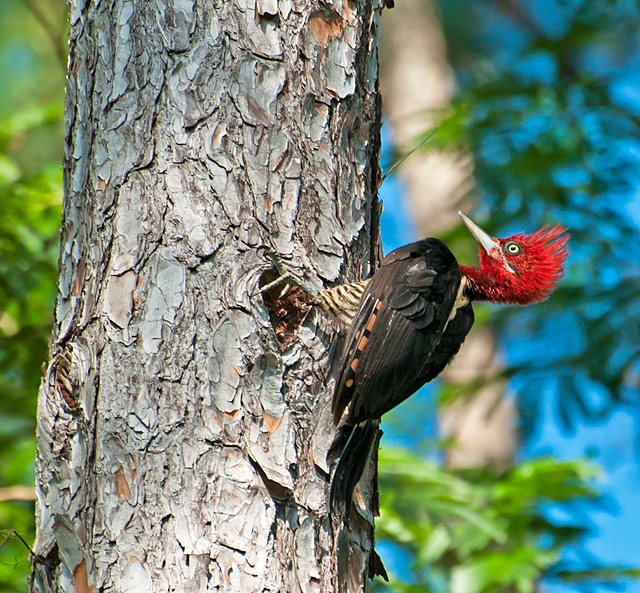
- ›Adult males have entirely red heads, while females have a whitish stripe from bill to ear coverts.
- ›Diet consists mainly of adult and larval beetles, with some berries.
- ›Forages on tree trunks and limb bases, pecking and probing bark.
- ›Listed as Least Concern by the IUCN, with a believed increasing population trend.
South America
Humid Forests, Moist Forests, Araucaria Forests
- Male entirely red head and neck
- Female whitish stripe from bill to ear coverts
- Black and white spot on male ear coverts
- Long horn-colored chisel bill
Beetles, Berries
Pecks and Hammers Tree Trunks, Probes and Flakes Off Bark, Forages At Middle Forest Levels
Tree Cavities
"Psó-Ko Po-Po-Po-Po-Rrat" Series, "Kee" Call, "Kew" Call, Double Tap Drumming
About Robust woodpecker
The robust woodpecker (Campephilus robustus) is a striking member of the woodpecker family, found in the humid and moist forests of eastern Brazil, eastern Paraguay, and the northeastern provinces of Misiones and Corrientes in Argentina. This species is notable for its size, measuring between 32 to 37 cm in length and weighing up to 294 grams.
Physical Characteristics
Distinguishing features vary between sexes. Adult males are characterized by an entirely red head and neck, with a small black and white spot on their ear coverts. Adult females, while sharing the whitish upperparts with buff or cinnamon tinges and black-barred underparts, possess a prominent wide whitish stripe with black edges that extends from their bill to their ear coverts. Both sexes have black tails and wings that are spotted with rusty-buff on the flight feathers. Their bills are long and horn-colored, resembling a chisel, with white to yellow-white irises and dark gray legs. Juveniles are generally duller and browner than adults.
Distribution and Habitat
The robust woodpecker inhabits intact humid forests and Araucaria moist forests, generally avoiding disturbed areas unless large trees remain. They are found from sea level up to elevations of 2,200 meters.
Behavior and Diet
This species is a year-round resident within its range. The robust woodpecker forages across all forest levels, with a preference for the middle strata, and rarely descends to the ground. Their foraging technique involves vigorous pecking and hammering on tree trunks and the bases of limbs, often probing and flaking off bark to find food. They primarily feed on adult and larval beetles and occasionally consume berries. Foraging typically occurs singly, in pairs, or in family groups, with infrequent participation in mixed-species feeding flocks.
Breeding and Vocalizations
Little is known about the breeding biology of the robust woodpecker. One observation recorded a nest being excavated in May, with young present in July. Their vocalizations include a distinct series described as "psó-ko po-po-po-po-rrat," as well as "kee" and "kew" calls. Their drumming is characterized by a double tap, noted as "to-plóp" or "thump-ump."
Conservation Status
The International Union for Conservation of Nature (IUCN) has assessed the robust woodpecker as Least Concern. While its range is somewhat limited and its population size is not precisely known, the population is believed to be increasing. No immediate threats have been identified, and the species is present in numerous protected areas. However, it is considered highly sensitive to forest fragmentation, underscoring the need for further research into its ecology and breeding habits.
Source: Wikipedia ↗
Frequently Asked Questions
What is the scientific name of the robust woodpecker?
The scientific name of the robust woodpecker is *Campephilus robustus*. It was formerly placed in genera like *Scapaneus* and *Phloeoceastes* before being assigned to the current genus *Campephilus*.
Where can the robust woodpecker be found?
The robust woodpecker is distributed across eastern Brazil, eastern Paraguay, and the northeastern provinces of Misiones and Corrientes in Argentina. It inhabits intact humid and Araucaria moist forests.
What are the physical characteristics of the robust woodpecker?
Adult males have striking entirely red heads and necks, while females are distinguished by a wide whitish stripe with black edges extending from their bill to their ear coverts. Both sexes share whitish upperparts with buff tinges and black-barred underparts, with wings featuring rusty-buff spots.
What does the robust woodpecker eat?
The primary diet of the robust woodpecker consists of adult and larval beetles. They also supplement their diet with some berries.
How does the robust woodpecker forage for food?
This species forages at various forest levels, with a slight preference for the middle strata, and rarely on the ground. It actively pecks and hammers on tree trunks and the bases of limbs, often probing and flaking off bark to access prey.
What is the conservation status of the robust woodpecker?
The robust woodpecker is assessed by the IUCN as Least Concern. Although its range is somewhat limited and population size is unknown, its population is believed to be increasing and no immediate threats have been identified.
What sounds does the robust woodpecker make?
Vocalizations include a distinctive "psó-ko po-po-po-po-rrat" series, as well as "kee" and "kew" calls given in flight and while perched. Its drumming is a double tap, described as "to-plóp" or "thump-ump".
Related Woodpecker species

Eastern grey woodpecker
The eastern grey woodpecker is a resident bird species found in tropical eastern Africa, known for its insectivorous diet and distinctive plumage. Both males and females share yellowish-green upper parts and a red rump, but males sport a red crown and nape, while females have a plain grey head. This species is considered common and its conservation status is of least concern.

Guayaquil woodpecker
The Guayaquil woodpecker is a large woodpecker species found in southwestern Colombia, Ecuador, and northwestern Peru. It is characterized by its black and buff barred upperparts, prominent white neck stripes, and in adult males, a striking red head. This species primarily inhabits dry to humid deciduous forests and mature secondary forests.
Helmeted woodpecker
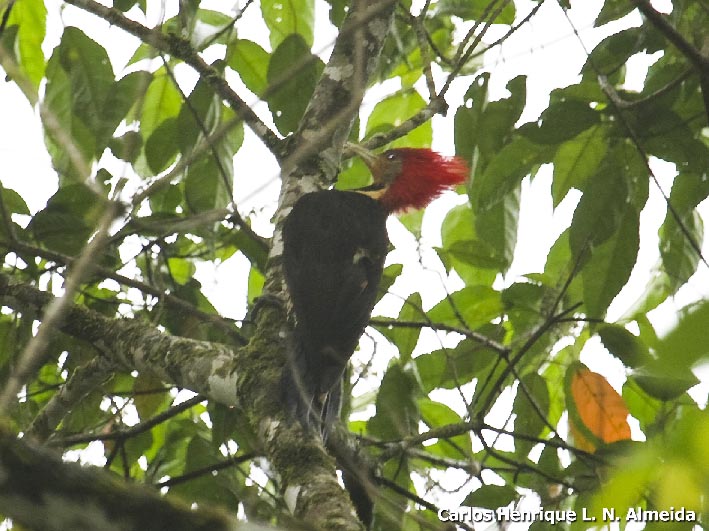
The helmeted woodpecker (Celeus galeatus) is a Vulnerable species found in Argentina, Brazil, and Paraguay, primarily inhabiting the Atlantic Forest. This medium-sized woodpecker is distinguished by its cinnamon face, long red crest, and black and buff plumage, with males exhibiting a distinctive red malar patch. It primarily forages by probing soft decaying trees rather than hammering, and its limited vocalizations include a distinctive long call.