
European green woodpecker
The European green woodpecker is a large woodpecker characterized by its vibrant green upperparts, pale yellowish-green underparts, red crown, and a distinct black moustachial stripe. Primarily found across Europe and parts of western Asia, this shy bird is more often heard than seen, known for its loud, distinctive calls. It predominantly forages for ants on the ground, a behavior that sets it apart from many other woodpecker species.
Key Facts
- ›Measures 30–36 cm in length with a wingspan of 45–51 cm.
- ›Distinctive features include a red crown and a black moustachial stripe, which has a red center in males.
- ›Primarily feeds on ants found on the ground, using a long, sticky tongue.
- ›Nests are excavated in trees, typically oaks, beeches, or fruit trees.
- ›Known for its loud, distinctive 'yaffling' call, which often alerts observers to its presence.
- ›Considered of 'Least Concern' by the IUCN due to stable populations and a large distribution.

Yaffle, Nickle
Europe, Western Asia
Semi-Open Landscapes, Small Woodlands, Hedges, Edges of Forests, Floodplain Forests, Grassland, Heaths, Plantations, Orchards, Lawns
Red Crown and Nape, Black Moustachial Stripe, Yellow Rump
Ants
- Forages on the ground
- Probes into the ground at ant nests
- Uses long, sticky tongue to lick up ants and larvae
Excavated Holes In Trees
Loud, Laughing Call, Noisy Kyü-Kyü-KyüCk In Flight, Song: Loud Series of 10–18 'Klü' Sounds, Female Call: Thinner Pü-Pü-Pü-Pü-Pü-Pü-Pü
About European green woodpecker
The European green woodpecker (Picus viridis), also commonly known as the yaffle, is a conspicuous member of the woodpecker family found across a wide range of Europe and into western Asia. This large bird is distinguished by its vibrant green upperparts, pale yellowish-green underside, a bright red crown, and a prominent black moustachial stripe, which is bisected by red in males but solid black in females. Despite its striking plumage, the European green woodpecker is a shy species, more often detected by its loud, distinctive calls than by sight.
Habitat and Diet
Essential to the survival of the European green woodpecker are areas that combine old deciduous trees for nesting with abundant ant populations nearby for food. These conditions are typically met in semi-open landscapes featuring small woodlands, hedgerows, scattered mature trees, forest edges, and floodplain forests. Foraging grounds can include grasslands, heaths, plantations, orchards, and even lawns. Their diet consists predominantly of ants, which they gather by foraging on the ground and probing into ant nests. Their specialized, elongated tongues are adapted for this purpose, aided by sticky secretions from enlarged salivary glands.
Behavior and Reproduction
Distinct from many other woodpeckers, the European green woodpecker rarely engages in 'drumming' on trees. Instead, its presence is often announced by its loud 'yaffling' call or a noisy flight call. During flight, they exhibit an undulating pattern of wingbeats followed by a glide. Nesting involves excavating a cavity in trees such as oaks, beeches, willows, and fruit trees, with the male typically undertaking most of the excavation work over a period of 15 to 30 days. A single brood of four to six white eggs is laid, incubated by both parents for 19–20 days. The altricial chicks fledge approximately 21–24 days after hatching.
Conservation
The European green woodpecker is classified as 'Least Concern' by the IUCN. Its populations are considered stable across its large range, which extends over an estimated Global Extent of Occurrence of one million to ten million square kilometers. The species is highly sedentary, with individuals rarely moving more than 500 meters between breeding seasons. Heavy snow cover can pose a challenge, significantly impacting feeding and potentially leading to high mortality, with population recovery sometimes taking up to ten years.
Source: Wikipedia ↗
Frequently Asked Questions
What does the European green woodpecker eat?
The primary food source for the European green woodpecker is ants from the genera Lasius and Formica. They forage on the ground to find these insects, probing into ant nests and using their long, sticky tongues to collect adult ants and larvae. Occasionally, they may also consume other insects and small reptiles.
What are the main physical characteristics of the European green woodpecker?
This woodpecker is large, measuring between 30–36 cm in length. Its upperparts are green, and its underparts are a pale yellowish-green, with a yellow rump. A striking feature is its red crown and nape, and both sexes possess a black moustachial stripe, though the male's stripe has a red center.
Where is the European green woodpecker found?
The European green woodpecker has a wide distribution across much of Europe and extends into western Asia. It is absent from some northern and eastern parts of Europe, as well as Ireland and Greenland. Spain and Portugal are home to the similar Iberian green woodpecker instead.
How does the European green woodpecker differ from other woodpeckers?
Unlike many other woodpecker species, the European green woodpecker spends a significant amount of time foraging on the ground for ants. It also 'drums' on trees very rarely, and its loud, laughing call, known as 'yaffling', is more characteristic than its drumming.
What are the nesting habits of the European green woodpecker?
Nesting holes are excavated in trees, with preferences for oaks, beeches, willows, and fruit trees in western and central Europe, and aspens in the north. The entrance hole is typically 60 mm × 75 mm, and the cavity can be up to 40 cm deep. Both parents share incubation duties, and the chicks fledge after about 21–24 days.
Related Woodpecker species

Eurasian wryneck
The Eurasian wryneck is a migratory woodpecker species found predominantly in temperate regions of Europe and Asia, wintering in tropical Africa and southern Asia. It is characterized by its thrush-like body shape, unique snake-like head-twisting ability used as a defense mechanism, and a diet primarily consisting of ants and other insects.

Chilean flicker
The Chilean flicker is a medium-sized woodpecker species found in central and southern Chile and southwestern Argentina. It primarily inhabits semi-open to open landscapes and feeds almost exclusively on ants found on the ground. This species is characterized by its dark slate gray head in males, buffish underparts with blackish brown barring, and a white rump.
Antillean piculet
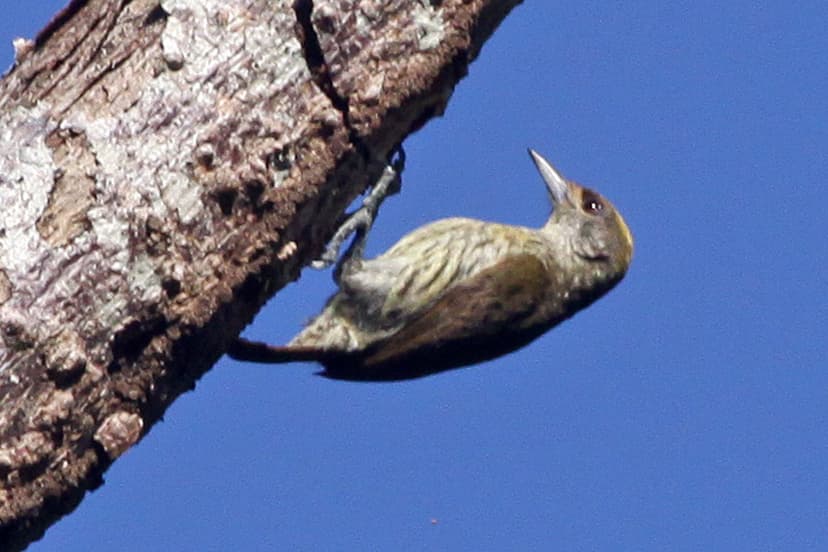
The Antillean piculet is a small woodpecker endemic to the Caribbean island of Hispaniola, shared by the Dominican Republic and Haiti. It is notable for being the sole member of its genus, Nesoctites, and is evolutionarily distinct from other piculets. This species inhabits a variety of forest types and scrublands, preferring dense undergrowth and foraging primarily for insects.