
Lafresnaye's piculet
Lafresnaye's piculet is a small bird belonging to the woodpecker family, found across parts of South America, including Brazil, Colombia, Ecuador, and Peru. This species is characterized by its olive-brown plumage, distinctive spotting on its head, and barred underparts, with slight variations among its four subspecies.
Key Facts
- ›Measures 9 to 10 cm in length and weighs 9 to 10 grams.
- ›Found in humid mature forest edges, clearings, and secondary forests.
- ›Primarily feeds on termites and other small invertebrates.
- ›Breeds between July and November, with nests found in shrubs.
- ›Considered Least Concern by the IUCN, though its population is believed to be decreasing.
- ›Known for a high-pitched 'tseeyt, tsit' vocalization.

Brazil, Colombia, Ecuador, Peru
Humid Mature Forest Edges, Forest Clearings, Secondary Forest
Olive-Brown, Green, Brownish Green, Yellowish Green, Grayish Buff, Yellow-Orange, Rufous
Red Or Yellow-Orange Spots On Forehead, Whitish Spots On Crown, Yellowish Green Bars On Upperparts, Black Bars On Underparts
Termites, Small Invertebrates
Gleans prey in lower and middle forest strata, Joins mixed-species foraging flocks
Holes In Shrubs
High-Pitched 'Tseeyt, Tsit', Extr. High 'See-See'
About Lafresnaye's piculet
Lafresnaye's piculet, scientifically known as Picumnus lafresnayi, is a small member of the woodpecker family found in the Amazon basin of South America. This species inhabits the edges and clearings of humid, mature forests, as well as secondary forest growth, and is typically observed up to 1,400 meters in elevation, occasionally reaching 1,800 meters in Ecuador.
Description and Identification
Measuring between 9 to 10 cm in length and weighing 9 to 10 grams, Lafresnaye's piculet exhibits distinct plumage. Adult males of the nominate subspecies possess a dark olive-brown cap with red spots on the forehead and whitish spots on the rest of the crown and nape. Their faces are a grayish buff with brown streaks, and a pale stripe extends behind the eye. The upperparts are dark green or brownish green, marked with yellowish green bars, while the tail is blackish with significant white markings on the outer feathers. The chin and throat are buffish white with fine black marks, and the underparts are pale yellowish white with prominent black bars. Adult females differ by having whitish spots across their entire crown. Juveniles are generally duller and greener than adults.
The four recognized subspecies display variations, notably in the forehead spotting, which is yellow-orange in subspecies other than the nominate form. Differences in facial coloration, underpart barring, and upperpart tinges further distinguish these subspecies.
Distribution and Habitat
Lafresnaye's piculet is distributed across Brazil, Colombia, Ecuador, and Peru. Specific subspecies occupy distinct regions: P. l. lafresnayi ranges from southeastern Colombia through eastern Ecuador to Peru's San Martín Department; P. l. punctifrons is found in northern Peru's Amazonas Department; P. l. taczanowskii inhabits northeastern and north-central Peru; and P. l. pusillus is located in north-central Brazil along the middle Amazon to the Rio Negro.
Behavior and Ecology
This species is considered a year-round resident throughout its range, with no known migratory patterns. Lafresnaye's piculet forages by gleaning prey, primarily termites and other small invertebrates, from the lower and middle strata of the forest. They are often observed joining mixed-species foraging flocks, which can enhance their feeding success.
Reproduction
Breeding for Lafresnaye's piculet appears to occur between July and November. Information on nesting is limited, but known nests have been found in holes within shrubs, approximately 3 meters above the ground, and have contained two eggs. Both sexes are involved in caring for the hatchlings, though the incubation period and time to fledging are not documented.
Vocalization
Lafresnaye's piculet is not particularly vocal, but it does produce occasional calls described as a high-pitched 'tseeyt, tsit' or an 'extr. high see-see'.
Conservation Status
The International Union for Conservation of Nature (IUCN) has classified Lafresnaye's piculet as Least Concern. While it possesses a large geographic range, its population size remains unknown and is believed to be in decline. No immediate threats have been identified, but the species is considered uncommon to fairly common in Ecuador and rare in Peru.
Source: Wikipedia ↗
Frequently Asked Questions
What is the scientific name of Lafresnaye's piculet?
The scientific name of Lafresnaye's piculet is Picumnus lafresnayi. It belongs to the subfamily Picumninae within the woodpecker family, Picidae.
What is the geographic range of Lafresnaye's piculet?
Lafresnaye's piculet is found in Brazil, Colombia, Ecuador, and Peru. Its distribution varies slightly among its four recognized subspecies.
What does Lafresnaye's piculet eat?
The primary food source for Lafresnaye's piculet is termites. It is also assumed to consume other small invertebrates found in its habitat.
What are the nesting habits of Lafresnaye's piculet?
Lafresnaye's piculet builds its nests in holes, typically in shrubs, about 3 meters above the ground. Limited information is available on their breeding, but nests have been observed to contain two eggs.
What is the conservation status of Lafresnaye's piculet?
The IUCN has assessed Lafresnaye's piculet as Least Concern. Despite its wide range, its population size is unknown and is believed to be declining.
Related Woodpecker species
Golden-spangled piculet
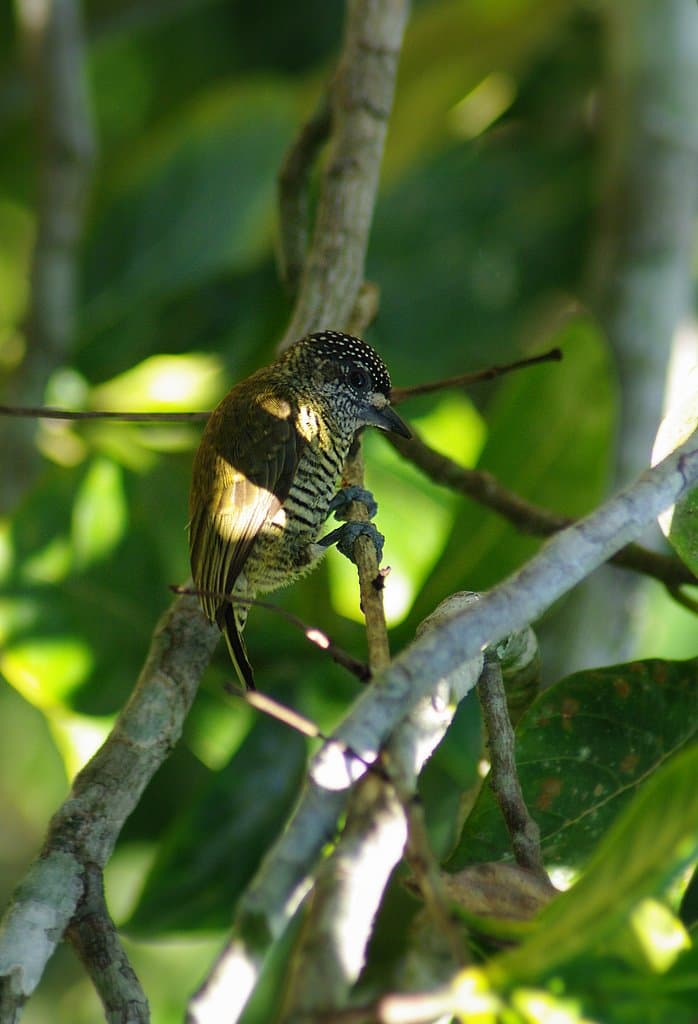
The golden-spangled piculet is a small bird found across several South American countries, inhabiting diverse wooded environments from rainforests to savannas. It is characterized by its distinctive plumage, with males and females exhibiting variations in their spotted caps, and is known for foraging in the lower strata of forests and nesting in soft wood.

Sulu pygmy woodpecker
The Sulu pygmy woodpecker is a small bird endemic to the Philippines, found in tropical lowland forests, mangroves, and arable lands. It is threatened by habitat loss due to deforestation and conversion of land for agriculture and urbanization. This species is known for foraging on dead tree branches, often alone or in pairs, and is presumed to feed on insects.
Yellow-eared woodpecker
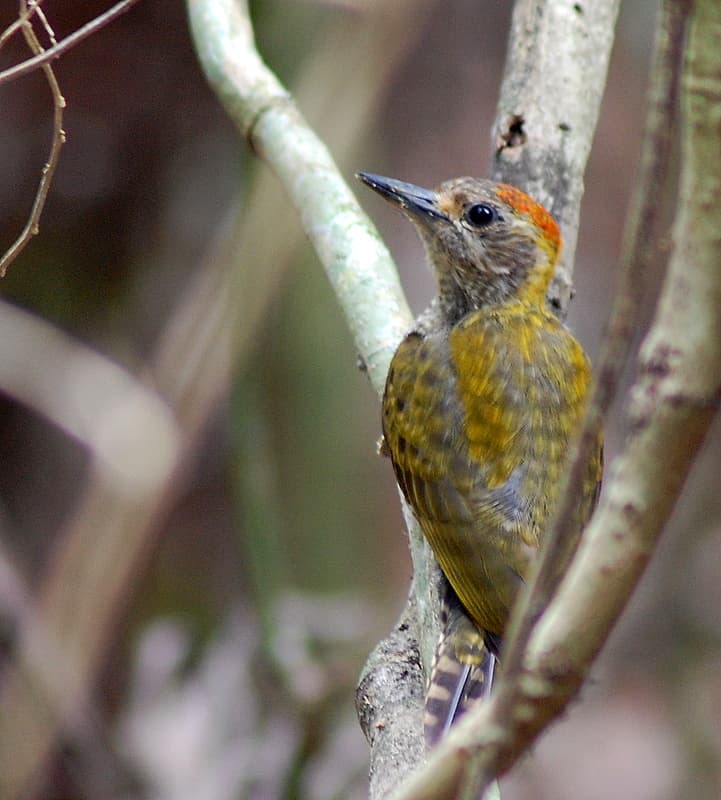
The yellow-eared woodpecker is a species of bird endemic to eastern Brazil, found between the states of Bahia and Rio de Janeiro. This species inhabits lowlands and hills of the Atlantic Forest, including primary and secondary forests, as well as parks. Adults are approximately 15 cm long and are characterized by olive-brown faces with whitish streaks and a pale golden-yellow nape, with males and females differing primarily in their head plumage.