
Grey-crowned woodpecker
The grey-crowned woodpecker is a bird species endemic to western Mexico, known for its distinctive head patterning. It inhabits semi-humid and humid forests, as well as pine-oak forests, and forages at all levels for a diet that includes insects and berries. The species is currently assessed as Least Concern by the IUCN, though its population is believed to be decreasing due to habitat loss.
Key Facts
- ›Endemic to western Mexico, found from southern Sonora and Chihuahua to southern Oaxaca.
- ›Inhabits semi-humid, humid, and pine-oak forests.
- ›Diet includes termites, other invertebrates, and berries.
- ›Males have a light gray crown and nape, with a red stripe below the buff-colored sides of the head.
- ›Females lack the red facial stripe.
- ›Assessed as Least Concern by the IUCN, but population is believed to be decreasing.

Grey-Crowned Woodpecker
Mexico
Confluent, Fine Patterning On the Head, Red Stripe Below Lores and Sides of Head
Termites, Invertebrates, Berries
Forages at all levels from ground to canopy
Tree Cavities
Song: Rapid, Shrill, Churring Rattle, Call: Sharp, Slightly Explosive Kea'Ah, Call: Gruff Mewing Growh, Drum: Short and Rapid
About Grey-crowned woodpecker
The grey-crowned woodpecker, scientifically known as Colaptes auricularis, is a bird species found exclusively in western Mexico. It belongs to the woodpecker family Picidae and is characterized by the fine, confluent patterning on its head, which gives it its name. This species inhabits the interior and edges of semi-humid and humid forests, as well as pine-oak forests, ranging in elevation from near sea level up to 2,400 meters.
Description and Identification
Adult grey-crowned woodpeckers measure approximately 19.5 to 21 cm in length and weigh around 65 grams. While males and females share much of their plumage, they differ significantly in their head coloration. Adult males possess a light gray crown and nape, with pale brownish buff on their lores and sides of the head, often marked with indistinct grayish bars. A distinctive wide red stripe runs below this buffy area, and they have a dull white chin and upper throat. Adult females, in contrast, lack any red coloration on their head. Both sexes have predominantly pale olive to olive-green upperparts, with their rump and uppertail coverts barred in pale yellow or yellowish white. Their wings are a brighter olive green than their backs, and their tails are pale yellowish olive green, sometimes featuring darker bars or spots on the outer feathers. The underparts of both sexes are yellowish white or pale yellowish, marked with irregular olive bars. Their bills are dark gray, irises are brown, and legs are gray.
Behavior and Ecology
The grey-crowned woodpecker is a year-round resident throughout its documented range. It exhibits versatile foraging behavior, searching for food at all vertical levels within its forest habitat, from the ground to the highest canopy. Although detailed dietary studies are limited, its known food sources include termites, other invertebrates, and berries. The breeding season for this species is not fully understood but is known to encompass at least March and April. Little else is recorded about its breeding biology. Vocalizations attributed to the grey-crowned woodpecker include a rapid, shrill, churring rattle, described as its song, along with calls such as a sharp, slightly explosive 'kea'ah' and a gruff 'mewing growh'. Its drumming pattern is noted as being short and rapid.
Distribution and Conservation
The species' distribution is confined to western Mexico, spanning from southern Sonora and Chihuahua to southern Oaxaca. The International Union for Conservation of Nature (IUCN) has assessed the grey-crowned woodpecker as Least Concern. While it possesses a large geographic range and an estimated population of at least 20,000 mature individuals, this population is believed to be in decline. No immediate threats have been identified, but the species faces increased risk due to its reliance on threatened tropical highland forest habitats. Habitat loss, driven by conversion for agriculture, wood harvesting, and livestock grazing, represents the primary threat to its long-term survival.
Source: Wikipedia ↗
Frequently Asked Questions
What is the scientific name of the grey-crowned woodpecker?
The scientific name of the grey-crowned woodpecker is Colaptes auricularis. It was previously classified under different genera, including Chloronerpes and Piculus, before being moved to Colaptes.
Where is the grey-crowned woodpecker found?
This species is endemic to western Mexico, with its range extending from southern Sonora and Chihuahua down to southern Oaxaca. It prefers forests with varying humidity levels and can also be found in pine-oak woodlands.
What does the grey-crowned woodpecker eat?
While its diet is not fully detailed, the grey-crowned woodpecker is known to consume termites, other invertebrates, and berries. It forages for food at all levels of the forest, from the ground to the canopy.
What are the physical characteristics of the grey-crowned woodpecker?
The grey-crowned woodpecker measures between 19.5 to 21 cm (7.7 to 8.3 in) and weighs around 65 g (2.3 oz). Adult males feature a light gray crown and nape with a red facial stripe, while females lack this red coloration. Both sexes have olive to olive-green upperparts and barred underparts.
What is the conservation status of the grey-crowned woodpecker?
The grey-crowned woodpecker is listed as Least Concern by the IUCN. Despite its broad range and estimated population size, its numbers are thought to be declining due to habitat loss.
Related Woodpecker species
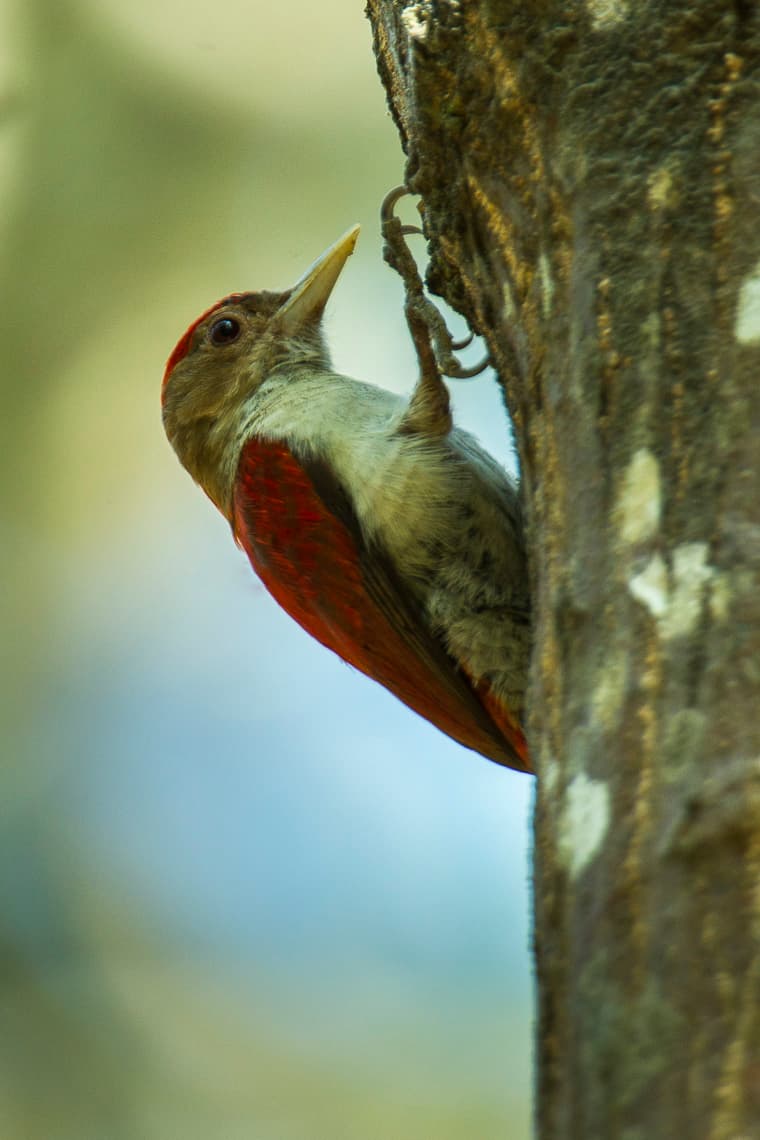
Scarlet-backed woodpecker
The scarlet-backed woodpecker is a small bird found in Colombia, Ecuador, and Peru, notable for its brownish-scarlet upperparts and the distinct head plumage differences between males and females. It inhabits a variety of dry and semi-humid woodlands and scrublands, foraging at all forest levels. Its conservation status is Least Concern, with a population believed to be increasing.

Guatemalan flicker
The Guatemalan flicker is a species of woodpecker found in Middle America, ranging from southern Mexico to Nicaragua. It is characterized by its distinct facial markings, barred back, and a white rump. This species primarily forages on the ground for insects and also consumes fruits and seeds, nesting in excavated cavities in dead trees.
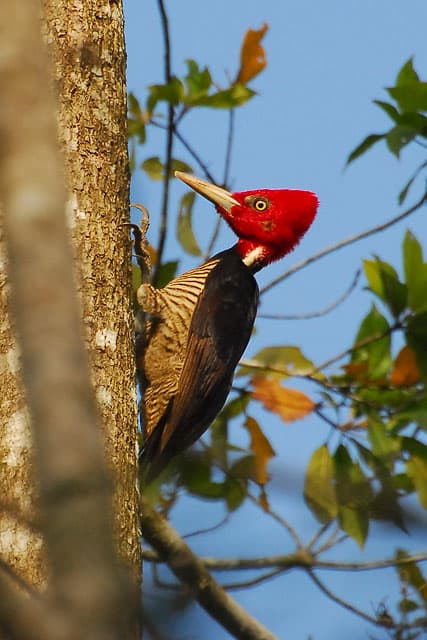
Pale-billed woodpecker
The pale-billed woodpecker is a large woodpecker species found from Mexico to Panama, inhabiting various forested landscapes including lowland tropical evergreen forests. It is characterized by its black upperparts with white or buffy white stripes, a long ivory-yellow bill, and a red head with a bushy crest in adult males. Primarily feeding on the larvae of wood-boring beetles, this species plays a role in forest ecosystems by excavating dead trees for nesting and foraging.