
Pale-billed woodpecker
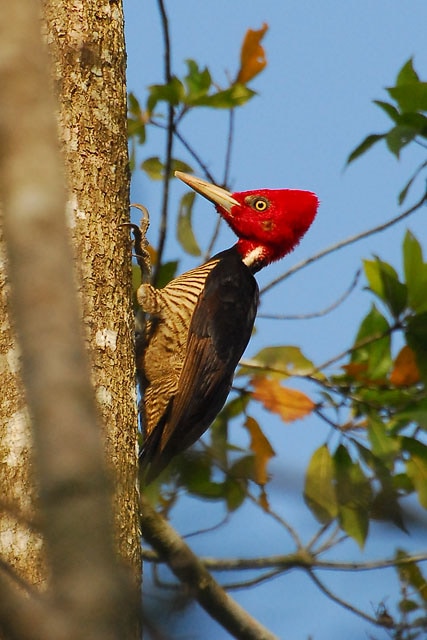
The pale-billed woodpecker is a large woodpecker species found from Mexico to Panama, inhabiting various forested landscapes including lowland tropical evergreen forests. It is characterized by its black upperparts with white or buffy white stripes, a long ivory-yellow bill, and a red head with a bushy crest in adult males. Primarily feeding on the larvae of wood-boring beetles, this species plays a role in forest ecosystems by excavating dead trees for nesting and foraging.
Key Facts
- ›Found from Mexico to Panama in diverse forested habitats.
- ›Measures 35.5 to 38 cm in length with a distinctive ivory-yellow bill.
- ›Adult males have a red head and bushy crest, while females have a black forecrown and throat.
- ›Diet primarily consists of large larvae of wood-boring beetles, supplemented with termites and fruits.
- ›Nests are excavated in large, often dead, trees, typically 3 to 12 meters above ground.
- ›Assessed as Least Concern by the IUCN, though its population is believed to be decreasing due to habitat loss.
Mexico, Central America, Panama
Lowland Tropical Evergreen Forest, Tropical Deciduous Forest, Mangroves, Montane Evergreen Forest, Pine-Oak Forest
Black, White, Buffy White, Dull Brown, Greenish Olive-Yellow, Red
- Long ivory yellow chisel bill
- Adult male red head with bushy crest
- White or buffy white stripes on neck and back forming a 'V'
- Black throat and upper breast
Larvae of Wood-Boring Beetles, Termites
- Forages in mid- to upper forest levels
- Feeds on tree trunks and large limbs
- Excavates in decayed wood
- Scales bark from dead trees
- Forages on the ground at stumps and fallen logs
Excavated nest cavity in a large tree, Often in dead trees, 3 to 12 meters above the ground
Variable, Nasal Chatter Or Sputter, Nasal Kip Kip Kip Kip-Hey'Eh'Eh Call, Low Whining Notes, Low Whining Or Moaning Call, Loud 'Bleating' Call
About Pale-billed woodpecker
The pale-billed woodpecker (Campephilus guatemalensis) is a distinctive species of woodpecker found across a broad range from Mexico to Panama. This bird inhabits the interior and edges of various forest types, with a particular preference for lowland tropical evergreen forests, but it also occurs in deciduous forests and mangroves in drier regions.
Physical Characteristics
Measuring between 35.5 and 38 centimeters in length, the pale-billed woodpecker is notable for its robust build and striking appearance. The nominate subspecies, C. g. guatemalensis, weighs between 263 and 282 grams, while C. g. regius is slightly lighter, ranging from 205 to 244 grams. Both sexes share black upperparts adorned with vertical white or buffy white stripes on the sides of the neck that extend onto the back, often forming a 'V' shape. Their tail is dull brown, and their wings are primarily black with dull brown outer primaries. The throat and upper breast are black, transitioning to light yellowish buff with narrow black bars on the underparts. A prominent feature is its long, ivory-yellow, chisel-shaped bill. Adult males are distinguished by a red head and a bushy crest, sometimes featuring a grayish-brown spot on the ear coverts. Adult females, in contrast, have a black forecrown, center of the crown, foreneck, and throat. Juveniles resemble adult females but possess a darker bill and generally dull black coloration on the sides of their heads.
Distribution and Habitat
The species is divided into three subspecies, each with a specific distribution within its overall range. C. g. regius is found in eastern Mexico, while C. g. nelsoni inhabits western Mexico. The nominate subspecies, C. g. guatemalensis, has the most extensive range, extending from Veracruz and the Yucatán Peninsula southward through Belize, Guatemala, El Salvador, Honduras, Nicaragua, and Costa Rica, into western Panama. The pale-billed woodpecker prefers forested environments and avoids heavily deforested areas. Its elevational range varies across its distribution, from sea level up to 2,000 meters in Mexico and certain parts of Central America.
Behavior and Diet
The pale-billed woodpecker is a year-round resident throughout its territory. It typically forages in the mid- to upper levels of the forest, seeking prey on tree trunks and large limbs. Its foraging technique involves excavating in decayed wood and stripping bark from dead trees. While often seen foraging alone or in pairs, it does not typically join mixed-species feeding flocks. The detailed diet is not fully documented but is believed to consist mainly of large larvae of wood-boring beetles, supplemented by termites and some small fruits.
Breeding and Vocalizations
The breeding season for the pale-billed woodpecker varies geographically, occurring from December to June in southern Mexico and between August and September in Costa Rica. Both sexes participate in excavating nest cavities, usually in large, often dead, trees, at heights of 3 to 12 meters above the ground. The clutch size is typically two eggs, and incubation is shared by both parents. Details regarding incubation periods, fledging times, and parental care are not extensively recorded. The species produces a range of vocalizations, including a variable, nasal chatter or sputter, low whining notes, and a loud bleating call. Its drumming is characterized by a loud, rapid, double rap, and occasionally, a resonant series of up to seven rapid raps.
Conservation Status
The pale-billed woodpecker is currently listed as Least Concern by the IUCN, owing to its extensive range and a substantial estimated population of at least 50,000 mature individuals. Despite this status, the population is believed to be decreasing, primarily due to habitat loss stemming from deforestation and over-logging. The species' reliance on large trees for foraging makes it particularly vulnerable to habitat fragmentation. In Mexico, populations are afforded special protection under the Mexican Official Norm NOM-059-SEMARNAT-2010.
Source: Wikipedia ↗
Frequently Asked Questions
What is the scientific name of the pale-billed woodpecker?
The scientific name of the pale-billed woodpecker is Campephilus guatemalensis. It belongs to the genus Campephilus, which includes other woodpecker species.
Where can the pale-billed woodpecker be found?
This species has a wide distribution, ranging from Mexico southward through Central America to Panama. It inhabits the interior and edges of various forested areas.
What does the pale-billed woodpecker eat?
Its diet is believed to be primarily composed of large larvae of wood-boring beetles. Termites and some small fruits are also consumed.
What are the physical characteristics of the pale-billed woodpecker?
The pale-billed woodpecker is between 35.5 and 38 cm long and features black upperparts with white or buffy white stripes. Adult males have a striking red head and crest, while females exhibit a black forecrown and throat.
What is the conservation status of the pale-billed woodpecker?
The International Union for Conservation of Nature (IUCN) has assessed the pale-billed woodpecker as Least Concern. However, its population is estimated to be decreasing, largely due to deforestation.
Related Woodpecker species

Stripe-breasted woodpecker
The stripe-breasted woodpecker is a bird species found in Southeast Asia, inhabiting subtropical and tropical moist forests. It is characterized by its black and white barred plumage, with males and females differing in crown coloration. This species primarily feeds on insects and nests in excavated cavities within rotten tree stumps or trees.

Guatemalan flicker
The Guatemalan flicker is a species of woodpecker found in Middle America, ranging from southern Mexico to Nicaragua. It is characterized by its distinct facial markings, barred back, and a white rump. This species primarily forages on the ground for insects and also consumes fruits and seeds, nesting in excavated cavities in dead trees.

Grey-crowned woodpecker
The grey-crowned woodpecker is a bird species endemic to western Mexico, known for its distinctive head patterning. It inhabits semi-humid and humid forests, as well as pine-oak forests, and forages at all levels for a diet that includes insects and berries. The species is currently assessed as Least Concern by the IUCN, though its population is believed to be decreasing due to habitat loss.