
Scarlet-backed woodpecker
The scarlet-backed woodpecker is a small bird found in Colombia, Ecuador, and Peru, notable for its brownish-scarlet upperparts and the distinct head plumage differences between males and females. It inhabits a variety of dry and semi-humid woodlands and scrublands, foraging at all forest levels. Its conservation status is Least Concern, with a population believed to be increasing.
Key Facts
- ›About 13 cm (5.1 inches) in length and weighing 23 to 33 g (0.81 to 1.2 oz).
- ›Males have red heads from forehead to nape, while females have entirely black heads.
- ›Upperparts are brownish-scarlet, with flight feathers being dark brown and underparts white with a buff wash.
- ›Inhabits arid scrublands, dry deciduous woodland, semi-humid forest, and dense riparian forest.
- ›Known calls include a 1-2 second rattle and a sharp 'ki-dik'.
- ›Assessed as Least Concern by the IUCN, with a population believed to be increasing.
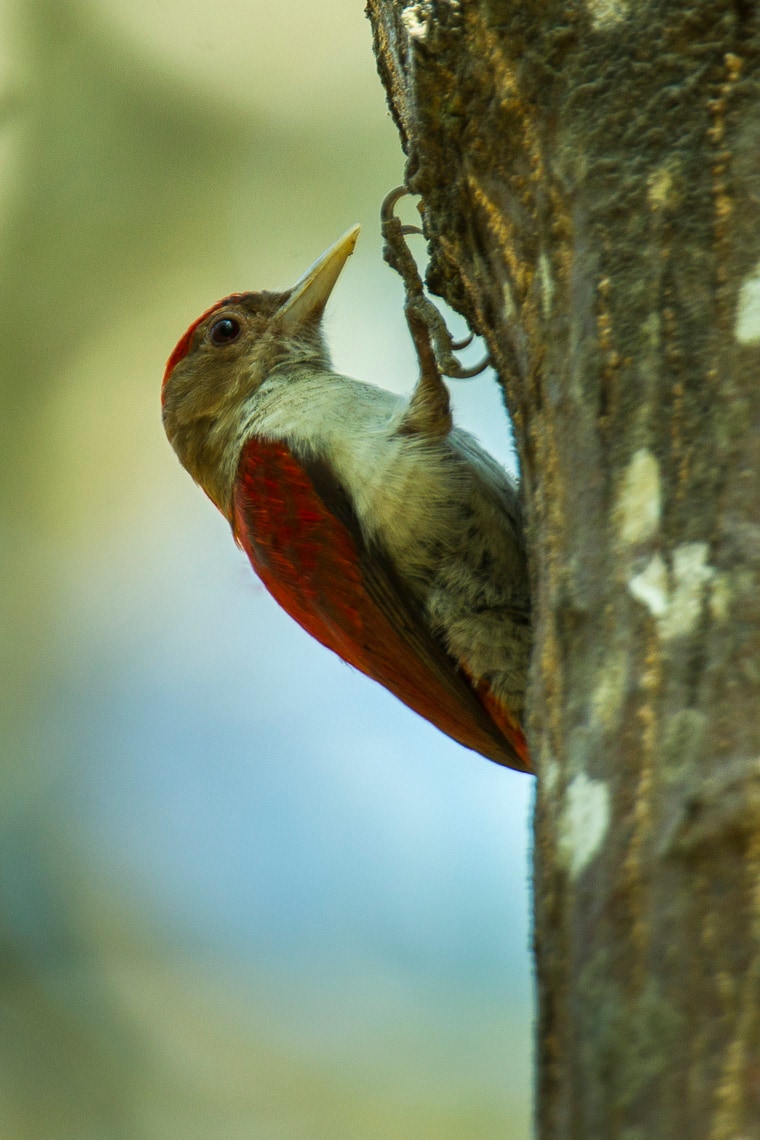
Scarlet-Backed Woodpecker
Colombia, Ecuador, Peru
Arid Scrublands, Dry Deciduous Woodland, Semi-Humid Forest, Dense Riparian Forest, Partially Cleared Areas
Brownish-Scarlet, Grayish Brown, White, Black, Red, Dark Brown, Redder Secondaries and Tertials, Whitish Yellow, Buff
- Red forehead to nape in males
- Black head in females
- Brownish-scarlet upperparts
- Whitish yellow outer tail feathers with black bars
Forages at all levels of the forest, Usually on small branches and thin twigs, Often forages in pairs
Rattle, Sharp 'Ki-Dik'
About Scarlet-backed woodpecker
The scarlet-backed woodpecker (Veniliornis callonotus) is a species of bird belonging to the Picidae family. It is found in the South American countries of Colombia, Ecuador, and Peru. This woodpecker is characterized by its size, measuring approximately 13 cm (5.1 inches) in length and weighing between 23 and 33 grams. Its plumage is predominantly brownish-scarlet on the upperparts, with darker flight feathers and white underparts that may have a faint buff wash.
Identification
A key feature distinguishing males and females is their head coloration. Adult males exhibit a striking red from their forehead to the nape, with many feathers edged in black. In contrast, adult females possess entirely black heads. The mid-section of the species' tail is blackish-brown, with the central pair of feathers being darker and the outer pair being whitish-yellow marked with black bars. Juveniles display more extensive olive or grayish mottling on their upperparts and are a buffier white underneath, with a less defined head pattern compared to adults.
Distribution and Habitat
The scarlet-backed woodpecker's range is divided between its two recognized subspecies. The nominate subspecies, V. c. callonotus, is found from Colombia's Nariño Department southward through western Ecuador to Guayas Province. The subspecies V. c. major extends from Ecuador's El Oro and Loja provinces into Peru, reaching as far south as the La Libertad Department. This species thrives in a variety of habitats, including arid scrublands, dry deciduous woodlands, semi-humid forests, and dense riparian forests. It is also observed in areas that have been partially cleared by human activity. Their altitudinal distribution is generally from near sea level up to 1,000 meters (3,300 ft), though they can be found less frequently up to 1,500 meters (4,900 ft) in Peru and locally as high as 1,800 meters (5,900 ft) in Ecuador.
Behavior and Ecology
Unlike some migratory species, the scarlet-backed woodpecker is considered a year-round resident throughout its established range. It forages across all levels of the forest, typically focusing on small branches and thin twigs, and is often seen in pairs. Detailed information about its specific diet is not widely documented. The breeding season for this woodpecker includes July in Ecuador, but comprehensive data on its breeding biology remains scarce. Vocalizations are characteristic, with a common call being a rattle lasting one to two seconds, and they also produce a sharp 'ki-dik' sound, sometimes delivered in quick succession.
Conservation Status
The International Union for Conservation of Nature (IUCN) has assessed the scarlet-backed woodpecker as Least Concern. While precise population figures are not known, the overall population is believed to be increasing. No significant immediate threats to the species have been identified. It is noted as being very localized in Colombia but is considered fairly common in Ecuador and Peru, where it is present in several protected areas. Notably, in Ecuador, the species has been observed to expand into more humid environments, a trend potentially linked to deforestation.
Source: Wikipedia ↗
Frequently Asked Questions
What is the scientific name of the scarlet-backed woodpecker?
The scientific name of the scarlet-backed woodpecker is Veniliornis callonotus. Some taxonomic systems, starting in 2018, have moved this species into the genus Dryobates.
Where can the scarlet-backed woodpecker be found?
This species is found in South America, primarily in Colombia, Ecuador, and Peru. Its range extends through specific departments and provinces within these countries.
What are the main habitat types for the scarlet-backed woodpecker?
Scarlet-backed woodpeckers inhabit a range of environments including arid scrublands, dry deciduous woodlands, semi-humid forests, and dense riparian forests. They can also be found in partially cleared areas.
How can I distinguish between male and female scarlet-backed woodpeckers?
The primary difference between males and females lies in their head plumage. Males have red coloration from their forehead to the nape, while females have entirely black heads.
What sounds does the scarlet-backed woodpecker make?
The most common vocalization is a rattle lasting 1-2 seconds. They also produce a sharp 'ki-dik' sound, sometimes in rapid series.
What is the conservation status of the scarlet-backed woodpecker?
The scarlet-backed woodpecker is listed as Least Concern by the IUCN. Its population is believed to be increasing, and no immediate threats have been identified.
Related Woodpecker species

Grey-crowned woodpecker
The grey-crowned woodpecker is a bird species endemic to western Mexico, known for its distinctive head patterning. It inhabits semi-humid and humid forests, as well as pine-oak forests, and forages at all levels for a diet that includes insects and berries. The species is currently assessed as Least Concern by the IUCN, though its population is believed to be decreasing due to habitat loss.
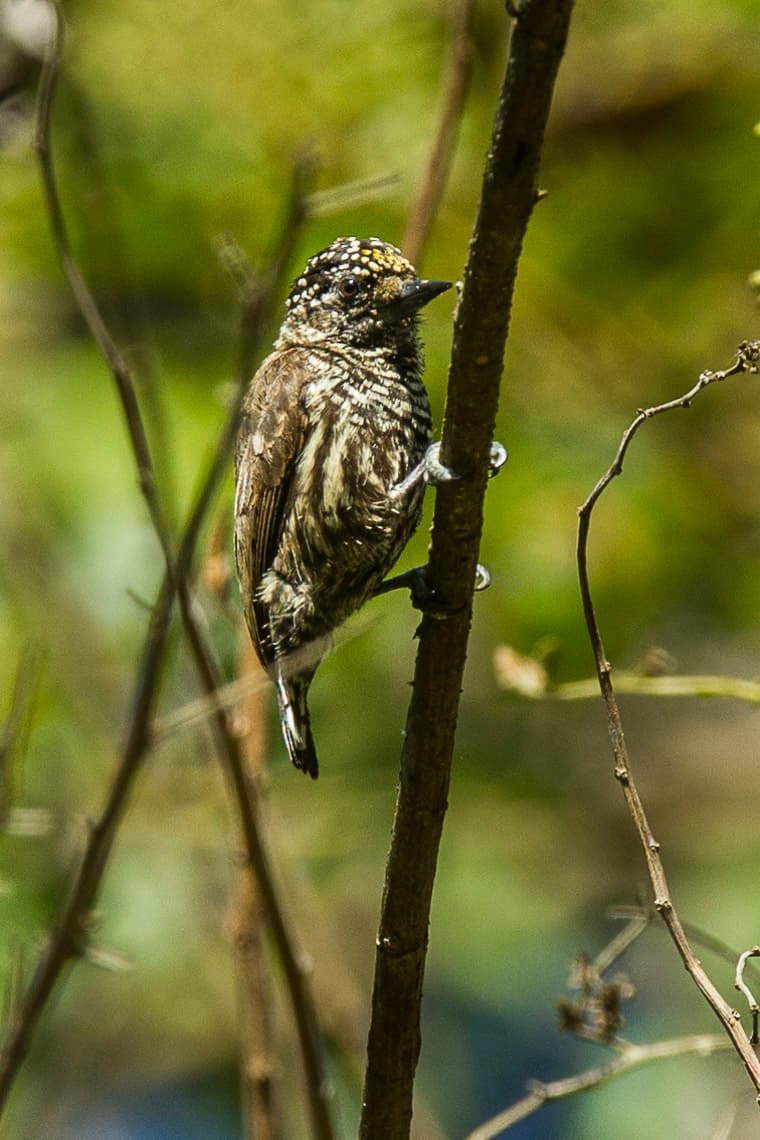
Ecuadorian piculet
The Ecuadorian piculet is a small bird found in the dry forests and scrublands of Ecuador and Peru. It is characterized by its gray-brown upperparts and whitish underparts with distinct barring, and males and females exhibit slight differences in their crown markings. This species is generally quiet but has a distinctive song and foraging habits.

Speckle-chested piculet
The Speckle-chested piculet is a small bird endemic to Peru, measuring 9 to 10 cm in length. It is characterized by its grayish-brown upperparts with pale gray edges and dark markings, and a distinctive black breast with large white teardrop-shaped spots. This species primarily inhabits humid lowland and montane forests within a very limited range in the eastern Andes.