
Greyish piculet
The greyish piculet is a small bird endemic to Colombia, measuring 9 to 10 cm in length. It inhabits semi-open landscapes and is characterized by its grayish-brown plumage with subtle olive tinges, and distinct markings on its crown and underparts, varying slightly between males and females.
Key Facts
- ›Endemic to Colombia, with two described subspecies.
- ›Measures between 9 to 10 cm in length and weighs 12 to 13 g.
- ›Inhabits semi-open areas such as forest edges, scrublands, and open woodlands.
- ›Found at elevations typically between 800 and 2,100 meters.
- ›Its breeding season is estimated to be from January to June.
- ›Classified as 'Least Concern' by the IUCN, despite a decreasing population trend.

Grey Piculet
Colombia
Dry Forest Edges, Humid Forest Edges, Primary Forest Edges, Secondary Forest Edges, Scrublands, Open Woodlands
Black crown with yellow tips and white spots, White spots on entire crown, Chestnut brown ear coverts, Gray-blue bare skin around the eye
High-Pitched Weak Trill On One Pitch
About Greyish piculet
Greyish Picullet
The greyish piculet (Picumnus granadensis) is a small bird species belonging to the woodpecker family (Picidae) and is endemic to Colombia. Measuring between 9 and 10 cm in length and weighing approximately 12 to 13 grams, this species is characterized by its grayish-brown plumage, often with an olive tinge. Sexual dimorphism is present, with adult males displaying a black crown featuring small yellow tips and white spots, while adult females have white spots across their entire crown.
Distribution and Habitat
This piculet inhabits semi-open landscapes across western Colombia. Its preferred habitats include the edges of dry to somewhat humid primary and secondary forests, as well as scrublands and open woodlands. They are typically found at elevations ranging from 800 to 2,100 meters, though they may descend to around 600 meters in the northern parts of their range. The species is a year-round resident throughout its distribution.
Behavior and Conservation
Details about the greyish piculet's foraging techniques and specific diet are not well-documented, though they are presumed to be similar to that of the closely related olivaceous piculet. The breeding season is understood to occur approximately from January to June, but little else is known about their breeding biology. Their vocalizations are described as infrequent, consisting of a high-pitched, weak trill on a single pitch. The International Union for Conservation of Nature (IUCN) has assessed the greyish piculet as 'Least Concern'. While its range is small and its population is believed to be decreasing, it does not currently meet the thresholds for a more threatened status, and no immediate threats have been identified.
Source: Wikipedia ↗
Frequently Asked Questions
What is the scientific name of the greyish piculet?
The scientific name of the greyish piculet is Picumnus granadensis. It belongs to the woodpecker family Picidae, specifically the subfamily Picumninae.
Where can the greyish piculet be found?
The greyish piculet is found exclusively in Colombia. Its distribution is divided between two subspecies, with one in the northwestern part of the country and the other in western Colombia.
What kind of habitats does the greyish piculet prefer?
The greyish piculet prefers semi-open landscapes. These include the edges of dry to somewhat humid primary and secondary forests, scrublands, and open woodlands.
What are the key physical characteristics of the greyish piculet?
Adult males have a black crown with yellow tips and white spots, chestnut brown ear coverts, and grayish-brown upperparts. Adult females are similar but have white spots on the entire crown. They are small, measuring 9-10 cm in length.
What is the conservation status of the greyish piculet?
The greyish piculet is listed as 'Least Concern' by the IUCN. While its population is believed to be decreasing and its range is small, it does not currently meet the criteria for a more threatened category.
Related Woodpecker species

Chilean flicker
The Chilean flicker is a medium-sized woodpecker species found in central and southern Chile and southwestern Argentina. It primarily inhabits semi-open to open landscapes and feeds almost exclusively on ants found on the ground. This species is characterized by its dark slate gray head in males, buffish underparts with blackish brown barring, and a white rump.

Red-stained woodpecker
The red-stained woodpecker is a species found across several South American countries, primarily inhabiting the interior of tall rainforests. It is characterized by its yellowish-green upperparts with red feather tips and pale yellow streaks, and its underparts are cinnamon-buff with dark olive-brown bars. This woodpecker is known for its relatively quiet nature, with a primary vocalization consisting of high-pitched nasal notes.
Common flameback
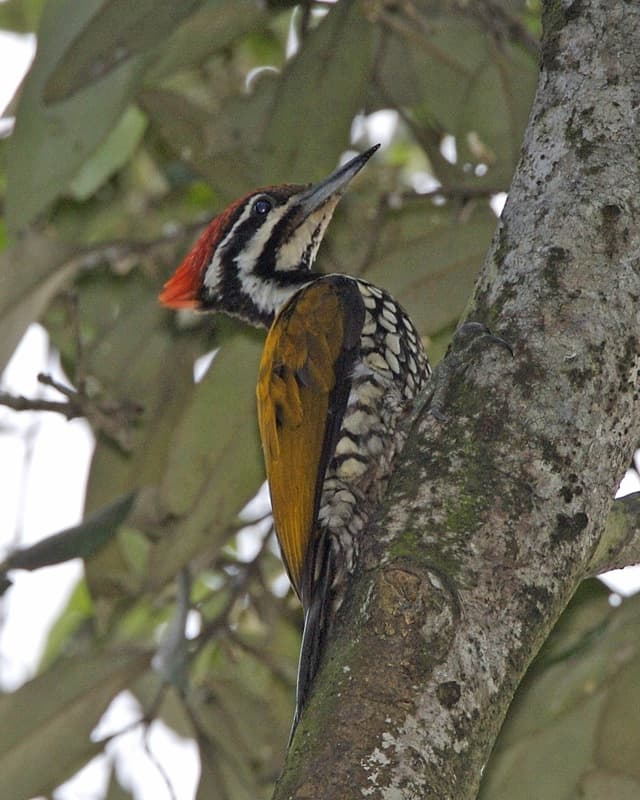
The common flameback, also known as the common goldenback, is a small woodpecker found across South and Southeast Asia. It is characterized by its spotted underside and, in males, a bright red crest, while females have a black crest with white streaks. This species inhabits a variety of environments, from open forests to mangroves, and is primarily an insectivore.