
Red-stained woodpecker
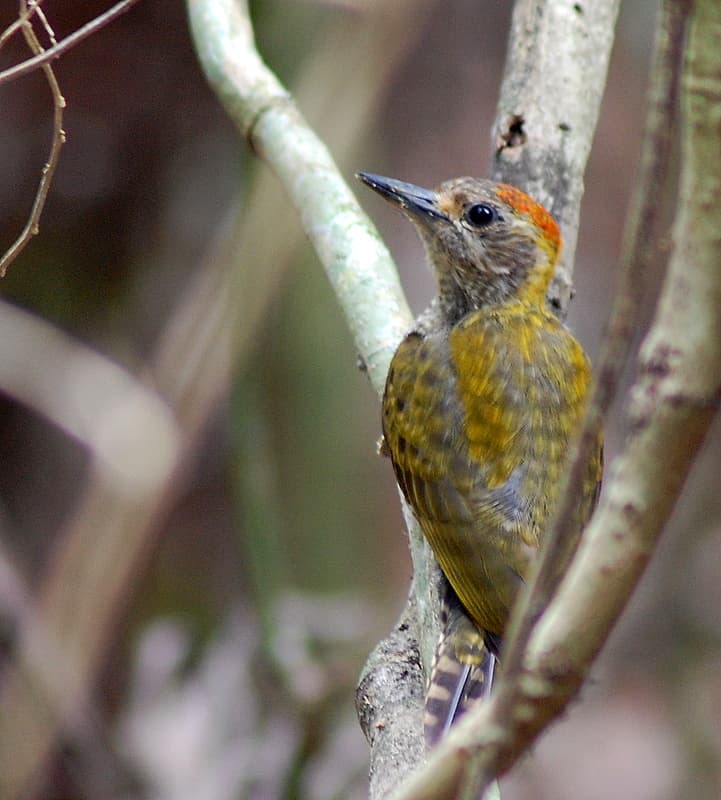
The red-stained woodpecker is a species found across several South American countries, primarily inhabiting the interior of tall rainforests. It is characterized by its yellowish-green upperparts with red feather tips and pale yellow streaks, and its underparts are cinnamon-buff with dark olive-brown bars. This woodpecker is known for its relatively quiet nature, with a primary vocalization consisting of high-pitched nasal notes.
Key Facts
- ›Found in Bolivia, Brazil, Colombia, Ecuador, Peru, and Venezuela.
- ›Inhabits the interior of tall rainforests, occasionally venturing to forest edges and secondary growth.
- ›Measures approximately 15 to 18 cm in length and weighs 32 to 44 g.
- ›Diet consists of arthropods and fruit.
- ›Believed to be a year-round resident throughout its range.
- ›Assessed as 'Least Concern' by the IUCN due to its large range and stable population.

Red-Stained Woodpecker
Bolivia, Brazil, Colombia, Ecuador, Peru, Venezuela
Tall Rainforest, Humid Lowland Terra Firme Forest, VáRzea Forest, Secondary Forest, Scrublands
Red Crown, Dark Olive-Brown Crown, Golden-Yellow Nape and Hindneck, Buffish Face With Olive Streaks, Red Feather Tips On Upperparts, Pale Yellow Streaks On Upperparts, Barring On Rump and Uppertail Coverts, Green Edges On Flight Feathers, Buffish White Bars On Flight Feathers, Yellowish Bars On Tail Feathers
Arthropods, Fruit
Forages From Mid-Level To Canopy, Forages Lower At Forest Edges, Forages Singly, Joins Mixed-Species Feeding Flocks, Follows Army Ant Swarms
- Series of up to C. 10–14 high-pitched nasal 'ghi' or 'kih' notes
About Red-stained woodpecker
The red-stained woodpecker (Veniliornis affinis) is a species of bird belonging to the woodpecker family, Picidae, and is found across several South American countries, including Bolivia, Brazil, Colombia, Ecuador, Peru, and Venezuela. While taxonomic systems may differ on its genus placement, with some classifying it under Veniliornis and others under Dryobates, its distinct subspecies are universally recognized.
Physical Description and Identification
This woodpecker is relatively small, measuring approximately 15 to 18 centimeters in length and weighing between 32 and 44 grams. Its plumage is predominantly yellowish-green on the upperparts, often adorned with red feather tips and pale yellow streaks, while the underparts are a cinnamon-buff color marked by dark olive-brown bars. A key distinguishing feature between sexes lies in their heads: males typically sport a red crown, whereas females possess a dark olive-brown crown. Both sexes share a golden-yellow nape and hindneck, and a buffish face with olive streaks.
Distribution and Habitat
The red-stained woodpecker is primarily an inhabitant of the interior of tall rainforests. It can also be found in humid lowland forests, including terra firme and várzea types, and occasionally ventures into secondary forests and scrublands, particularly at forest edges. Its altitudinal range varies across its distribution, from near sea level to over 1,300 meters in Peru.
Behavior and Ecology
This species is believed to be a resident throughout its range, not undertaking seasonal migrations. Foraging typically occurs from the mid-level to the canopy, though it may descend lower near forest edges. The red-stained woodpecker often forages alone but will join mixed-species feeding flocks and is known to follow army ant swarms. Its diet comprises arthropods and fruit. While not particularly vocal, its primary sound is a series of high-pitched, nasal notes.
Conservation Status
The International Union for Conservation of Nature (IUCN) has assessed the red-stained woodpecker as 'Least Concern'. This classification is due to its extensive geographic range and a population that is believed to be stable, with no significant immediate threats identified. It is also noted that the species occurs within several protected areas, though it is described as 'very poorly known' and possibly overlooked.
Source: Wikipedia ↗
Frequently Asked Questions
What are the main characteristics of the red-stained woodpecker?
The red-stained woodpecker is about 15 to 18 cm long and weighs 32 to 44 g. Adults have yellowish-green upperparts with red feather tips and pale yellow streaks, and cinnamon-buff underparts with dark olive-brown bars. Males have a red crown, while females have a dark olive-brown crown.
Where is the red-stained woodpecker found?
This species is distributed across several South American nations, including Bolivia, Brazil, Colombia, Ecuador, Peru, and Venezuela. Its distribution is further detailed by its four subspecies, each inhabiting specific regions within these countries.
What kind of habitat does the red-stained woodpecker prefer?
The red-stained woodpecker primarily inhabits the interior of tall rainforests. While it may occasionally be found at forest edges, in secondary forests, and scrublands, its preferred environment is dense, humid forest.
What does the red-stained woodpecker eat?
The diet of the red-stained woodpecker is known to include arthropods and fruit. It forages from the mid-level to the canopy of the forest.
Is the red-stained woodpecker noisy?
The red-stained woodpecker is not considered highly vocal. Its primary vocalization is described as a series of up to 10–14 high-pitched nasal 'ghi' or 'kih' notes.
What is the conservation status of the red-stained woodpecker?
The red-stained woodpecker is listed as 'Least Concern' by the International Union for Conservation of Nature (IUCN). This status is attributed to its extremely large range and a population believed to be stable, with no immediate threats identified.
Related Woodpecker species

Chilean flicker
The Chilean flicker is a medium-sized woodpecker species found in central and southern Chile and southwestern Argentina. It primarily inhabits semi-open to open landscapes and feeds almost exclusively on ants found on the ground. This species is characterized by its dark slate gray head in males, buffish underparts with blackish brown barring, and a white rump.
Yellow-eared woodpecker
The yellow-eared woodpecker is a species of bird endemic to eastern Brazil, found between the states of Bahia and Rio de Janeiro. This species inhabits lowlands and hills of the Atlantic Forest, including primary and secondary forests, as well as parks. Adults are approximately 15 cm long and are characterized by olive-brown faces with whitish streaks and a pale golden-yellow nape, with males and females differing primarily in their head plumage.

Pale-crested woodpecker
The pale-crested woodpecker is a bird species found in parts of South America, inhabiting semi-deciduous forests, cerrado woodlands, and dry Chaco woodlands, often near palms. It is characterized by its pale blond to buffish head and crest, rufous-black upperparts, and a primary diet of ants.