
Guayaquil woodpecker
The Guayaquil woodpecker is a large woodpecker species found in southwestern Colombia, Ecuador, and northwestern Peru. It is characterized by its black and buff barred upperparts, prominent white neck stripes, and in adult males, a striking red head. This species primarily inhabits dry to humid deciduous forests and mature secondary forests.
Key Facts
- ›Measures 32 to 34 cm (13 to 13 in) in length and weighs between 230 to 253 g (8.1 to 8.9 oz).
- ›Adult males have an entirely red head, while females have a creamy stripe extending from the bill.
- ›Found in dry to humid deciduous forests and mature secondary forests.
- ›Its diet is not definitively documented but is presumed similar to related species.
- ›Vocalizations include a liquid, rolling "kwi-kwi-kwe-rrrrrrr" call and a one-second drumming roll.
- ›Assessed by the IUCN as Least Concern, despite a decreasing population trend.

South America
- Adult males entirely red head
- Females have a creamy stripe from bill to ear coverts
- White neck stripes forming a 'V' on the upper back
- Barred lower back and underparts
Insects
Forages In Pairs, Usually In the Forest Canopy
- Liquid, Rolling "Kwi-Kwi-Kwe-Rrrrrrr"
- Excited Calls: "Kwik-Kwik-Kwikerrr" and "Kik-Kwiddit"
- Drumming: One-Second Roll of 4–7 Strikes
About Guayaquil woodpecker
The Guayaquil woodpecker (Campephilus gayaquilensis) is a distinctive member of the woodpecker family, scientifically classified within the subfamily Picinae. This species, formerly placed in genera like Scapaneus and Phloeoceastes, is now firmly established in the genus Campephilus.
Physical Characteristics
Measuring between 32 to 34 cm (13 to 13 in) in length and weighing approximately 230 to 253 g (8.1 to 8.9 oz), the Guayaquil woodpecker is a substantial bird. Both sexes share black upperparts from the neck to the upper back, with the lower back and uppertail coverts featuring whitish buff and blackish barring. A notable feature is the white stripes on the sides of the neck that extend onto the upper back, often meeting in a "V" shape. The wings are brownish-black to black, with flight feathers showing brown coloration and small cinnamon or buff spots. The underside of the wings is white with brown tips and pale cinnamon bases.
Adult males are easily identified by their entirely red heads. Adult females, in contrast, lack the male's distinct head color and instead possess a wide creamy stripe edged with black, running from the bill to the ear coverts, which then bends down to meet the white neck stripe. The bill is described as a long, grayish chisel with a paler mandible, the iris is pale yellow, and the legs are gray-brown to greenish gray. Juveniles bear a resemblance to adults but exhibit less barring on their rump and underparts; juvenile males have heads similar to adult females, while juvenile females show more black than their adult counterparts.
Distribution and Habitat
The Guayaquil woodpecker's range extends across southwestern Colombia's Cauca Department, south through Ecuador west of the Andes, and into northwestern Peru's Department of Cajamarca. Its preferred habitats are the interior and edges of dry to humid deciduous forests, as well as mature secondary forests. Elevations inhabited by the species vary, reaching up to 1,100 m (3,600 ft) in Colombia and 1,500 m (4,900 ft) in Ecuador and Peru, though typically found below 800 m (2,600 ft) in the latter two countries.
Behavior and Ecology
This species is a year-round resident within its established range. Guayaquil woodpeckers are often observed foraging in pairs, typically high in the forest canopy. While their specific diet has not been extensively documented, it is presumed to be similar to that of the closely related crimson-crested woodpecker, likely consisting of insects and larvae extracted from wood.
Vocalizations and Drumming
The characteristic call of the Guayaquil woodpecker is a "liquid, rolling "kwi-kwi-kwe-rrrrrrr"". When agitated or excited, they produce "kwik-kwik-kwikerrr" and "kik-kwiddit" notes. Their drumming pattern is a distinct one-second roll composed of 4–7 strikes, with the initial strike being loud and forceful, followed by progressively weaker ones.
Breeding and Conservation
The breeding season for the Guayaquil woodpecker is not precisely defined but has been noted to include at least October and May. Little else is publicly known regarding its breeding biology. The International Union for Conservation of Nature (IUCN) has assessed the Guayaquil woodpecker as Least Concern. Despite an estimated population of at least 25,000 mature individuals, this population is believed to be decreasing. The primary threat to the species is habitat loss and fragmentation due to agricultural expansion and ranching. However, the Guayaquil woodpecker demonstrates a notable tolerance for habitat degradation and fragmentation. The species is present in several protected areas across Ecuador and Peru, which aids in its conservation.
Source: Wikipedia ↗
Frequently Asked Questions
What is the scientific name of the Guayaquil woodpecker?
The scientific name of the Guayaquil woodpecker is *Campephilus gayaquilensis*. It has previously been placed in genera such as Scapaneus and Phloeoceastes before its current classification.
Where can the Guayaquil woodpecker be found?
This species is distributed from southwestern Colombia's Cauca Department, south through Ecuador west of the Andes, and into northwestern Peru's Department of Cajamarca.
What kind of forests does the Guayaquil woodpecker inhabit?
The Guayaquil woodpecker prefers the interior and edges of dry to humid deciduous forests. It also inhabits mature secondary forests.
What are the distinguishing physical features of the Guayaquil woodpecker?
Adult males are notable for their entirely red heads, while females possess a wide creamy stripe from the bill that contrasts with their white neck stripes. Both sexes have black upperparts and whitish buff underparts with barring.
What sounds does the Guayaquil woodpecker make?
Its most common call is described as a liquid, rolling "kwi-kwi-kwe-rrrrrrr". When excited, it makes "kwik-kwik-kwikerrr" and "kik-kwiddit" notes. Its drumming is a short roll of 4–7 strikes.
What is the conservation status of the Guayaquil woodpecker?
The Guayaquil woodpecker is listed as Least Concern by the IUCN. Although its population is estimated to be decreasing, it has a large range and occurs in protected areas.
Related Woodpecker species

Chestnut piculet
The chestnut piculet is a small bird found in Colombia and Venezuela, known for its rufous-brown plumage and active foraging habits. It inhabits a variety of landscapes, from rainforests to arid scrublands, and is often seen in small groups or mixed-species flocks. While its diet is presumed to consist of small insects, much of its breeding biology remains undocumented.
Golden-green woodpecker
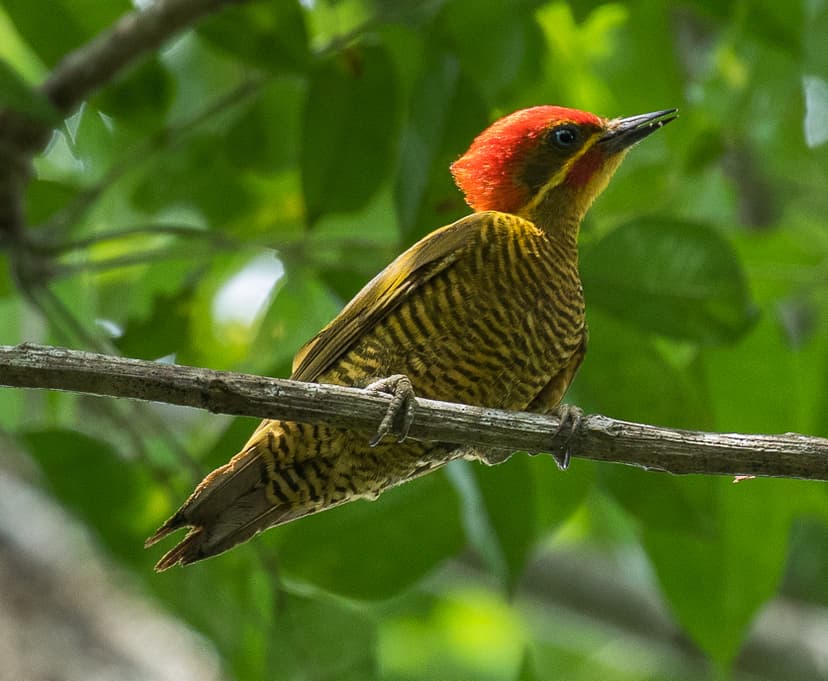
The golden-green woodpecker is a South American bird found in a variety of wooded habitats across the continent. Characterized by its size and distinctive head markings that vary between sexes and subspecies, it primarily feeds on ants and termites. This species is generally considered to be of Least Concern, despite a suspected decreasing population trend.
Ecuadorian piculet
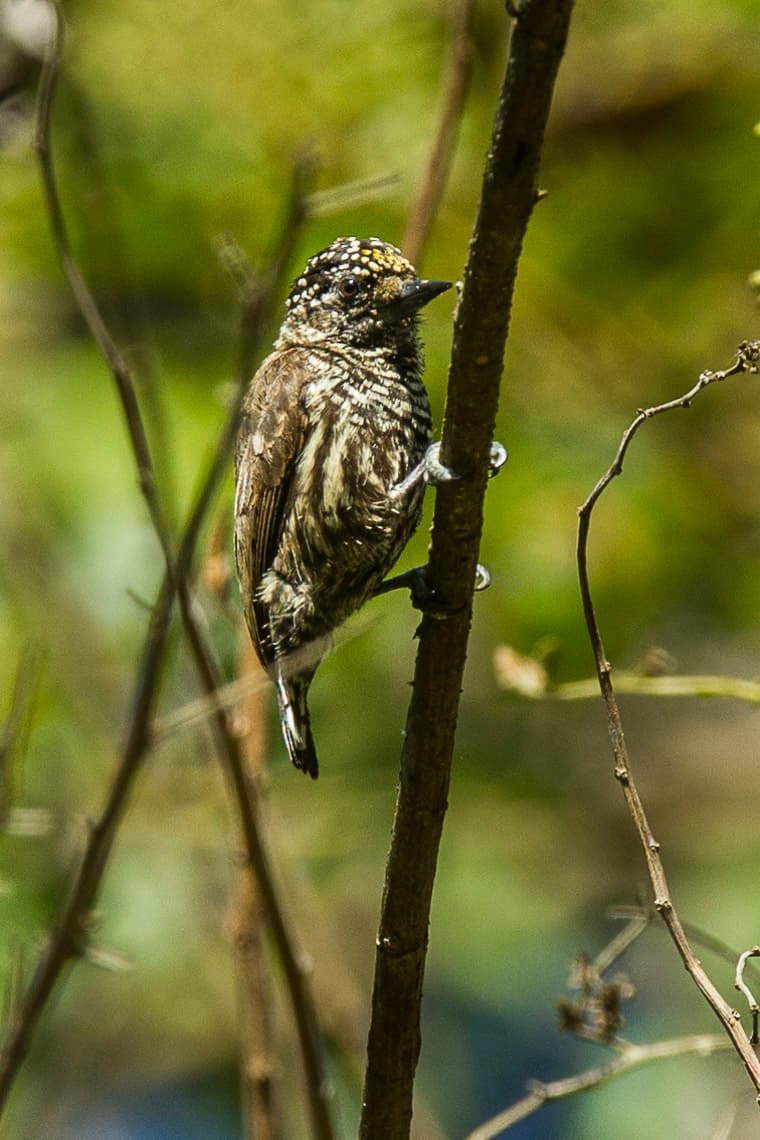
The Ecuadorian piculet is a small bird found in the dry forests and scrublands of Ecuador and Peru. It is characterized by its gray-brown upperparts and whitish underparts with distinct barring, and males and females exhibit slight differences in their crown markings. This species is generally quiet but has a distinctive song and foraging habits.