
Ecuadorian piculet
The Ecuadorian piculet is a small bird found in the dry forests and scrublands of Ecuador and Peru. It is characterized by its gray-brown upperparts and whitish underparts with distinct barring, and males and females exhibit slight differences in their crown markings. This species is generally quiet but has a distinctive song and foraging habits.
Key Facts
- ›Found in Ecuador and Peru, primarily in deciduous forests and arid scrublands.
- ›Measures 9 to 10 cm in length and weighs approximately 10 to 12 grams.
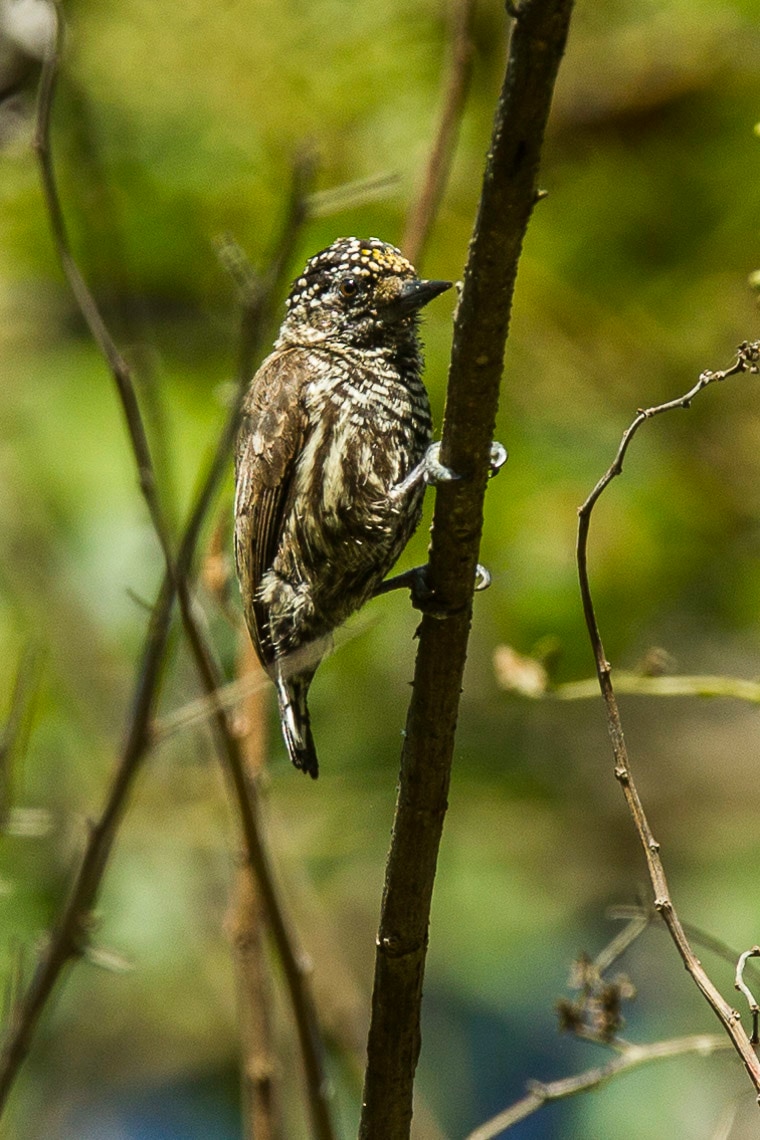
- ›Adult males have a black cap with yellow spots, while females have whitish spots on their crown.
- ›Its diet consists mainly of very small insects, and it forages by picking and tapping on thin branches.
- ›The breeding season occurs from June/July to September, depending on the region.
- ›Classified as Least Concern by the IUCN, with a believed stable population trend.
Ecuador, Peru
Deciduous Forest, Arid Scrublands, Humid Landscapes
- Males have a black cap with yellow and white spots
- Females have whitish spots on their entire crown
- Gray-brown upperparts with obscure darker bars
- Whitish underparts with black or dusky barring and streaks
Insects
Actively Forages On Thin Branches, Picks and Taps
Slow, Descending Series of Notes, High-Pitched Tseee-Tsut Or Tseeet, Quick, Stuttering Series
About Ecuadorian piculet
The Ecuadorian piculet (Picumnus sclateri) is a small avian species belonging to the woodpecker family (Picidae), specifically within the subfamily Picumninae. This diminutive bird inhabits a range across Ecuador and Peru, where it primarily resides in deciduous forests and arid scrubland environments. While it can also be found in more humid landscapes in certain regions, its core habitat preference leans towards drier, more open woodlands.
Physical Characteristics
Measuring between 9 to 10 cm in length and weighing approximately 10 to 12 grams, the Ecuadorian piculet is one of the smaller woodpecker species. Its plumage is generally a muted gray-brown on the upperparts, often featuring obscure darker bars. The underparts are typically whitish, marked with distinct black or dusky barring on the breast and flanks, and streaks on the belly. A key distinguishing feature lies in the crown markings, which differ between sexes. Adult males display a black cap with small yellow spots on the forehead and tiny white spots on the remainder of the crown. In contrast, adult females are similar but possess whitish spots across their entire crown.
Distribution and Habitat
The distribution of the Ecuadorian piculet is divided among its three subspecies. P. s. parvistriatus is found in western Ecuador, while P. s. sclateri ranges from southwestern Ecuador into northwestern Peru. The subspecies P. s. porcullae inhabits northwestern Peru. The species is generally found at elevations ranging from near sea level up to around 1,800 meters, though most commonly observed below 1,200 meters.
Behavior and Diet
The Ecuadorian piculet is described as a relatively quiet bird, though it does possess a discernible song. This song is characterized by a slow, descending series of notes, typically numbering three but sometimes extending to seven. It also produces other vocalizations, including high-pitched calls and a quicker, stuttering sound. Its diet is primarily composed of very small insects, which it procures by actively foraging on thin branches, employing picking and tapping techniques. Socially, they are often observed alone, in pairs, or in small family groups and may associate with mixed-species flocks of other small passerines.
Breeding and Conservation
The breeding season for the Ecuadorian piculet varies slightly by region, occurring from July through September in Ecuador and from June to September in Peru. Little is extensively documented regarding its breeding biology beyond this timing. The International Union for Conservation of Nature (IUCN) has assessed the Ecuadorian piculet as Least Concern, reflecting a population believed to be stable. While it has a restricted geographic range, no immediate significant threats have been identified, though human activity and habitat destruction can have local impacts.
Source: Wikipedia ↗
Frequently Asked Questions
What are the different subspecies of the Ecuadorian piculet?
The Ecuadorian piculet has three recognized subspecies: the nominate P. s. sclateri, P. s. parvistriatus, and P. s. porcullae. P. s. parvistriatus was initially described as a distinct species.
What is the size and weight of the Ecuadorian piculet?
Adult Ecuadorian piculets are typically between 9 and 10 cm (3.5 to 3.9 inches) in length and weigh around 10 to 12 grams (0.35 to 0.42 ounces).
How can I distinguish between male and female Ecuadorian piculets?
Adult males have a black cap adorned with small yellow spots on the forehead and tiny white spots elsewhere. Adult females are similar but possess whitish spots across their entire crown.
What kind of habitat does the Ecuadorian piculet prefer?
The Ecuadorian piculet primarily inhabits deciduous forests and arid scrublands. In some areas, like Loja in Ecuador, it can also be found in more humid environments.
What does the Ecuadorian piculet eat and how does it forage?
Its diet is predominantly composed of very small insects, though details are not extensively known. It actively searches for food on thin branches, using picking and tapping methods.
What are the vocalizations of the Ecuadorian piculet?
The Ecuadorian piculet is described as relatively quiet. Its song is a slow, descending series of notes, typically three but sometimes up to seven. It also makes high-pitched calls like 'tseee-tsut' or 'tseeet,' and a rapid, 'tititi-swee' sound.
What is the conservation status of the Ecuadorian piculet?
The Ecuadorian piculet is listed as Least Concern by the International Union for Conservation of Nature (IUCN). Its population is believed to be stable, and no immediate major threats have been identified.
Related Woodpecker species
Scarlet-backed woodpecker
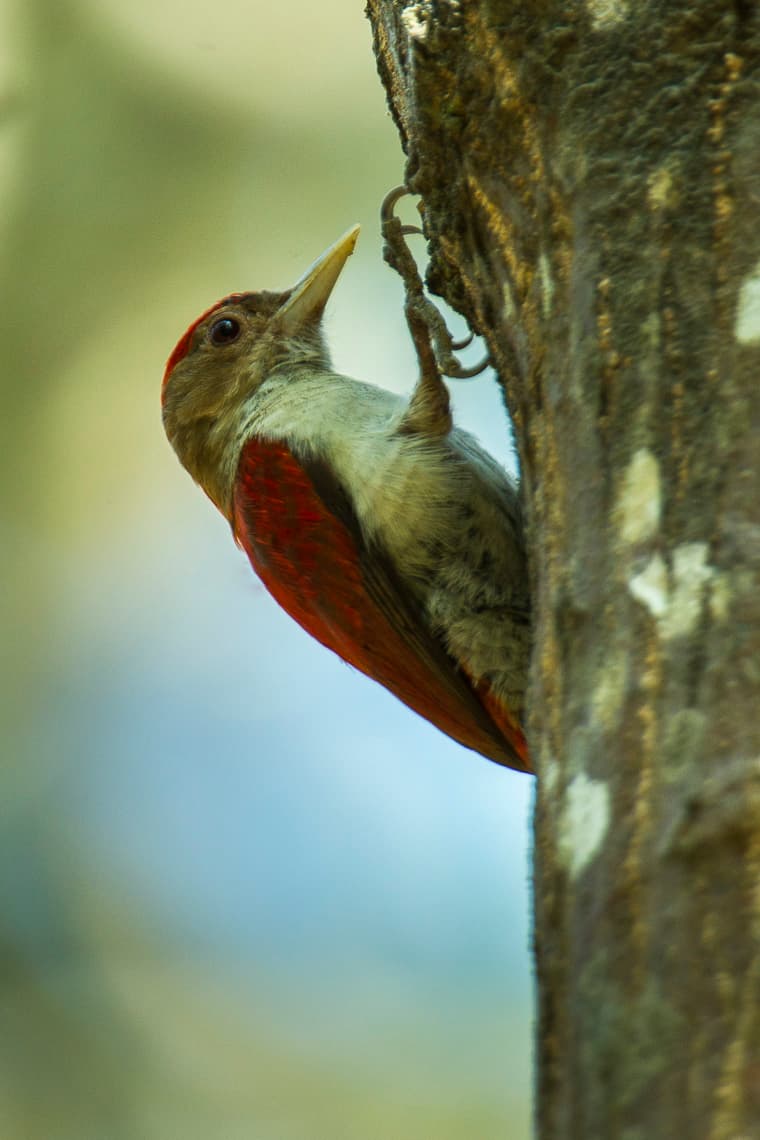
The scarlet-backed woodpecker is a small bird found in Colombia, Ecuador, and Peru, notable for its brownish-scarlet upperparts and the distinct head plumage differences between males and females. It inhabits a variety of dry and semi-humid woodlands and scrublands, foraging at all forest levels. Its conservation status is Least Concern, with a population believed to be increasing.

Bar-breasted piculet
The bar-breasted piculet is the smallest living species in the woodpecker family, characterized by its small size and distinctive barring on its underparts. It inhabits humid tropical forests primarily in the Amazon Basin, spanning parts of Bolivia, Brazil, Colombia, and Peru.
Dot-fronted woodpecker
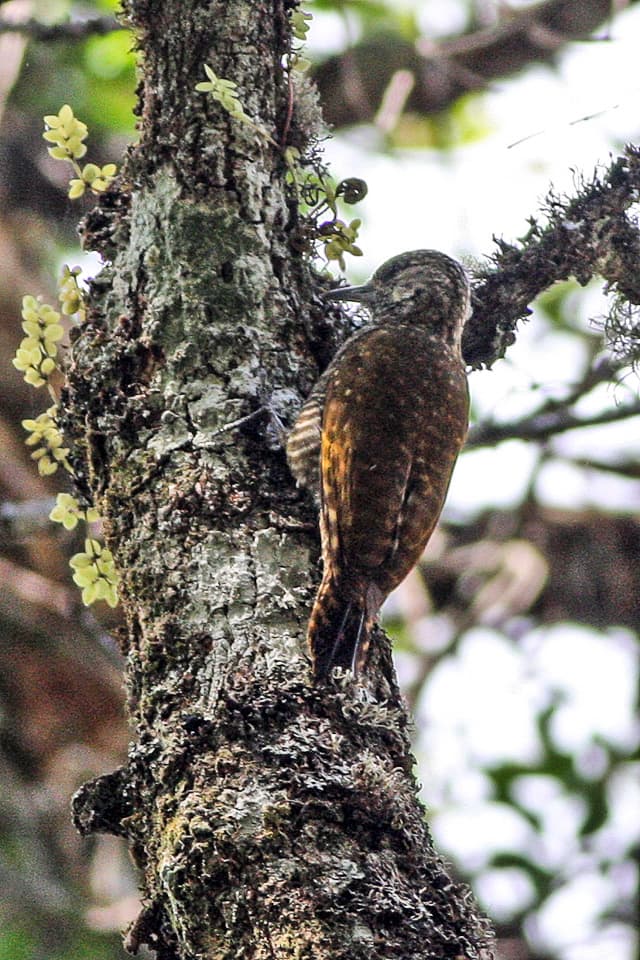
The dot-fronted woodpecker (Veniliornis frontalis) is a species found in Argentina and Bolivia, inhabiting dry montane woodlands and humid forests. Measuring approximately 16 cm in length, it is characterized by its olive to gray-brown forehead with white spots, and males display red on their crown and nape.