
Golden-green woodpecker
The golden-green woodpecker is a South American bird found in a variety of wooded habitats across the continent. Characterized by its size and distinctive head markings that vary between sexes and subspecies, it primarily feeds on ants and termites. This species is generally considered to be of Least Concern, despite a suspected decreasing population trend.
Key Facts
- ›Found in Panama and most mainland South American countries, excluding Chile and Uruguay.
- ›Ranges from 18 to 27 cm in length and weighs between 55 to 91 grams.
- ›Males and females exhibit different plumage on their heads, with males typically having red on their forehead and nape.
- ›Inhabits diverse environments including rainforests, deciduous forests, and treed savannahs.
- ›Diet primarily consists of ants and termites, foraged by gleaning, pecking, and excavating.
- ›Assessed as Least Concern by the IUCN, with a large but potentially decreasing population.
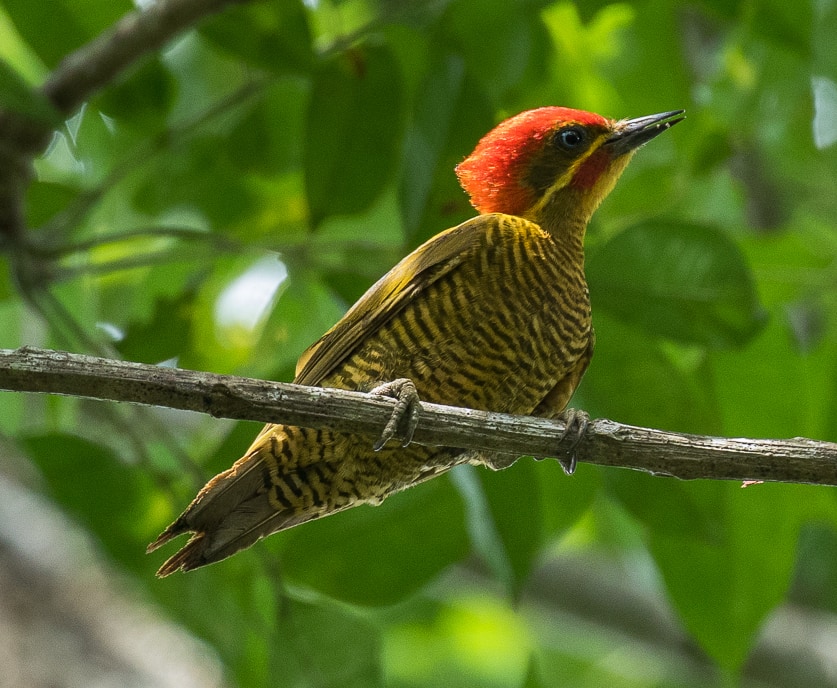
South America, Panama
Terra Firme Forest, VáRzea Forest, Rainforest, Deciduous Forest, Treed Savannah, Pastures, Clearings
- Sex-specific head plumage
- Pale yellow stripe on male's head
- Red malar band on male's head
- Olive green stripe below malar band on male's head
Ants, Termites
Gleaning, Pecking, Excavating
Tree Cavities, Nest of Arboreal Insects
- A Series of 15 Almost Toneless, Hoarse 'Schraah' Notes, Sounding Like A Hysterically Crying Baby.
About Golden-green woodpecker
The golden-green woodpecker (Piculus chrysochloros) is a species of bird found across a wide expanse of South America and Panama. It inhabits a variety of wooded environments, from dense rainforests to more open areas like treed savannahs and pastures. This woodpecker is characterized by its size, typically ranging from 18 to 27 cm in length, and by the distinct plumage differences between males and females, particularly on their heads.
Distribution and Habitat
This species is distributed throughout Panama and most mainland South American countries, notably excluding Chile and Uruguay. Its habitat preferences are broad, encompassing terra firme and várzea forests, rainforests, deciduous forests, as well as more open landscapes such as treed savannahs, pastures, and clearings. The golden-green woodpecker can be found from sea level up to elevations of 650 meters (2,100 ft), depending on the region.
Diet and Behavior
The golden-green woodpecker primarily forages in the subcanopy and canopy layers of forests, often alone, in pairs, or as part of mixed-species feeding flocks. Its diet is known to include ants and termites, which it obtains by gleaning from surfaces, as well as by pecking and excavating into wood or insect nests. The species is a year-round resident throughout its range. Its breeding season varies geographically, with nesting occurring in tree cavities or within the nests of arboreal insects.
Vocalization and Conservation
The characteristic vocalization of the golden-green woodpecker is described as a series of approximately 15 hoarse, toneless notes that resemble the sound of a crying baby. The International Union for Conservation of Nature (IUCN) has assessed the golden-green woodpecker as Least Concern. Despite having an extremely large range and an estimated population of at least half a million mature individuals, this population is believed to be decreasing. No immediate threats to the species have been identified, and it is found in several protected areas.
Source: Wikipedia ↗
Frequently Asked Questions
What is the scientific name for the golden-green woodpecker?
The scientific name for the golden-green woodpecker is Piculus chrysochloros. It belongs to the subfamily Picinae within the woodpecker family, Picidae.
Where is the golden-green woodpecker found?
The golden-green woodpecker is distributed across Panama and most mainland South American countries, with the exceptions of Chile and Uruguay. Its range covers diverse habitats from forests to more open, treed areas.
How big is the golden-green woodpecker?
This woodpecker species typically measures between 18 to 27 cm (7.1 to 11 inches) in length and weighs between 55 to 91 grams (1.9 to 3.2 ounces).
What does the golden-green woodpecker eat?
The diet of the golden-green woodpecker is known to include ants and termites. They forage by gleaning insects from surfaces and also by pecking and excavating to reach prey.
What is the conservation status of the golden-green woodpecker?
The golden-green woodpecker is listed as Least Concern by the IUCN. While it has a large range and population, the population is believed to be decreasing.
What are the main differences between male and female golden-green woodpeckers?
Males and females of the golden-green woodpecker have the same plumage except on their heads. Males of the nominate subspecies have red from the forehead to the nape, while females do not have red on their heads, with their crowns being olive or greenish yellow depending on the subspecies.
Related Woodpecker species
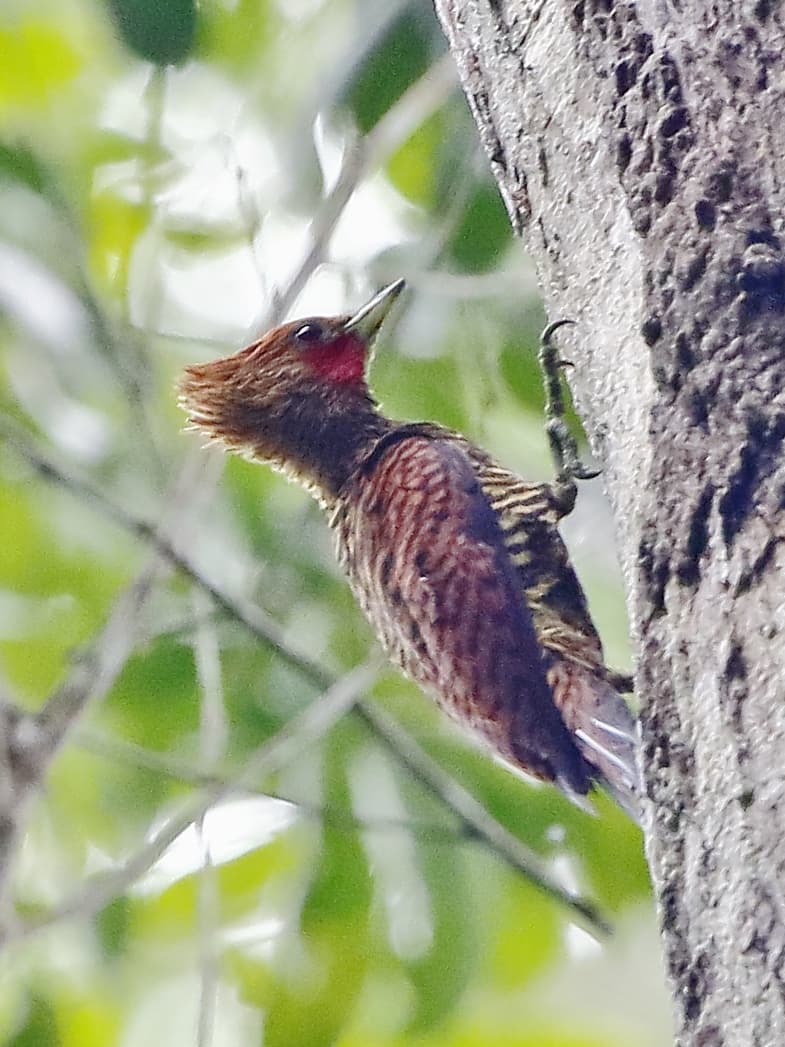
Waved woodpecker
The Waved Woodpecker (Celeus undatus) is a species found across much of northern South America, inhabiting various wooded landscapes from rainforest edges to savannas. It is characterized by its rufous-chestnut plumage, often marked with wavy black bars, and a distinctive crest. Primarily feeding on ants and termites, this species excavates its nest cavities in trees.

Red-necked woodpecker
The red-necked woodpecker is a large bird found across much of mainland South America, primarily within the Amazon Basin. It is characterized by its striking red head and neck, black upperparts, and bright red underparts. This species inhabits various forest types and woodland areas, foraging on tree trunks for insect larvae and some fruit.

Yellow-bellied sapsucker
The yellow-bellied sapsucker is a medium-sized woodpecker found in Canada and the northeastern United States, known for its distinctive feeding habits of drilling sap wells. Its plumage features a mix of black, white, and yellow, with males displaying a red forehead. These birds play a role in forest ecosystems, though their feeding can sometimes damage trees.