
Heart-spotted woodpecker
The heart-spotted woodpecker is a distinctive bird found across Asia, known for its black and white plumage, stubby body, and large head. They are often detected by their frequent calls as they forage for invertebrates under tree bark, typically in pairs or small groups within mixed-species flocks. This species inhabits subtropical and tropical moist lowland forests.
Key Facts
- ›Distinctive black and white plumage with heart-shaped spots on white shoulders.
- ›Characterized by a stubby body and a large, wedge-shaped head.
- ›Forages for invertebrates under bark on slender outer branches of trees.
- ›Found in mixed-species foraging flocks, often moving in pairs or small groups.
- ›Inhabits subtropical and tropical moist lowland forests.
- ›Known for frequent calling, making them easy to detect.

Heart-Spotted Woodpecker
Asia, India, Himalayas, Southeast Asia, Bangladesh, Myanmar, Thailand, Laos, Cambodia, Vietnam
- Contrasting black and white plumage
- Heart-shaped black spots on white shoulders
- Stubby body
- Large, wedge-shaped head
- Tuft of specialized, lipid-rich feathers on the rump
Invertebrates, Insects Under Bark, Insect Larvae
Forages on thin branches, Pecks pods of Cassia fistula for larvae, Forages under bark
Dead Branches, Fence Posts
Sharp Twee-Twee-Twee, Trill of Several Notes, Nasal Ki-Yeew, Repeated Su-Sie Calls, Infrequent Drumming
About Heart-spotted woodpecker
The heart-spotted woodpecker, scientifically known as Hemicircus canente, is a unique bird species recognized for its striking appearance and distinctive vocalizations. Its plumage is a bold contrast of black and white, prominently featuring heart-shaped black spots on its white shoulders. A defining characteristic is its stubby body, coupled with a large, wedge-shaped head, which gives it a somewhat unusual silhouette.
This species primarily inhabits subtropical and tropical moist lowland forests across a broad swathe of Asia. Its range includes parts of India, the Himalayas, and Southeast Asia, encompassing countries like Bangladesh, Myanmar, Thailand, Laos, Cambodia, and Vietnam. Within India, it is found in the Western Ghats and central Indian forests, as well as in Himalayan forests.
Heart-spotted woodpeckers are often detected by their frequent calls as they diligently forage for invertebrates concealed beneath the bark of trees, particularly on slender outer branches. They typically move in pairs or small groups and are known to join mixed-species foraging flocks, demonstrating social foraging behaviors. Their nests are usually excavated in dead branches or sometimes in fence posts, with a clutch of two to three unmarked white eggs being common.
Source: Wikipedia ↗
Frequently Asked Questions
What are the key physical characteristics of the heart-spotted woodpecker?
The heart-spotted woodpecker is easily identified by its contrasting black and white plumage, featuring heart-shaped spots on its white shoulders. It possesses a distinctively stubby body and a large, wedge-shaped head, which makes its head appear disproportionately large for its short body and tail.
Where is the heart-spotted woodpecker found?
This species has a wide distribution across Asia. Populations are found in the forests of southwestern and central India, with further ranges extending into the Himalayas and Southeast Asia, including Bangladesh, Myanmar, Thailand, Laos, Cambodia, and Vietnam.
What does the heart-spotted woodpecker eat and how does it forage?
The heart-spotted woodpecker primarily feeds on insects found under the bark of trees. They are known to forage on the slender outer branches, often pecking at pods of Cassia fistula to extract insect larvae. They are frequently heard calling as they search for food.
What are the nesting habits of the heart-spotted woodpecker?
Nests are typically bored into dead branches, featuring a narrow opening of 3 to 4 cm in diameter. The tunnel descends obliquely for about 20 cm before widening into a chamber. Occasionally, nests may also be constructed in fence posts. The usual clutch consists of two or three unmarked white eggs.
What sounds does the heart-spotted woodpecker make?
The heart-spotted woodpecker has a varied vocalization. Its calls include a sharp 'twee-twee-twee', sometimes escalating into a trill of several notes. It also emits a nasal 'ki-yeew' and repeated 'su-sie' calls. Drumming is infrequent, primarily occurring during the breeding season and before the monsoons.
Related Woodpecker species

Crimson-winged woodpecker
The crimson-winged woodpecker is a vibrant bird found in the subtropical and tropical moist lowland forests of Southeast Asia, including countries like Malaysia, Indonesia, and Thailand. It is known for its striking appearance and primarily feeds on insects and larvae found within its forest habitat. This species is easily identifiable due to its bright coloration.
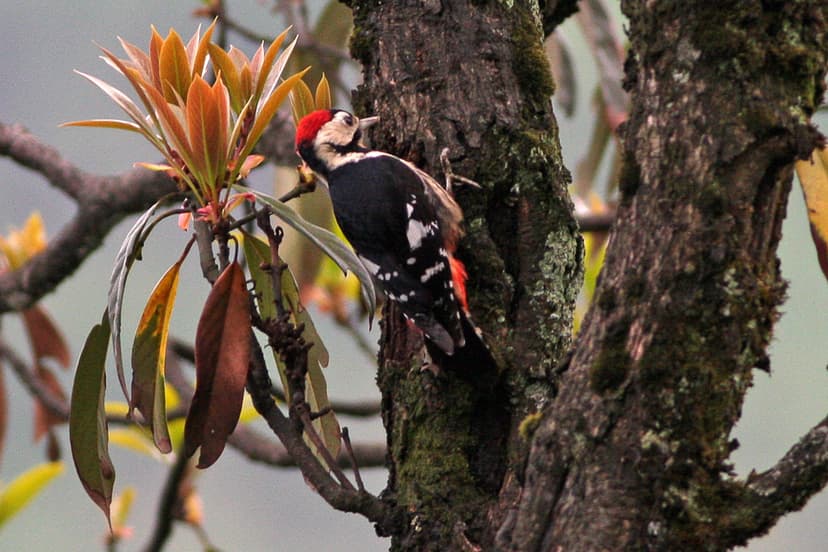
Necklaced woodpecker
The necklaced woodpecker is a small, stout, black-and-white bird found in lowland and montane forests across Southeast Asia and China. It is characterized by buffy underparts, with males displaying a distinctive fiery orange neck patch and a crimson red crown.
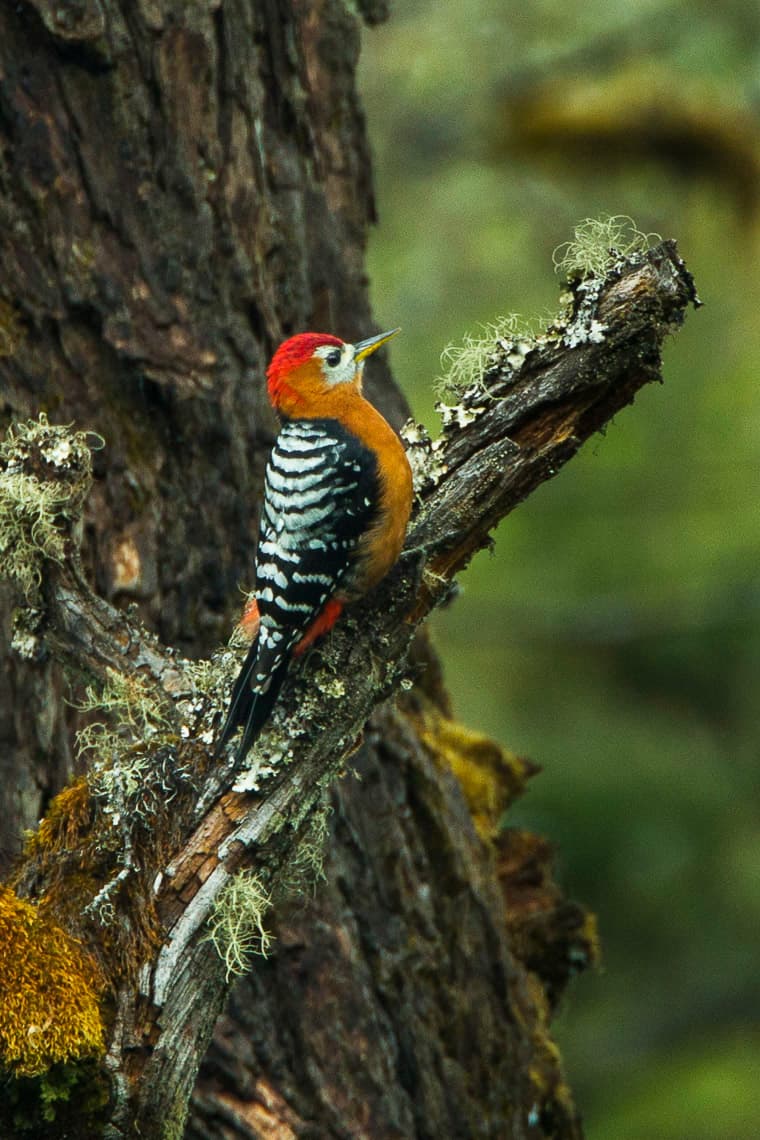
Rufous-bellied woodpecker
The rufous-bellied woodpecker, also known as the rufous-bellied sapsucker, is a bird species found across the Himalayas and parts of Southeast Asia, inhabiting subtropical and tropical moist forests. It is characterized by its distinctive pitting of tree bark to feed on sap, and its plumage includes a black mantle and back with white barring on the wings and tail, contrasted by a rufous or cinnamon underside.