
Japanese green woodpecker
The Japanese green woodpecker (Picus awokera) is a medium-sized woodpecker endemic to Japan, easily recognized by its bright green wings and tail, gray head, neck, and chest, and white underparts with black markings. It inhabits various forest types, parks, and gardens across Japan's islands, feeding primarily on ants and other invertebrates, supplemented with fruits and seeds.
Key Facts
- ›Endemic to Japan, found on its major and smaller islands.
- ›Characterized by bright green wings and tail, a gray head and chest, and white underparts.
- ›Inhabits open mixed forests, warm-temperate evergreen forests, parks, and gardens.
- ›Primarily feeds on ants, but also consumes bugs, beetles, larvae, spiders, fruits, berries, seeds, resin, and nectar.
- ›Nests in tree cavities, typically between two to four meters deep.
- ›Conservation status is Least Concern, with a stable population.
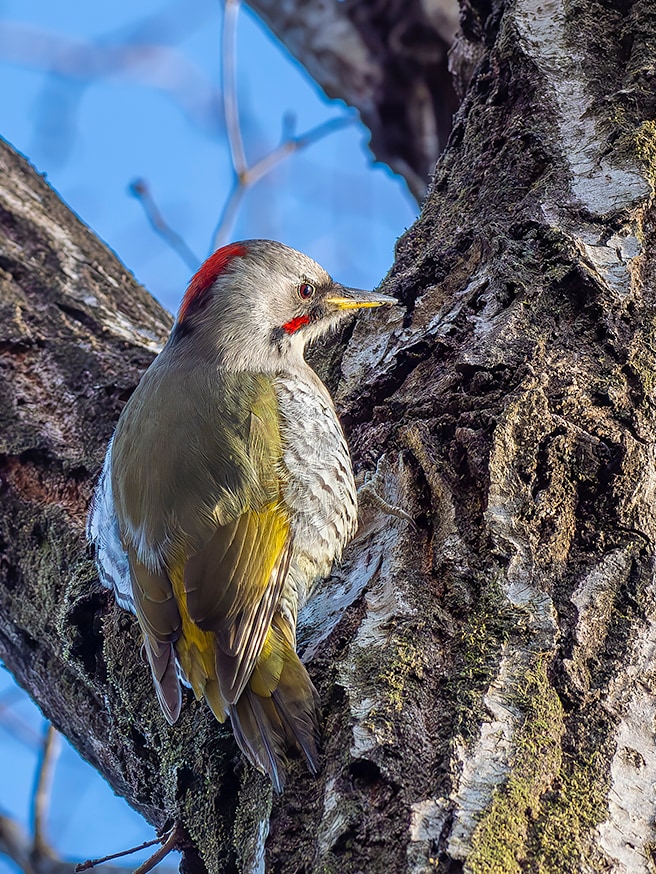
Japanese Woodpecker
Japan
Red Or Black Mustache and Crown, Gray Head, Neck, and Chest, White Underparts With Black Markings, Red Iris
Ants, Bugs, Beetles, Beetle Larvae, Spiders, Fruits, Berries, Seeds, Resin, Nectar
- Forages in the middle tree layer
- Forages at heights between 2 and 10m on larger branches and twigs
- Sometimes forages on the ground
Cavities of Trees
Loud Whip-Crack-Similar 'Pijo', Two-Syllable 'Ket, Ket', Very Fast and Long Drumrolls
About Japanese green woodpecker
The Japanese green woodpecker, scientifically known as Picus awokera, is a medium-sized bird endemic to the Japanese archipelago. This species is closely related to the European green woodpecker but is distinguished by its unique geographical isolation and specific physical traits.
Description and Identification
Adult Japanese green woodpeckers typically reach a length of around 30 cm. Their plumage is characterized by vibrant green wings and tail, contrasting with a gray head, neck, and chest. The underparts are white and marked with black patterns. A notable feature is the presence of a red or black mustache and crown, setting it apart from the black-faced European species. The bird's eyes are red, and its legs and feet are a light gray color.
Distribution and Habitat
This woodpecker is found across most of Japan's major islands, including Honshu, Kyushu, and Hokkaido, as well as smaller islands like Tobishima, Awashima, Sado, and Tsushima. Its total distribution area spans approximately 281,000 square kilometers. The species thrives in a variety of forest environments, preferring open mixed forests in the north and warm-temperate evergreen forests in the south. They are also commonly observed in human-modified landscapes such as parks and gardens, though they tend to avoid dense, older coniferous monocultures. Their preferred altitudes range from 300 to 1400 meters, but they can be found from lowlands up to 2000 meters.
Diet and Foraging Behavior
The Japanese green woodpecker's diet is diverse. It primarily consists of ants from various genera, including Lasius, Formica, Camponotus, and Crematogaster. In addition to ants, their menu includes other insects, beetles, beetle larvae, and spiders. They also supplement their diet with fruits, berries, seeds, resin, and nectar. Foraging typically occurs in the middle layer of trees, at heights between 2 and 10 meters, on larger branches and twigs. Occasionally, they will forage on the ground.
Reproduction and Nesting
Japanese green woodpeckers are known to live in pairs. The breeding season spans from April to June. They are cavity nesters, excavating or utilizing existing holes in trees. These nests are usually located at depths of two to four meters within the tree trunk. Females typically lay a clutch of seven or eight eggs.
Vocalizations
This species is quite vocal, particularly before and after the breeding season. Their calls include a loud, distinctive sound resembling a whip-crack, often transcribed as 'pijo'. They also produce a two-syllable call, 'ket, ket'. In addition to vocalizations, they engage in drumming, creating very fast and long drumrolls.
Taxonomy and Subspecies
The Japanese green woodpecker is classified into at least three subspecies: Picus awokera awokera (the nominate subspecies found on Honshu), Picus awokera horii (native to Kyushu), and Picus awokera takatsukasae (found on Tanegashima and Yakushima). The scientific name, Picus awokera, is derived from the Japanese name for the species, 'aogera'.
Conservation Status
The conservation status of the Japanese green woodpecker is listed as Least Concern by the International Union for Conservation of Nature (IUCN). While precise population figures are not available, the species is considered common and its population trend is stable across its range.
Source: Wikipedia ↗
Frequently Asked Questions
What does the Japanese green woodpecker look like?
The Japanese green woodpecker is about 30 cm long with bright green wings and tail. It has a gray head, neck, and chest, white underparts with black markings, and a yellow bill. A notable feature is its red iris.
Where is the Japanese green woodpecker found?
This species is found across most of the major islands of Japan, as well as smaller islands such as Tobishima, Awashima, Sado, and Tsushima. Its total distribution area covers approximately 281,000 km2.
What is the diet of the Japanese green woodpecker?
The Japanese green woodpecker's diet is varied, with ants from genera like Lasius and Formica forming a significant part. They also eat bugs, beetles, beetle larvae, spiders, and occasionally consume fruits, berries, seeds, resin, and nectar.
How does the Japanese green woodpecker reproduce?
These woodpeckers live in pairs and breed from April to June. They build nests in tree cavities that are between two to four meters deep, and females typically lay seven or eight eggs.
What is the conservation status of the Japanese green woodpecker?
The Japanese green woodpecker is listed as Least Concern by the IUCN. Its population is considered stable, and it is generally common within its range.
What sounds does the Japanese green woodpecker make?
The species is vocal, especially before and after the breeding season. Known calls include a loud, whip-crack-like 'pijo' and a two-syllable 'ket, ket'. They also produce very fast and long drumming rolls.
Related Woodpecker species

Puerto Rican woodpecker
The Puerto Rican woodpecker is a unique species endemic to the archipelago of Puerto Rico, making it the only resident woodpecker species on the island. It is characterized by its striking black plumage, bright red throat and breast, and a distinctive white patch across its head. This species is common throughout Puerto Rico, inhabiting forests, plantations, and groves, and plays a role in the ecosystem by sharing its nesting cavities with other endemic birds.

Northern flicker
The Northern Flicker is a medium-sized woodpecker found across most of North America and parts of Central America. It is notable for its diverse common names, often derived from its vocalizations, and for being one of the few woodpecker species that migrate. This bird exhibits distinct plumage variations between its eastern and western populations, particularly in the color of its wing and tail shafts.
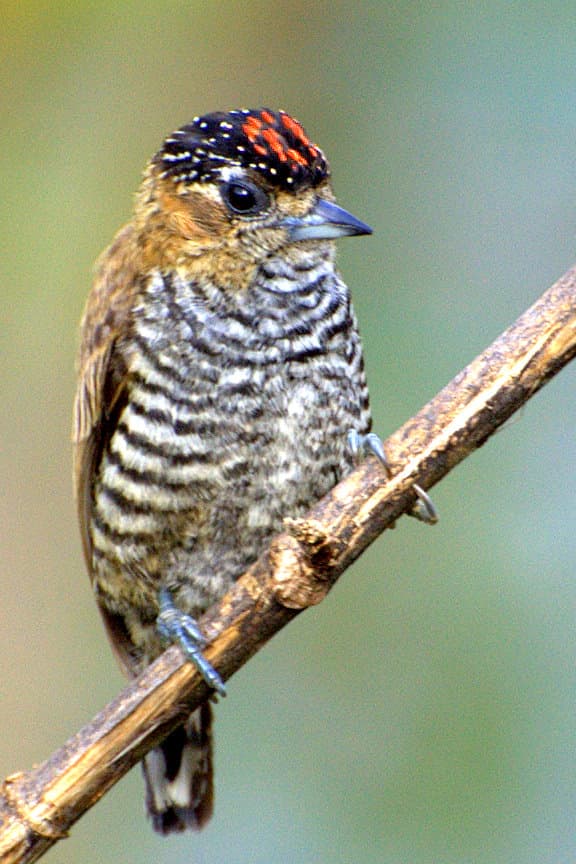
Ochre-collared piculet
The ochre-collared piculet is a small woodpecker species found in Argentina, Brazil, and Paraguay. It is characterized by its cinnamon-buff collar and has a black cap with red tips (in males) and white spots. This species primarily inhabits lowland rainforests, secondary growth, and thickets.