
Levaillant's woodpecker
Levaillant's woodpecker is a large African member of the woodpecker family, found in the Maghreb countries of Morocco, Algeria, and Tunisia. It is characterized by its dark green upperparts, yellowish-green underparts, crimson nape, and a distinctive black moustache with a pale border.
Key Facts
- ›Inhabits mountain forests in Morocco, Algeria, and Tunisia.
- ›Measures 30-33 cm in length with a wingspan of 45-51 cm.
- ›Plumage is dark green above and yellowish-green below, with a crimson nape.
- ›Males have a crimson crown, while females have a grey crown.
- ›Call is described as a loud ringing laugh, similar to the European green woodpecker's 'yaffle'.
- ›Nests are typically made in holes in trees, and clutches consist of 4-8 glossy white eggs.

Levaillant's Green Woodpecker
Africa
Dark Green, Yellowish Green, Crimson, Chrome Yellow
Crimson Nape, Black Moustache With Pale Border, Crimson Crown, Grey Crown
Insects
- Captures insects with a rapid outward flick of the tongue
- Uses sticky saliva to adhere food to tongue tip
Hole In A Tree
Loud Ringing Laugh
About Levaillant's woodpecker
Levaillant's woodpecker, scientifically known as Picus vaillantii, is a prominent member of the woodpecker family (Picidae) inhabiting the mountainous regions of Northwest Africa. It is exclusively found in the Maghreb countries of Morocco, Algeria, and Tunisia, where it prefers to breed in mountain forests, often reaching elevations up to around 2000 meters near the treeline.
Physical Characteristics
This species is a large woodpecker, measuring between 30 to 33 centimeters in length with a wingspan ranging from 45 to 51 centimeters. Its plumage is predominantly dark green on its upperparts and yellowish-green on its underside. A striking feature is its crimson nape, and it possesses a noticeable black moustache that is bordered above by a pale line. The rump is a bright chrome yellow, and the outer edges of its primary feathers are marked with black and white barring. Both the bill and feet are a slate grey color. Sexual dimorphism is present in the crown: males display a crimson crown, while females have a grey crown. Notably, both sexes lack the black markings on the lores and around the eyes that are common in many other green woodpecker forms.
Behavior and Reproduction
Levaillant's woodpecker exhibits a distinctive foraging behavior, using a rapid flick of its long, sticky tongue to capture insects. Despite its considerable size and weight, it is capable of an easy, bounding flight. The species constructs its nests in holes excavated in trees. Typically, a clutch consists of 4 to 8 glossy white eggs, which are laid on wood chips within the nest cavity. Its call is a loud, ringing laugh, often described as 'plue, plue, plue,' which bears a strong resemblance to the 'yaffle' call of the European green woodpecker, though it is often perceived as being slightly faster in tempo.
Source: Wikipedia ↗
Frequently Asked Questions
Where is Levaillant's woodpecker found?
Levaillant's woodpecker is found in the three Maghreb countries of Morocco, Algeria, and Tunisia in northwest Africa. It breeds in mountain forests up to the treeline at around 2000m.
What does Levaillant's woodpecker look like?
This species is dark green above and yellowish green below, with a crimson nape and a black moustache that has a pale border. The rump is chrome yellow, and the outer webs of the primaries are barred black and white. Males have a crimson crown, while females have a grey crown.
What is the call of Levaillant's woodpecker?
The call of Levaillant's woodpecker is a loud ringing laugh, described as 'plue, plue, plue'. This call is very similar to the European green woodpecker's 'yaffle', but is noted as being slightly faster.
How does Levaillant's woodpecker find its food?
This woodpecker captures insect food by using a rapid outward flick of its long tongue. The food is then gummed to the tip of the tongue by sticky saliva.
What are the nesting habits of Levaillant's woodpecker?
The nest of Levaillant's woodpecker is a hole in a tree. Females lay between 4 and 8 glossy white eggs, which are placed on wood chips within the nest.
Related Woodpecker species

Northern flicker
The Northern Flicker is a medium-sized woodpecker found across most of North America and parts of Central America. It is notable for its diverse common names, often derived from its vocalizations, and for being one of the few woodpecker species that migrate. This bird exhibits distinct plumage variations between its eastern and western populations, particularly in the color of its wing and tail shafts.
African piculet
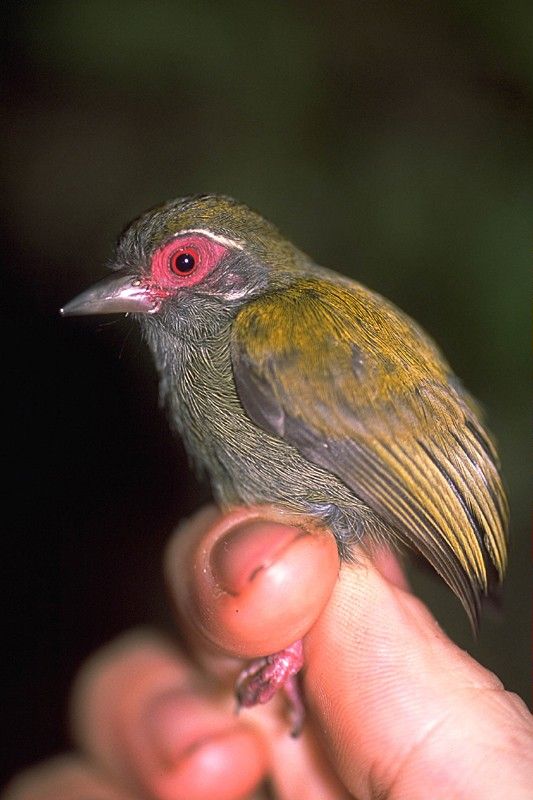
The African piculet is a small bird found in lowland secondary forests across several African countries. It is characterized by its dark greenish-yellow upperparts, greyish underparts, and a distinctive chestnut or reddish forehead in males. This species is known for its active foraging behavior, hammering branches to find beetle larvae.
Antillean piculet
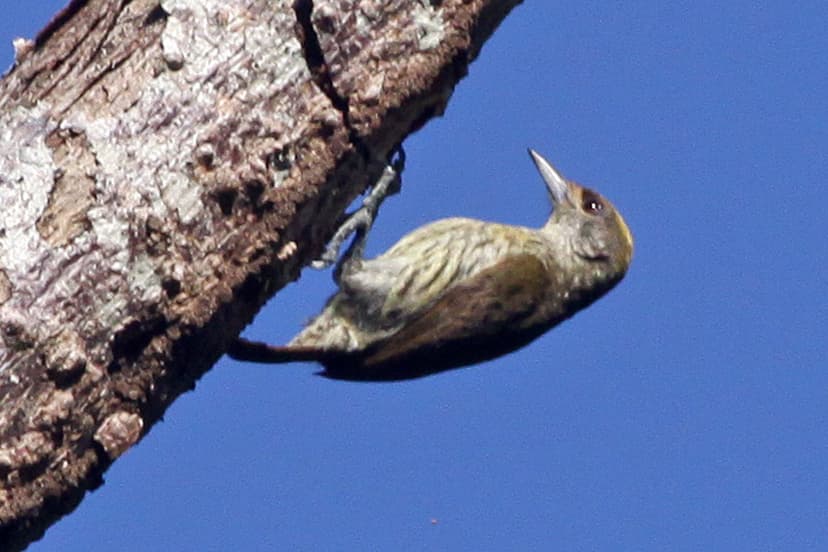
The Antillean piculet is a small woodpecker endemic to the Caribbean island of Hispaniola, shared by the Dominican Republic and Haiti. It is notable for being the sole member of its genus, Nesoctites, and is evolutionarily distinct from other piculets. This species inhabits a variety of forest types and scrublands, preferring dense undergrowth and foraging primarily for insects.