
Lineated woodpecker
The Lineated Woodpecker is a large, predominantly black woodpecker found from southern Mexico to northern Argentina and Trinidad. It is characterized by a prominent red crest, with males also displaying a red malar stripe and forehead, while females have these areas black. This species inhabits forest borders and open woodlands, feeding primarily on insects.
Key Facts
- ›Large woodpecker, measuring 31.5 to 36 cm in length.
- ›Mainly black plumage with a red crest, and whitish lines on the neck and shoulders.
- ›Males have a red malar stripe and forehead, absent in females.
- ›Inhabits forest borders and open woodlands across its extensive range.
- ›Diet consists mainly of insects, including ants, beetles, and termites, with some seeds and fruits.
- ›Nests in cavities excavated in dead trees.

North America, Central America, South America, Caribbean
Forest Borders, Open Woodland
- Red crest
- Whitish lines from bill down neck and shoulders
- Red malar stripe and forehead
- Black malar stripe and forehead
Insects, Ants and Larvae, Beetles and Larvae, Termites, Seeds, Fruits, Berries, Nuts
Chipping out holes in trees to find insects
Nest Holes In Dead Trees
Loud, Ringing Wic-Wic-Wic Call
About Lineated woodpecker
The Lineated Woodpecker, scientifically known as Dryocopus lineatus, is a large and widespread species of woodpecker found throughout much of Central and South America, extending north into southern Mexico and east to Trinidad. It is a resident breeder, meaning it does not typically migrate seasonally.
Description and Identification
This species typically measures between 31.5 and 36 cm in length. Its plumage is predominantly black, distinguished by a vibrant red crest. Whitish lines extend from the base of its bill down its neck and shoulders, although these shoulder lines can be reduced or absent in individuals from the southeastern parts of its range. The underparts are whitish and heavily barred with black. In flight, white patches are visible on the wings. Adult males possess a distinctive red stripe from the bill to the throat (malar stripe) and a red forehead, features that are black in adult females. The bill is usually black, though pale-billed individuals are not uncommon.
Ecology and Behavior
The Lineated Woodpecker prefers habitats such as forest borders and more open woodland areas. They are not typically mountain birds but have been observed in uplands on occasion. Their primary food source consists of insects, including ants, beetles, and termites, along with their larvae. They supplement their diet with seeds, fruits, berries, and nuts. Foraging involves chipping out holes in trees to access insect prey. Both sexes drum, and their characteristic call is a loud, ringing 'wic-wic-wic'.
Reproduction
Nesting occurs in cavities excavated in dead trees, usually at heights ranging from 2 to 27 meters above the ground. Both male and female Lineated Woodpeckers participate in excavating these nest holes, which are substantial in size. They lay a clutch of 2 to 4 eggs, which are incubated by both parents, with males taking over incubation duties at night. Chicks are fed approximately once an hour through regurgitation by both parents. The incubation and fledging periods have not been specifically documented.
Conservation Status
The Lineated Woodpecker is classified as 'Least Concern' by the IUCN. Its population is believed to be increasing, and no significant threats have been identified that endanger the species.
Source: Wikipedia ↗
Frequently Asked Questions
What is the scientific name of the Lineated Woodpecker?
The scientific name of the Lineated Woodpecker is Dryocopus lineatus. This binomial name was given by Carl Linnaeus in 1766.
Where is the Lineated Woodpecker found?
The Lineated Woodpecker is a resident breeding bird found from southern Mexico down through northern Argentina, and also on the island of Trinidad in the Caribbean.
What does the Lineated Woodpecker eat?
Its diet primarily consists of insects, particularly ants and their larvae, beetles and their larvae, and termites. They also consume some seeds, fruits, berries, and nuts.
How large is a Lineated Woodpecker?
Lineated Woodpeckers are quite large, typically measuring between 31.5 and 36 cm (12.4 to 14.2 inches) in length.
What are the distinguishing features of the Lineated Woodpecker?
Key features include its predominantly black plumage, a striking red crest, and whitish lines running from the bill down the neck and shoulders. Adult males also have a red malar stripe and forehead, which are black in females.
What is the conservation status of the Lineated Woodpecker?
The Lineated Woodpecker is assessed as 'Least Concern' by the IUCN. Its population is believed to be increasing, and no specific threats have been identified.
Related Woodpecker species
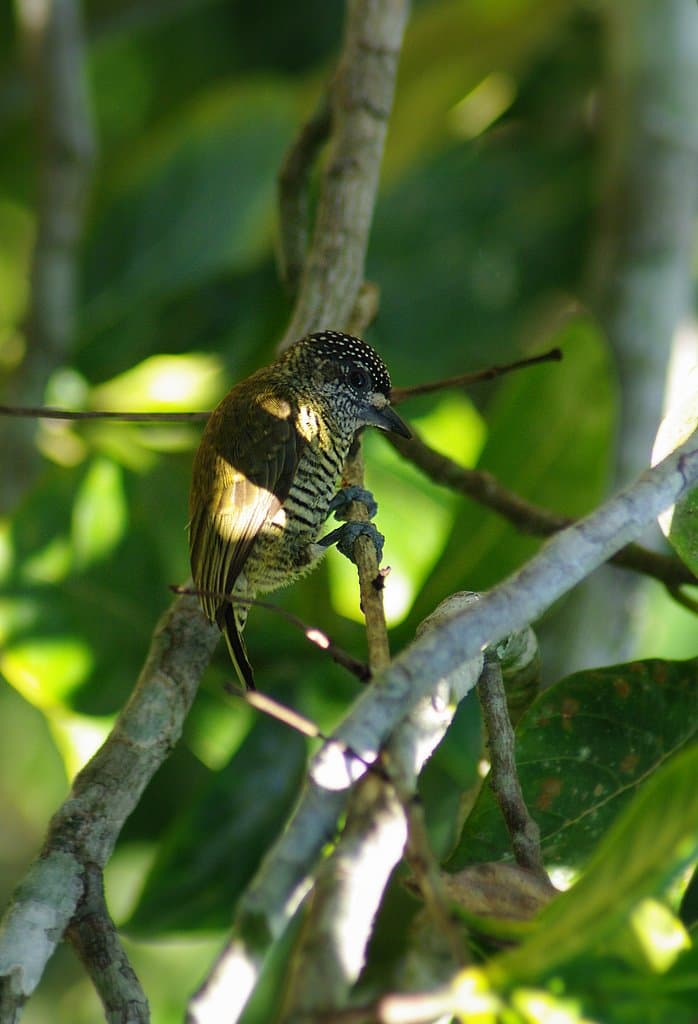
Golden-spangled piculet
The golden-spangled piculet is a small bird found across several South American countries, inhabiting diverse wooded environments from rainforests to savannas. It is characterized by its distinctive plumage, with males and females exhibiting variations in their spotted caps, and is known for foraging in the lower strata of forests and nesting in soft wood.

Green-barred woodpecker
The Green-barred woodpecker is a species of bird found across South America, inhabiting diverse environments from dry scrub to humid forests. It is characterized by its predominantly greenish upperparts with dark barring and spotted underparts, with significant variation among its five subspecies. Primarily feeding on ants, it also consumes fruits and other insects, playing a role in seed dispersal.

Yellow-bellied sapsucker
The yellow-bellied sapsucker is a medium-sized woodpecker found in Canada and the northeastern United States, known for its distinctive feeding habits of drilling sap wells. Its plumage features a mix of black, white, and yellow, with males displaying a red forehead. These birds play a role in forest ecosystems, though their feeding can sometimes damage trees.