
Magellanic woodpecker
The Magellanic woodpecker is a large woodpecker species found in the southern parts of Chile and Argentina. It is distinguished by its predominantly black plumage, a white wing patch, and a grey beak, with males sporting a striking crimson head and crest. This species is the largest living woodpecker of its genus and inhabits mature temperate forests.
Key Facts
- ›The Magellanic woodpecker is the largest woodpecker species in South America and the genus Campephilus.
- ›Males have a crimson head and crest, while females have a predominantly black head with a red patch near the bill base.
- ›They inhabit mature Nothofagus and Nothofagus-Austrocedrus forests.
- ›Their diet primarily consists of wood-boring grubs and adult beetles, supplemented with sap, fruits, and occasionally small vertebrates.
- ›Breeding occurs in the Southern Hemisphere's springtime, with females laying one to four eggs.
- ›The species is listed as of Least Concern by the IUCN, though forest loss and fragmentation pose threats.

Magellanic Woodpecker
South America
Mature Nothofagus Forests, Nothofagus-Austrocedrus Forests, Temperate Forests
Large Size, Crimson Head and Crest, Red Coloration Near Bill Base, White Wing Patch, Grey, Chisel-Like Beak
Wood-Boring Grubs, Adult Beetles, Spiders
Active food searching, Forage in live trees, Forage on dead substrates, Forage on decaying and dead trees, Search for prey on humid lower tree trunks
Tree Trunks, Nest Cavity Typically 5–15 m Above Ground
Explosive, Nasal Call, Gargling Call, Loud Double Knock Drumming
About Magellanic woodpecker
The Magellanic woodpecker (Campephilus magellanicus) is a significant bird species found in the southern reaches of Chile and Argentina. It is recognized as the southernmost representative of the woodpecker genus Campephilus and holds the distinction of being the largest living species within this genus, especially following the presumed extinction of the ivory-billed and imperial woodpeckers. Its substantial size and striking appearance make it a notable inhabitant of its environment.
Description and Identification
Measuring between 36 to 45 cm (14 to 18 inches) in length, the Magellanic woodpecker is one of the largest woodpeckers globally. Its plumage is predominantly black, contrasted by a distinct white patch on its wings and a grey, chisel-shaped beak. Males are particularly recognizable by their vibrant crimson heads and crests. Females, while also largely black, feature an area of red coloration near the base of their bills. Juvenile birds resemble females but possess smaller crests and a browner hue to their feathers, making them readily distinguishable within their habitat.
Habitat and Diet
This species thrives in mature temperate forests, specifically those dominated by Nothofagus and Nothofagus-Austrocedrus trees. Their diet primarily consists of wood-boring insect larvae and adult beetles, which they extract from tree trunks and branches. Spiders also form a part of their diet. Occasionally, their foraging extends to include sap, fruits, small reptiles, bats, and the eggs and young of other bird species, showcasing a degree of dietary flexibility.
Behavior and Breeding
Magellanic woodpeckers are known for their active foraging habits, spending much of their day searching for food. They commonly feed in pairs or small family groups and utilize both live trees and dead wood, including fallen logs. The breeding season occurs during the Southern Hemisphere's springtime, from October to January. Both male and female woodpeckers collaborate in excavating nest cavities in tree trunks, typically situated between 5 to 15 meters above the ground. Females lay one to four eggs, with two eggs being the most common clutch size. Parents share all incubation, territorial defense, and chick-rearing duties. A unique aspect of their breeding behavior is that adults usually breed only every second year, a pattern not commonly observed in other woodpecker species. Young woodpeckers remain with their parents for 2-3 years before becoming sexually mature, though successful breeding pairs often form between the ages of 4 to 5.
Conservation Status
Currently, the Magellanic woodpecker is classified as Least Concern by the IUCN. However, the species faces threats from ongoing forest loss and fragmentation in its native temperate forest habitats, particularly in south-central Chile. These environmental changes, driven by timber extraction and conversion to plantations, have led to a contraction and fragmentation of the species' distribution, restricting it to protected and remnant forest areas.
Source: Wikipedia ↗
Frequently Asked Questions
What is the size of the Magellanic woodpecker?
The Magellanic woodpecker is a large species, typically measuring between 36 to 45 cm (14 to 18 inches) in length. Males weigh between 312–369 g (11.0–13.0 oz), and females weigh between 276–312 g (9.7–11.0 oz).
What does the Magellanic woodpecker eat?
Their diet mainly comprises wood-boring grubs and adult beetles. They also occasionally consume sap, fruits, small reptiles, bats, and the eggs and nestlings of other birds.
Where does the Magellanic woodpecker live?
The Magellanic woodpecker is found in southern Chile and southwestern Argentina. It resides within mature Nothofagus and Nothofagus-Austrocedrus forests.
What are the distinctive features of the Magellanic woodpecker?
This species is largely black with a white wing patch and a grey, chisel-like beak. Males are notable for their bright crimson head and crest, while females have a mostly black head with a red area near the bill.
When does the Magellanic woodpecker breed?
The Magellanic woodpecker breeds during the Southern Hemisphere's springtime, which spans from October to January. Both parents cooperate in excavating nests and raising their young.
What is the conservation status of the Magellanic woodpecker?
The Magellanic woodpecker is currently listed as Least Concern by the IUCN. However, population declines have been observed due to threats like forest loss and fragmentation.
Related Woodpecker species

Himalayan woodpecker
The Himalayan woodpecker is a medium-sized, pied bird found in the northern Indian subcontinent, particularly in the Himalayas and surrounding areas. It inhabits boreal and temperate forests and is characterized by its black and white plumage, with males having a red crown and females a black one. This species is assessed as being of least concern by the IUCN.
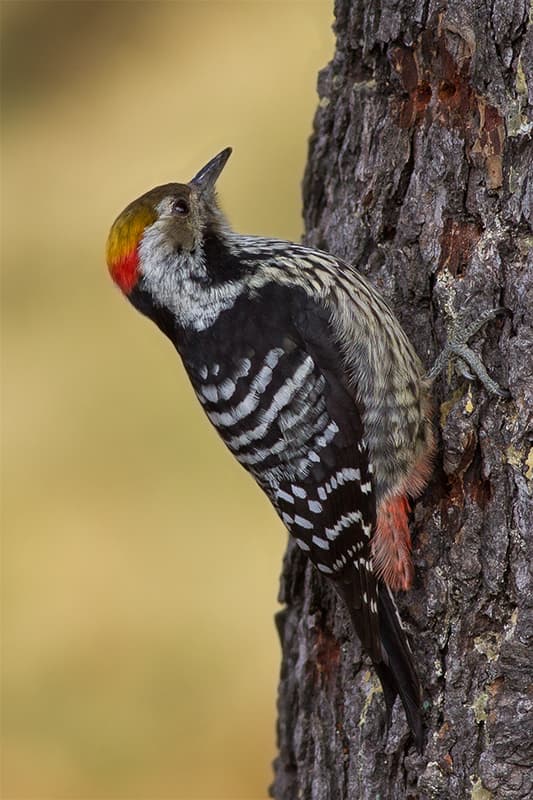
Brown-fronted woodpecker
The brown-fronted woodpecker is a medium-sized, pied bird found in the lower-to-middle altitudes of the Himalayas, spanning across Afghanistan, India, Nepal, Pakistan, and Bhutan. Its natural habitats include temperate and moist montane forests. It is characterized by prominent black markings, yellow in its crown, and distinct underpart streaking.

Scaly-bellied woodpecker
The scaly-bellied woodpecker is a large, green woodpecker species found in the Indian subcontinent and adjacent regions, including Afghanistan, Iran, India, Nepal, Pakistan, and Turkmenistan. It is characterized by distinct scaling on its underside, a black moustache, and a large pale bill. Males have a red crown, while females have a blackish crown.